Notice: تابع WP_Block_Type_Registry::register به طورنادرست فراخوانی شد. نامهای نوع بلوک نباید حروف بزرگ داشته باشند. لطفاً برای اطلاعات بیشتر، اشکال زدایی در وردپرس را مشاهده کنید. (این پیام در نگارش 5.0.0 افزوده شده است.) in /home/ethicsho/public_html/wp-includes/functions.php on line 5313
Warning: Use of undefined constant TDC_PATH_LEGACY - assumed 'TDC_PATH_LEGACY' (this will throw an Error in a future version of PHP) in /home/ethicsho/public_html/wp-content/plugins/td-composer/td-composer.php on line 109
Warning: Use of undefined constant TDSP_THEME_PATH - assumed 'TDSP_THEME_PATH' (this will throw an Error in a future version of PHP) in /home/ethicsho/public_html/wp-content/plugins/td-composer/td-composer.php on line 113 بایگانیهای Scholars Press - خانه اخلاق پژوهان جوان Notice: Trying to access array offset on value of type bool in /home/ethicsho/public_html/wp-content/plugins/wp-ulike/inc/general-functions.php on line 807
This scarce antiquarian book is included in our special Legacy Reprint Series. In the interest of creating a more extensive selection of rare historical book reprints, we have chosen to reproduce this title even though it may possibly have occasional imperfections such as missing and blurred pages, missing text, poor pictures, markings, dark backgrounds and other reproduction issues beyond our control. Because this work is culturally important, we have made it available as a part of our commitment to protecting, preserving and promoting the world’s literature.
Scholarship on Plato’s dialogues persistently divides its focus between the dramatic or literary and the philosophical or argumentative dimensions of the texts. But this hermeneutic division of labor is naive, for Plato’s arguments are embedded in dramatic dialogues and developed through complex, largely informal exchanges between literary characters. Consequently, it is questionable how readers can even attribute arguments and theses to the author himself. The answer to this question lies in transcending the scholarly divide and integrating the literary and philosophical dimensions of the texts. This is the task of Trials of Reason. The study focuses on a set of fourteen so-called early dialogues, beginning with a methodological framework that explains how to integrate the argumentation and the drama in these texts. Unlike most canonical philosophical works, the early dialogues do not merely express the results of the practice of philosophy. Rather, they dramatize philosophy as a kind of motivation, the desire for knowledge of goodness. They dramatize philosophy as a discursive practice, motivated by this desire and ideally governed by reason. And they dramatize the trials to which desire and reason are subject, that is, the difficulties of realizing philosophy as a form of motivation, a practice, and an epistemic achievement. In short, Trials of Reason argues that Plato’s early dialogues are as much works of meta-philosophy as philosophy itself.
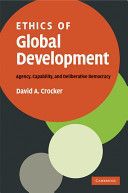
Poverty, inequality, violence, environmental degradation, and tyranny continue to afflict the world. Ethics of Global Development offers a moral reflection on the ends and means of local, national, and global efforts to overcome these five scourges. After emphasizing the role of ethics in development studies, policy-making, and practice, David A. Crocker analyzes and evaluates Amartya Sen’s philosophy of development in relation to alternative ethical outlooks. He argues that Sen’s turn to robust ideals of human agency and democracy improves on both Sen’s earlier emphasis on ‘capabilities and functionings’ and Martha Nussbaum’s version of the capability orientation. This agency-focused capability approach is then extended and strengthened by applying it to the challenges of consumerism and hunger, the development responsibilities of affluent individuals and nations, and the dilemmas of globalization. Throughout the book the author argues for the importance of more inclusive and deliberative democratic institutions.
ما از اخلاق چه انتظاری داریم؟ این سوال شاید تاحدودی برای عموم مردم و یا متخصصان این رشته قابل پاسخ باشد؛ اینکه خوب بودن را به ما بیاموزد و در تنظیم روابط فردی م...

جشن کتاب تهران به ایستگاه سی و یکم رسیده است. حال و احوال نشر کتاب خوب نیست و باید فرهنگدوستان را به خرید و هدیه دادن کتاب ترغیب نمود. خانه اخلاقپژوهان جوان ب...

بنیاد کتابهای اخلاق اسلامی عمدتا پالایش جان از آلودگیها و آراستن آن به زیباییها است. اندیشه محوری این قبیل کتابها آن است که انسان فعلی آنی نیست که باید باشد...

-
0 Comments