Notice: تابع WP_Block_Type_Registry::register به طورنادرست فراخوانی شد. نامهای نوع بلوک نباید حروف بزرگ داشته باشند. لطفاً برای اطلاعات بیشتر، اشکال زدایی در وردپرس را مشاهده کنید. (این پیام در نگارش 5.0.0 افزوده شده است.) in /home/ethicsho/public_html/wp-includes/functions.php on line 5313
Warning: Use of undefined constant TDC_PATH_LEGACY - assumed 'TDC_PATH_LEGACY' (this will throw an Error in a future version of PHP) in /home/ethicsho/public_html/wp-content/plugins/td-composer/td-composer.php on line 109
Warning: Use of undefined constant TDSP_THEME_PATH - assumed 'TDSP_THEME_PATH' (this will throw an Error in a future version of PHP) in /home/ethicsho/public_html/wp-content/plugins/td-composer/td-composer.php on line 113 بایگانیهای Oneworld - خانه اخلاق پژوهان جوان Notice: Trying to access array offset on value of type bool in /home/ethicsho/public_html/wp-content/plugins/wp-ulike/inc/general-functions.php on line 807
In The Ethics of Romanticism Laurence Lockridge vigorously revives ethical criticism and at the same time brings to light the Romantics’ profound engagement with ethical questions. He argues that a will to value is the pervasive motive of Romantic writers from Blake, Wordsworth, Coleridge and De Quincey to Shelley, Hazlitt, Keats and Byron. They articulate a compelling ethics that has had a significant influence on modern thought. Yet its character has never before been systematically explored within the larger contexts of European thought. Lockridge argues that a focus on the ethical dimension of literature is the single most powerful strategy for structuring a writer’s work as a whole, and that it can even prove congenial. He gives original, interrelated readings of the eight major British Romantic writers. In discussing the place of ethical criticism in modern letters, he qualifies or refutes opposing views – conservative, Marxist, and deconstructive. His book gives strong evidence of one direction criticism might fruitfully take in future years.
We live our lives through our emotions, writes Robert Solomon, and it is our emotions that give our lives meaning. What interests or fascinates us, who we love, what angers us, what moves us, what bores us–all of this defines us, gives us character, constitutes who we are. In True to Our Feelings, Solomon illuminates the rich life of the emotions–why we don’t really understand them, what they really are, and how they make us human and give meaning to life. Emotions have recently become a highly fashionable area of research in the sciences, with brain imaging uncovering valuable clues as to how we experience our feelings. But while Solomon provides a guide to this cutting-edge research, as well as to what others–philosophers and psychologists–have said on the subject, he also emphasizes the personal and ethical character of our emotions. He shows that emotions are not something that happen to us, nor are they irrational in the literal sense–rather, they are judgements we make about the world, and they are strategies for living in it. Fear, anger, love, guilt, jealousy, compassion–they are all essential to our values, to living happily, healthily, and well. Solomon highlights some of the dramatic ways that emotions fit into our ethics and our sense of the good life, how we can make our emotional lives more coherent with our values and be more “true to our feelings” and cultivate emotional integrity. The story of our lives is the story of our passions. We fall in love, we are gripped by scientific curiosity and religious fervor, we fear death and grieve for others, we humble ourselves in envy, jealousy, and resentment. In this remarkable book, Robert Solomon shares his fascination with the emotions and illuminates our passions in an exciting new way.
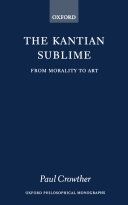
With this, the first volume in the Oxford Philosophical Monographs series, Paul Crowther breaks new ground by providing what is probably the first study in any language to be devoted exclusively to Kant’s theory of the sublime. It fills a gap in an area of scholarship where Kant makes crucial links between morality and aesthetics and will be particularly useful for Continental philosophers, among whom the Kantian sublime is currently receiving widespread discussion in debates about the nature of postmodernism. Crowther’s arguments center on the links which Kant makes between morality and aesthetics, and seek ultimately to modify Kant’s approach in order to establish the sublime as a viable aesthetic concept with a broader cultural significance.
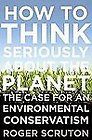
“The environment has long been the undisputed territory of the political Left, which casts international capitalism, consumerism, and the over-exploitation of natural resources as the principle threats to the planet, and sees top-down interventions as the most effective solution. In How to Think Seriously About the Planet, Roger Scruton rejects this view and offers a fresh approach to tackling the most important political problem of our time. The environmental movement, he contends, is philosophically confused and has unrealistic agendas. Its sights are directed at the large-scale events and the confrontation between international politics and multinational business. But Scruton argues that no large-scale environmental project, however well-intentioned, will succeed if it is not rooted in small-scale practical reasoning. Seeing things on a large scale promotes top-down solutions, managed by unaccountable bureaucracies that fail to assess local conditions and are rife with unintended consequences. Scruton argues for the greater efficacy of local initiatives over global schemes, civil association over political activism, and small-scale institutions of friendship over regulatory hyper-vigilance. And he suggests that conservatism is far better suited to solving environmental problems than either liberalism or socialism. Rather than entrusting the environment to unwieldy NGOs and international committees, we must assume personal responsibility and foster local control. People must be empowered to take charge of their environment, to care for it as they would a home, and to involve themselves through the kind of local associations that have been the traditional goal of conservative politics. Our common future is by no means assured, but as Roger Scruton clearly demonstrates in this important book, there is a path that can ensure the future safety of our planet and our species.”–
ما از اخلاق چه انتظاری داریم؟ این سوال شاید تاحدودی برای عموم مردم و یا متخصصان این رشته قابل پاسخ باشد؛ اینکه خوب بودن را به ما بیاموزد و در تنظیم روابط فردی م...

جشن کتاب تهران به ایستگاه سی و یکم رسیده است. حال و احوال نشر کتاب خوب نیست و باید فرهنگدوستان را به خرید و هدیه دادن کتاب ترغیب نمود. خانه اخلاقپژوهان جوان ب...

بنیاد کتابهای اخلاق اسلامی عمدتا پالایش جان از آلودگیها و آراستن آن به زیباییها است. اندیشه محوری این قبیل کتابها آن است که انسان فعلی آنی نیست که باید باشد...

-
0 Comments