Notice: تابع WP_Block_Type_Registry::register به طورنادرست فراخوانی شد. نامهای نوع بلوک نباید حروف بزرگ داشته باشند. لطفاً برای اطلاعات بیشتر، اشکال زدایی در وردپرس را مشاهده کنید. (این پیام در نگارش 5.0.0 افزوده شده است.) in /home/ethicsho/public_html/wp-includes/functions.php on line 5313
Warning: Use of undefined constant TDC_PATH_LEGACY - assumed 'TDC_PATH_LEGACY' (this will throw an Error in a future version of PHP) in /home/ethicsho/public_html/wp-content/plugins/td-composer/td-composer.php on line 109
Warning: Use of undefined constant TDSP_THEME_PATH - assumed 'TDSP_THEME_PATH' (this will throw an Error in a future version of PHP) in /home/ethicsho/public_html/wp-content/plugins/td-composer/td-composer.php on line 113 بایگانیهای Liberty Fund Inc. - خانه اخلاق پژوهان جوان Notice: Trying to access array offset on value of type bool in /home/ethicsho/public_html/wp-content/plugins/wp-ulike/inc/general-functions.php on line 807
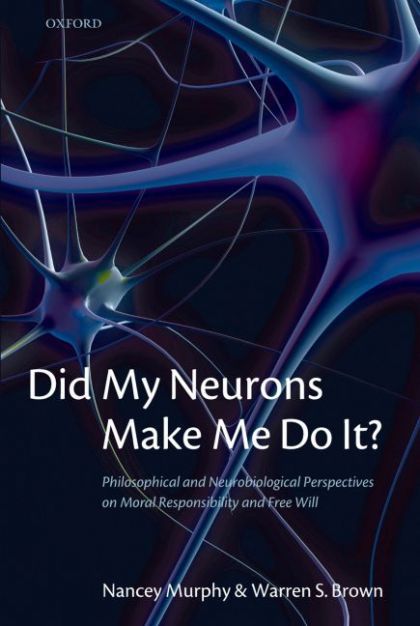
If humans are purely physical, and if it is the brain that does the work formerly assigned to the mind or soul, then how can it fail to be the case that all of our thoughts and actions are determined by the laws of neurobiology? If this is the case, then free will, moral responsibility, and, indeed, reason itself would appear to be in jeopardy. Nancey Murphy and Warren S. Brown here defend a non-reductive version of physicalism whereby humans are (sometimes) the authors of their own thoughts and actions. Did My Neurons Make Me Do It? brings together insights from both philosophy and the cognitive neurosciences to defeat neurobiological reductionism. One resource is a “post-Cartesian” account of mind as essentially embodied and constituted by action-feedback-evaluation-action loops in the environment, and “scaffolded” by cultural resources. Another is a non-mysterious account of downward (mental) causation explained in terms of a complex, higher-order system exercising constraints on lower-level causal processes. These resources are intrinsically related: the embeddedness of brain events in action-feedback loops is the key to their mentality, and those broader systems have causal effects on the brain itself. With these resources Murphy and Brown take on two problems in philosophy of mind: a response to the charges that physicalists cannot account for the meaningfulness of language nor the causal efficacy of the mental qua mental. Solutions to these problems are a prerequisite to addressing the central problem of the book: how can biological organisms be free and morally responsible? The authors argue that the free-will problem is badly framed if it is put in terms of neurobiological determinism; the real issue is neurobiological reductionism. If it is indeed possible to make sense of the notion of downward causation, then the relevant question is whether humans exert downward causation over some of their own parts and processes. If all organisms do this to some extent, what needs to be added to this animalian flexibility to constitute free and responsible action? The keys are sophisticated language and hierarchically ordered cognitive processes allowing (mature) humans to evaluate their own actions, motives, goals, and rational and moral principles.
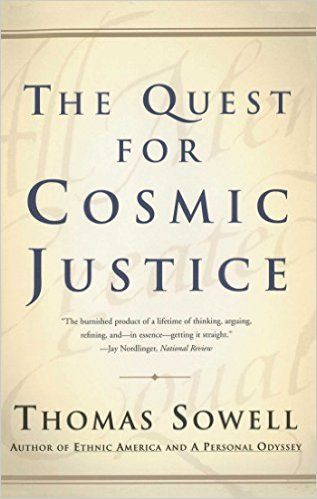
This is not a comforting book — it is a book about disturbing issues that are urgently important today and enduringly critical for the future. It rejects both “merit” and historical redress as principles for guiding public policy. It shows how “peace” movements have led to war and to needless casualties in those wars. It argues that “equality” is neither right nor wrong, but meaningless.The Quest for Cosmic Justice shows how confused conceptions of justice end up promoting injustice, how confused conceptions of equality end up promoting inequality, and how the tyranny of social visions prevents many people from confronting the actual consequences of their own beliefs and policies. Those consequences include the steady and dangerous erosion of the fundamental principles of freedom — and the quiet repeal of the American revolution.
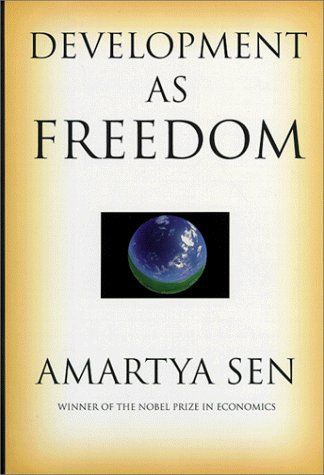
Development as Freedomis a general exposition of the economic ideas and analyses of Amartya Sen, winner of the 1998 Nobel Prize in Economic Science. This brilliant and indispensable treatise compellingly analyzes the nature of contemporary economic development from the perspective of human freedom. Freedom, Sen persuasively argues, is at once the ultimate goal of economic life and the most efficient means of realizing general welfare. It is a good to be enjoyed by the world’s entire population. Drawing on moral and political philosophy and technical economic analysis, this work gives the nonspecialist reader powerful access to Sen’s paradigm-altering vision and vividly shows how he, in the words of the Nobel Prize committee, has both “restored an ethical dimension to the discussion of economic problems” and “opened up new fields of study for subsequent generations of researchers.” To a world divided between those who fear the ruthlessness of the free market under prevailing conditions of global capitalism and those who fear the terror of authoritarian states that stifle indi- vidual liberty as well as initiative,Development as Freedompresents a necessary intellectual and moral framework of analysis and scrutiny. By rigorously addressing one of the largest questions of all–“What is the relation between our economic wealth and our ability to live as we would like?”–Sen allows economics once again, as it did in the time of Adam Smith, to address the social basis of individual well-being and freedom. He also confronts the human dilemma that “despite unprecedented increases in overall opulence, the contemporary world denies elementary freedoms to vast numbers–perhaps even the majority–of people.” This is a landmark work that shows how in individual human freedom–the exclusive possession, Sen shows, of no particular nation, region or historical, intellectual or religious tradition–lies the capacity for political participation, economic development and social progress.
There is a veritable gold rush mentality in the life science world as scientists, entrepreneurs and multinationals are staking claims to the ‘code of life’ embodied in the world’s current stock of plants, animals, microbes and human populations. In response, the communities that see themselves as the custodians of both that traditional knowledge and specific genetic resources have demanded greater recognition of their role in creating and conserving this resource, access to any resulting improvements and a share of the benefits arising from their patrimony. This has precipitated a widespread effort—in local communities, in the marketplace, in many developing and developed countries and at the talks in the Doha Round of the WTO—to reconcile the interests and concerns of the two opposing groups. This edited volume explores the legal, economic and political context for the debate about intellectual property rights for traditional knowledge and genetic resources and critically analyses the theory and practice of access and benefits sharing efforts around the world. The book also investigates the current flashpoints—the David and Goliath battle between Monsanto and Percy Schmeiser over farmers’ rights; the dispute over coexistence of GM and organic production; and the ownership and control of human genetic materials stored in human gene banks around the world. .
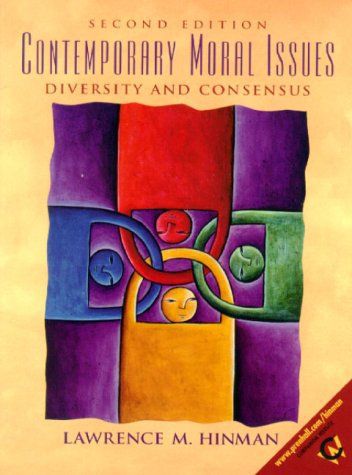
This anthology provides a comprehensive selection of readings on eleven contemporary social issues revolving around three general themes: Matters of Life and Death, Matters of Equality and Diversity, and Expanding the Circle (duties beyond borders, living together with animals, and environmental ethics). Each group of readings is accompanied by narrative selections that present the moral issues from a first person point of view; an extensive introduction surveys the problems and issues; and a bibliographical essay to relevant additional literature. Each selection is accompanied by pre- and post-reading questions. An ethical self-inventory–with pre-test and post-test–helps readers track changes in their own beliefs as they work through the readings, and a special section shows readers step-by-step how develop a personal position on ethical issues. A Pluralistic Approach to Moral Problems. How to Develop a Position on Ethical Issues. MATTERS OF LIFE AND DEATH: Abortion; Genetic Manipulation and Cloning; Euthanasia; Punishment and the Death Penalty. MATTERS OF EQUALITY AND DIVERSITY: Race and Ethnicity; Gender; Sexual Orientation; Poverty and Welfare; EXPANDING THE CIRCLE: Duties Beyond Borders; Living Together with Animals; Environmental Ethics. For anyone interested in Ethics, Social Ethics, and Contemporary Moral Problems.
ما از اخلاق چه انتظاری داریم؟ این سوال شاید تاحدودی برای عموم مردم و یا متخصصان این رشته قابل پاسخ باشد؛ اینکه خوب بودن را به ما بیاموزد و در تنظیم روابط فردی م...

جشن کتاب تهران به ایستگاه سی و یکم رسیده است. حال و احوال نشر کتاب خوب نیست و باید فرهنگدوستان را به خرید و هدیه دادن کتاب ترغیب نمود. خانه اخلاقپژوهان جوان ب...

بنیاد کتابهای اخلاق اسلامی عمدتا پالایش جان از آلودگیها و آراستن آن به زیباییها است. اندیشه محوری این قبیل کتابها آن است که انسان فعلی آنی نیست که باید باشد...

-
0 Comments