

Notice: تابع WP_Block_Type_Registry::register به طورنادرست فراخوانی شد. نامهای نوع بلوک نباید حروف بزرگ داشته باشند. لطفاً برای اطلاعات بیشتر، اشکال زدایی در وردپرس را مشاهده کنید. (این پیام در نگارش 5.0.0 افزوده شده است.) in /home/ethicsho/public_html/wp-includes/functions.php on line 5313
Warning: Use of undefined constant TDC_PATH_LEGACY - assumed 'TDC_PATH_LEGACY' (this will throw an Error in a future version of PHP) in /home/ethicsho/public_html/wp-content/plugins/td-composer/td-composer.php on line 109
Warning: Use of undefined constant TDSP_THEME_PATH - assumed 'TDSP_THEME_PATH' (this will throw an Error in a future version of PHP) in /home/ethicsho/public_html/wp-content/plugins/td-composer/td-composer.php on line 113 بایگانیهای 1997 - صفحه 2 از 6 - خانه اخلاق پژوهان جوان Notice: Trying to access array offset on value of type bool in /home/ethicsho/public_html/wp-content/plugins/wp-ulike/inc/general-functions.php on line 807
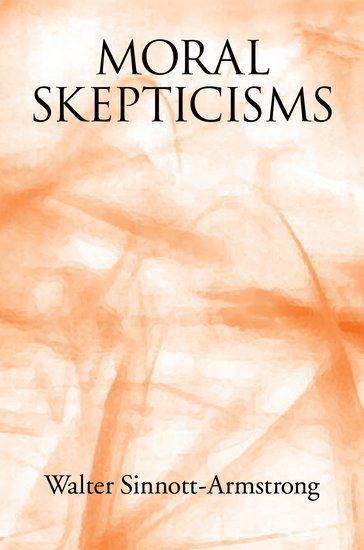
All contentious moral issues–from gay marriage to abortion and affirmative action–raise difficult questions about the justification of moral beliefs. How can we be justified in holding on to our own moral beliefs while recognizing that other intelligent people feel quite differently and that many moral beliefs are distorted by self-interest and by corrupt cultures? Even when almost everyone agrees–e.g. that experimental surgery without consent is immoral–can we know that such beliefs are true? If so, how? These profound questions lead to fundamental issues about the nature of morality, language, metaphysics, justification, and knowledge. They also have tremendous practical importance in handling controversial moral questions in health care ethics, politics, law, and education. Sinnott-Armstrong here provides an extensive overview of these difficult subjects, looking at a wide variety of questions, including: Are any moral beliefs true? Are any justified? What is justified belief? The second half of the book explores various moral theories that have grappled with these issues, such as naturalism, normativism, intuitionism, and coherentism, all of which are attempts to answer moral skepticism. Sinnott-Armstrong argues that all these approaches fail to rule out moral nihilism–the view that nothing is really morally wrong or right, bad or good. Then he develops his own novel theory,–“moderate Pyrrhonian moral skepticism”–which concludes that some moral beliefs can be justified out of a modest contrast class but no moral beliefs can be justified out of an extreme contrast class. While explaining this original position and criticizing alternatives, Sinnott-Armstrong provides a wide-ranging survey of the epistemology of moral beliefs.
In this significant contribution to Hegel scholarship, Robert Williams develops the most comprehensive account to date of Hegel’s concept of recognition (Anerkennung). Fichte introduced the concept of recognition as a presupposition of both Rousseau’s social contract and Kant’s ethics. Williams shows that Hegel appropriated the concept of recognition as the general pattern of his concept of ethical life, breaking with natural law theory yet incorporating the Aristotelian view that rights and virtues are possible only within a certain kind of community.He explores Hegel’s intersubjective concept of spirit (Geist) as the product of affirmative mutual recognition and his conception of recognition as the right to have rights. Examining Hegel’s Jena manuscripts, his Philosophy of Right, the Phenomenology of Spirit, and other works, Williams shows how the concept of recognition shapes and illumines Hegel’s understandings of crime and punishment, morality, the family, the state, sovereignty, international relations, and war. A concluding chapter on the reception and reworking of the concept of recognition by contemporary thinkers including Derrida, Levinas, and Deleuze demonstrates Hegel’s continuing centrality to the philosophical concerns of our age.
Is the point of belief and assertion invariably to think or say something true? Is the truth of a belief or assertion absolute, or is it only relative to human interests? Most philosophers think it incoherent to profess to believe something but not think it true, or to say that some of the things we believe are only relatively true. Common sense disagrees. It sees many opinions, such as those about matters of taste, as neither true nor false; it takes it as obvious that some ofthe truth is relative.Mark Richard’s accessible book argues that when it comes to truth, common sense is right, philosophical orthodoxy wrong. The first half of the book examines connections between the performative aspects of talk (what we do when we speak), our emotions and evaluations, and the conditions under which talk and thought qualifies as true or false. It argues that the performative and expressive sometimes trump the semantic, making truth and falsity the wrong dimension of evaluation for belief orassertion. Among the topics taken up are: racial slurs and other epithets; relations between logic and truth; the status of moral and ethical talk; vagueness and the liar paradox. The book’s second half defends the idea that much of everyday thought and talk is only relatively true or false. Truth isinevitably relative, given that we cannot work out in advance how our concepts will apply to the world. Richard explains what it is for truth to be relative, rebuts standard objections to relativism, and argues that relativism is consistent with the idea that one view can be objectively better than another. The book concludes with an account of matters of taste and of how it is possible for divergent views of such matters to be equally valid, even if not true or false.When Truth Gives Out will be of interest not only to philosophers who work on language, ethics, knowledge, or logic, but to any thoughtful person who has wondered what it is, or isn’t, for something to be true.
“Two Books of the Elements of Universal Jurisprudence” was Pufendorf’s first work, published in 1660. Its appearance effectively inaugurated the modern natural-law movement in the German-speaking world. The work also established Pufendorf as a key figure and laid the foundations for his major works, which were to sweep across Europe and North America. ‘Elements of Universal Jurisprudence’ established Pufendorf’s political theory, which, when fully developed, became the most significant alternative to rights-based theories. Pufendorf rejected the concept of natural rights as liberties and the suggestion that political government is justified by its protection of such rights, arguing instead for a principled limit to the state’s role in human life. The Liberty Fund edition is based on the translation by William Abbott Oldfather prepared for the Classics of International Law series published by the Carnegie Endowment for International Peace.
ما از اخلاق چه انتظاری داریم؟ این سوال شاید تاحدودی برای عموم مردم و یا متخصصان این رشته قابل پاسخ باشد؛ اینکه خوب بودن را به ما بیاموزد و در تنظیم روابط فردی م...

جشن کتاب تهران به ایستگاه سی و یکم رسیده است. حال و احوال نشر کتاب خوب نیست و باید فرهنگدوستان را به خرید و هدیه دادن کتاب ترغیب نمود. خانه اخلاقپژوهان جوان ب...

بنیاد کتابهای اخلاق اسلامی عمدتا پالایش جان از آلودگیها و آراستن آن به زیباییها است. اندیشه محوری این قبیل کتابها آن است که انسان فعلی آنی نیست که باید باشد...

-
0 Comments