Notice: تابع WP_Block_Type_Registry::register به طورنادرست فراخوانی شد. نامهای نوع بلوک نباید حروف بزرگ داشته باشند. لطفاً برای اطلاعات بیشتر، اشکال زدایی در وردپرس را مشاهده کنید. (این پیام در نگارش 5.0.0 افزوده شده است.) in /home/ethicsho/public_html/wp-includes/functions.php on line 5313
Warning: Use of undefined constant TDC_PATH_LEGACY - assumed 'TDC_PATH_LEGACY' (this will throw an Error in a future version of PHP) in /home/ethicsho/public_html/wp-content/plugins/td-composer/td-composer.php on line 109
Warning: Use of undefined constant TDSP_THEME_PATH - assumed 'TDSP_THEME_PATH' (this will throw an Error in a future version of PHP) in /home/ethicsho/public_html/wp-content/plugins/td-composer/td-composer.php on line 113 بایگانیهای 2 - خانه اخلاق پژوهان جوان Notice: Trying to access array offset on value of type bool in /home/ethicsho/public_html/wp-content/plugins/wp-ulike/inc/general-functions.php on line 807
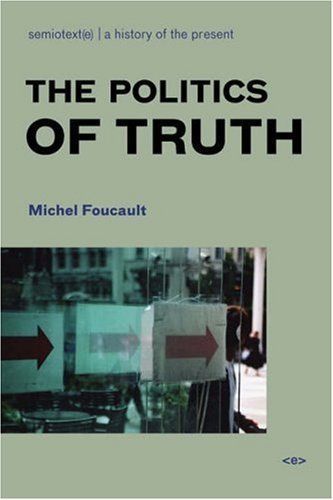
In 1784, the German newspaper Berlinische Monatsschrift asked its audience to reply to the question “What is Enlightenment?” Immanuel Kant took the opportunity to investigate the purported truths and assumptions of his age. Two hundred years later, Michel Foucault wrote a response to Kant’s initial essay, positioning Kant as the initiator of the discourse and critique of modernity. The Politics of Truth takes this initial encounter between Foucault and Kant, as a framework for its selection of unpublished essays and transcripts of lectures Foucault gave in America and France between 1978 and 1984, the year of his death. Ranging from reflections on the Enlightenment and revolution to a consideration of the Frankfurt School, this collection offers insight into the topics preoccupying Foucault as he worked on what would be his last body of published work, the three-volume History of Sexuality. It also offers what is in a sense the most “American” moment of Foucault’s thinking, for it was in America that he realized the necessity of tying his own thought to that of the Frankfurt School.
This book argues that Jewish values are not fixed propositions embedded in written form that can be easily handed off from one generation to the next. Jewish values are necessarily the product of contemporary Jewish minds.
In a series of original and perceptive philosophical essays — including those on “Birth and Death,” “Virtue and Human Flourishing,” ‘The Need to Sleep,” “Sex,” “Truth and Reality,” “Vanity and Destiny,” and “The Fear of Death” — the author reflects on the nature of morality and its relation to experience, on the individual mind and its place in philosophy, and on the strangeness of life itself. Drawing widely on literature and philosophy — from Nietzsche and Schopenhauer, Shakespeare, Dostoyevsky, George Eliot, Kafka, Jean-Paul Sartre, D. H. Lawrence, and others — Living Philosophy has some affinities with the philosophy practised by such figures as Martha Nussbaum, Stanley Cavell, and Peter Winch. Hamilton develops a way of approaching philosophy that opens up room not so much to answer the pressing questions of life as to deepen our sense of what those questions are.
Providing a groundbreaking collective commentary, by an international group of leading philosophical scholars, Blackwell’s Guide to Hegel’s Phenomenology of Spirit transforms and expands our understanding and appreciation of one of the most challenging works in Western philosophy. Collective philosophical commentary on the whole of Hegel’s Phenomenology in sequence with the original text.Original essays by leading international philosophers and Hegel experts.Provides a comprehensive Bibliography of further sources.
ما از اخلاق چه انتظاری داریم؟ این سوال شاید تاحدودی برای عموم مردم و یا متخصصان این رشته قابل پاسخ باشد؛ اینکه خوب بودن را به ما بیاموزد و در تنظیم روابط فردی م...

جشن کتاب تهران به ایستگاه سی و یکم رسیده است. حال و احوال نشر کتاب خوب نیست و باید فرهنگدوستان را به خرید و هدیه دادن کتاب ترغیب نمود. خانه اخلاقپژوهان جوان ب...

بنیاد کتابهای اخلاق اسلامی عمدتا پالایش جان از آلودگیها و آراستن آن به زیباییها است. اندیشه محوری این قبیل کتابها آن است که انسان فعلی آنی نیست که باید باشد...

-
0 Comments