Notice: تابع WP_Block_Type_Registry::register به طورنادرست فراخوانی شد. نامهای نوع بلوک نباید حروف بزرگ داشته باشند. لطفاً برای اطلاعات بیشتر، اشکال زدایی در وردپرس را مشاهده کنید. (این پیام در نگارش 5.0.0 افزوده شده است.) in /home/ethicsho/public_html/wp-includes/functions.php on line 5313
Warning: Use of undefined constant TDC_PATH_LEGACY - assumed 'TDC_PATH_LEGACY' (this will throw an Error in a future version of PHP) in /home/ethicsho/public_html/wp-content/plugins/td-composer/td-composer.php on line 109
Warning: Use of undefined constant TDSP_THEME_PATH - assumed 'TDSP_THEME_PATH' (this will throw an Error in a future version of PHP) in /home/ethicsho/public_html/wp-content/plugins/td-composer/td-composer.php on line 113 بایگانیهای T58.5 .K59 2010 - خانه اخلاق پژوهان جوان Notice: Trying to access array offset on value of type bool in /home/ethicsho/public_html/wp-content/plugins/wp-ulike/inc/general-functions.php on line 807
Lisa Tessman’s Burdened Virtues is a deeply original and provocative work that engages questions central to feminist theory and practice, from the perspective of Aristotelian ethics. Focused primarily on selves who endure and resist oppression, she addresses the ways in which devastating conditions confronted by these selves both limit and burden their moral goodness, and affect their possibilities of flourishing. She describes two different forms of “moral trouble” prevalent under oppression. The first is that the oppressed self may be morally damaged, prevented from developing or exercising some of the virtues; the second is that the very conditions of oppression require the oppressed to develop a set of virtues that carry a moral cost to those who practice them–traits that Tessman refers to as “burdened virtues.” These virtues have the unusual feature of being disjoined from their bearer’s own well being. Tessman’s work focuses on issues that have been missed by many feminist moral theories, and her use of the virtue ethics framework brings feminist concerns more closely into contact with mainstream ethical theory. This book will appeal to feminist theorists in philosophy and women’s studies, but also more broadly, ethicists and social theorists.
Contemporary debate about religion seems to be going nowhere. Atheists persist with their arguments, many plausible and some unanswerable, but these make no impact on religious believers. Defenders of religion find atheists equally unwilling to cede ground. The Meaning of Belief offers a way out of this stalemate. An atheist himself, Tim Crane writes that there is a fundamental flaw with most atheists’ basic approach: religion is not what they think it is. Atheists tend to treat religion as a kind of primitive cosmology, as the sort of explanation of the universe that science offers. They conclude that religious believers are irrational, superstitious, and bigoted. But this view of religion is almost entirely inaccurate. Crane offers an alternative account based on two ideas. The first is the idea of a religious impulse: the sense people have of something transcending the world of ordinary experience, even if it cannot be explicitly articulated. The second is the idea of identification: the fact that religion involves belonging to a specific social group and participating in practices that reinforce the bonds of belonging. Once these ideas are properly understood, the inadequacy of atheists’ conventional conception of religion emerges. The Meaning of Belief does not assess the truth or falsehood of religion. Rather, it looks at the meaning of religious belief and offers a way of understanding it that both makes sense of current debate and also suggests what more intellectually responsible and practically effective attitudes atheists might take to the phenomenon of religion.–
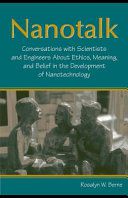
No one really knows where nanotechnology is leading, what its pursuit will mean, and how it may affect human and other forms of life. Nevertheless, its research and development are moving briskly into that unknown. It has been suggested that rapid movement towards ‘who knows where’ is endemic to all technological development; that its researchers pursue it for curiosity and enjoyment, without knowing the consequences, believing that their efforts will be beneficial. Further, that the enthusiasm for development comes with no malicious intent but rather from simple ignorance. Contrary to that commonly held perception about the collective pursuit of technological development, there are individual research scientists and engineers who are quite willing to reflect on the meaning of their work in nanotechnology.Nanotalk is a book of conversations and explorations with thirty five such nano-research scientists and engineers who share their ideas, experiences, perceptions, and beliefs about their work, humanity, nature, change, and the future of the world with nanotechnology. Precisely because of the unknowable nature of nanotechnology research and development, conscientious foresight and ethical reflection are warranted every step of the way. Not only do nanotechnology research and development represent enormous financial commitments, but they also require a profound leap of faith regarding its possible outcomes. Using these conversations as the basis of reflection and deliberation, the author explores the possible significance of nanotechnology to humanity and how it might be pursued conscientiously and ethically.
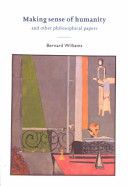
This new volume of philosophical papers by Bernard Williams is divided into three sections: the first Action, Freedom, Responsibility, the second Philosophy, Evolution and the Human Sciences; in which appears the essay which gives the collection its title; and the third Ethics, which contains essays closely related to his 1983 book Ethics and the Limits of Philosophy. Like the two earlier volumes of Williams’s papers published by Cambridge University Press, Problems of the Self and Moral Luck, this volume will be welcomed by all readers with a serious interest in philosophy. It is published alongside a volume of essays on Williams’s work, World, Mind, and Ethics: Essays on the Ethical Philosophy of Bernard Williams, edited by J. E. J. Altham and Ross Harrison, which provides a reappraisal of his work by other distinguished thinkers in the field.
In this clear, critical examination of the ideas of one of the greatest and most influential of modern philosophers, Inwood makes Hegel’s arguments fully accessible. He reconstructs Hegel’s thought throughout the book by arguing with him, considering Hegel’s system as a whole and examining the wide range of problems that it was designed to solve – metaphysical, epistemological, theological and political. The logical and metaphysical ideas which underpin the system and which supply the key to understanding much of what is obscure in Hegel’s thought are fully explained.
ما از اخلاق چه انتظاری داریم؟ این سوال شاید تاحدودی برای عموم مردم و یا متخصصان این رشته قابل پاسخ باشد؛ اینکه خوب بودن را به ما بیاموزد و در تنظیم روابط فردی م...

جشن کتاب تهران به ایستگاه سی و یکم رسیده است. حال و احوال نشر کتاب خوب نیست و باید فرهنگدوستان را به خرید و هدیه دادن کتاب ترغیب نمود. خانه اخلاقپژوهان جوان ب...

بنیاد کتابهای اخلاق اسلامی عمدتا پالایش جان از آلودگیها و آراستن آن به زیباییها است. اندیشه محوری این قبیل کتابها آن است که انسان فعلی آنی نیست که باید باشد...

-
0 Comments