Notice: تابع WP_Block_Type_Registry::register به طورنادرست فراخوانی شد. نامهای نوع بلوک نباید حروف بزرگ داشته باشند. لطفاً برای اطلاعات بیشتر، اشکال زدایی در وردپرس را مشاهده کنید. (این پیام در نگارش 5.0.0 افزوده شده است.) in /home/ethicsho/public_html/wp-includes/functions.php on line 5313
Warning: Use of undefined constant TDC_PATH_LEGACY - assumed 'TDC_PATH_LEGACY' (this will throw an Error in a future version of PHP) in /home/ethicsho/public_html/wp-content/plugins/td-composer/td-composer.php on line 109
Warning: Use of undefined constant TDSP_THEME_PATH - assumed 'TDSP_THEME_PATH' (this will throw an Error in a future version of PHP) in /home/ethicsho/public_html/wp-content/plugins/td-composer/td-composer.php on line 113 بایگانیهای K5077 .R39 1997 - خانه اخلاق پژوهان جوان Notice: Trying to access array offset on value of type bool in /home/ethicsho/public_html/wp-content/plugins/wp-ulike/inc/general-functions.php on line 807
Recent critiques of international development practice, affecting some of the West’s best known aid organisations, have attacked the motives of those heading the ‘machine’ of development. This book draws lessons from actual projects to propose a
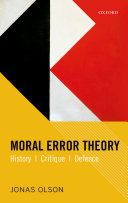
Jonas Olson presents a critical survey of moral error theory, the view that there are no moral facts and so all moral claims are false. In Part I (History), he explores the historical context of the debate, and discusses the moral error theories of David Hume and of some more or less influential twentieth century philosophers, including Axel Hägerström, Bertrand Russell, Ludwig Wittgenstein, and Richard Robinson. He argues that the early cases for moral error theory are suggestive but that they would have been stronger had they included something like J. L. Mackie’s arguments that moral properties and facts are metaphysically queer. Part II (Critique) focuses on these arguments. Olson identifies four queerness arguments, concerning supervenience, knowledge, motivation, and irreducible normativity, and goes on to establish that while the first three are not compelling, the fourth has considerable force, especially when combined with debunking explanations of why we tend to believe that there are moral properties and facts when in fact there are none. One conclusion of Part II is that a plausible error theory takes the form of an error theory about irreducible normativity. In Part III (Defence), Olson considers challenges according to which that kind of error theory has problematic ramifications regarding hypothetical reasons, epistemic reasons, and deliberation. He ends his discussion with a consideration of the implications of moral error theory for ordinary moral thought and talk, and for normative theorizing.
What constitutes the moral in human behavior, what marks out right or wrong conduct from conduct ethically indifferent, we have not yet considered. But no man is wholly without information in the field of morals, and we may here fall back upon such conceptions as men generally possess before they have evolved a science of morals. In the light of such conceptions a simple and comparatively undeveloped culture may compare very favorably with one much higher in the scale of civilization.
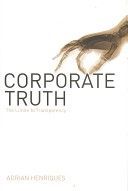
In the corporate jungle inhabited by Enrons and WorldComs, a lack of transparency is the root of all scandal, yet delivering transparency seems immensely difficult with the often competing interests of shareholders, corporate boards, government regulators, and other stakeholders. Written by noted corporate social responsibility practitioner Adrian Henriques and drawing on a vast wealth of real-life examples from the commercial world, this lively business book goes in search of the appropriate limits of transparency. From commercial confidentiality to the ethics of marketing to lobbying and corporate corruption, the author addresses the position, significance, and limits of transparency in modern corporate life and works through the dilemmas that the increasing calls for transparency present. From the secrets of the board room to the struggles of NGOs, transparency is a persistent challenge-how much is enough? How much do we need? How do we do it? This book, ideally suited to business leaders and managers, consultants and business students alike addresses these questions and more.
ما از اخلاق چه انتظاری داریم؟ این سوال شاید تاحدودی برای عموم مردم و یا متخصصان این رشته قابل پاسخ باشد؛ اینکه خوب بودن را به ما بیاموزد و در تنظیم روابط فردی م...

جشن کتاب تهران به ایستگاه سی و یکم رسیده است. حال و احوال نشر کتاب خوب نیست و باید فرهنگدوستان را به خرید و هدیه دادن کتاب ترغیب نمود. خانه اخلاقپژوهان جوان ب...

بنیاد کتابهای اخلاق اسلامی عمدتا پالایش جان از آلودگیها و آراستن آن به زیباییها است. اندیشه محوری این قبیل کتابها آن است که انسان فعلی آنی نیست که باید باشد...

-
0 Comments