Notice: تابع WP_Block_Type_Registry::register به طورنادرست فراخوانی شد. نامهای نوع بلوک نباید حروف بزرگ داشته باشند. لطفاً برای اطلاعات بیشتر، اشکال زدایی در وردپرس را مشاهده کنید. (این پیام در نگارش 5.0.0 افزوده شده است.) in /home/ethicsho/public_html/wp-includes/functions.php on line 5313
Warning: Use of undefined constant TDC_PATH_LEGACY - assumed 'TDC_PATH_LEGACY' (this will throw an Error in a future version of PHP) in /home/ethicsho/public_html/wp-content/plugins/td-composer/td-composer.php on line 109
Warning: Use of undefined constant TDSP_THEME_PATH - assumed 'TDSP_THEME_PATH' (this will throw an Error in a future version of PHP) in /home/ethicsho/public_html/wp-content/plugins/td-composer/td-composer.php on line 113 بایگانیهای HB72 .S434 1987 - خانه اخلاق پژوهان جوان Notice: Trying to access array offset on value of type bool in /home/ethicsho/public_html/wp-content/plugins/wp-ulike/inc/general-functions.php on line 807
Before his death in 2003, Bernard Williams planned to publish a collection of historical essays, focusing primarily on the ancient world. This posthumous volume brings together a much wider selection, written over some forty years. His legacy lives on in this masterful work, the first collection ever published of Williams’s essays on the history of philosophy. The subjects range from the sixth century B.C. to the twentieth A.D., from Homer to Wittgenstein by way of Socrates, Plato, Aristotle, Descartes, Hume, Sidgwick, Collingwood, and Nietzsche. Often one would be hard put to say which part is history, which philosophy. Both are involved throughout, because this is the history of philosophy written philosophically. Historical exposition goes hand in hand with philosophical scrutiny. Insights into the past counteract blind acceptance of present assumptions. In his touching and illuminating introduction, Myles Burnyeat writes of these essays: “They show a depth of commitment to the history of philosophy seldom to be found nowadays in a thinker so prominent on the contemporary philosophical scene.” The result celebrates the interest and importance to philosophy today of its near and distant past.The Sense of the Past is one of three collections of essays by Bernard Williams published by Princeton University Press since his death. In the Beginning Was the Deed: Realism and Moralism in Political Argument, selected, edited, and with an introduction by Geoffrey Hawthorn, and Philosophy as a Humanistic Discipline, selected, edited, and with an introduction by A. W. Moore, make up the trio.
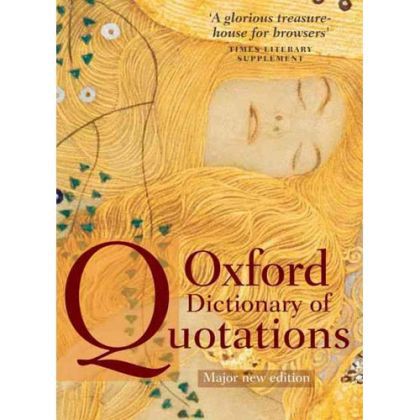
Here is a major new edition of the most authoritative dictionary of quotations available, bringing you the wit and wisdom of past and present–from the ancient adages of East and West to today’s most memorable lines. This new edition is a paradise of over 20,000 quotations for all occasions, comprehensively indexed by keyword. Whether you lean towards the words of Jane Austen: “Think only of the past as its remembrance gives you pleasure,” or the advice of Paris Hilton: “Dress cute wherever you go. Life is too short to blend in,” the Oxford Dictionary of Quotations provides the ultimate answer to the questions “Who said that?” and “What’s been said about this?” Drawing on Oxford’s unrivalled dictionary research program and unique language monitoring, this Seventh Edition offers almost a thousand new quotations, from over 500 authors. These include classic quotations from established names for which new evidence of current usage has been found as well as earlier quotations used by well-known literary authors from around the English-speaking world, ranging from the maxim of Confucius for a ruler, “If you desire what is good, the people will be good” (quoted by Thoreau), and the view of the Stoic philosopher Epictetus that “Not things, but opinions about things, trouble men” (Laurence Sterne). Now featuring a ribbon-marker, enhanced cross-referencing, a new crystal-clear text design, and an expanded introduction, The Oxford Dictionary of Quotations is an invaluable addition to every home library as well as the working libraries of all professional speakers and writers.
Educational policy and discussion, in Britain and the USA, are increasingly dominated by the confused ideology of egalitarianism. David E. Cooper begins by identifying the principles hidden among the confusions, and argues that these necessarily conflict with the ideal of educational excellence – in which conflict it is this ideal that must be preserved. He goes on to criticize the use of education as a tool for promoting wider social equality, focussing especially on the muddles surrounding ‘equal opportunities’, ‘social mix’ and ‘reverse discrimination’. Further chapters criticize the ‘new egalitarianism’ favoured, on epistemological grounds, by various sociologists of knowledge in recent years and ‘cultural egalitarianism’ according to which standard criteria of educational value merely reflect parochial and economic interests.
Moral problems do not always come in the form of great social controversies. More often, the moral decisions we make are made quietly, constantly, and within the context of everyday activities and quotidian dilemmas. Indeed, these smaller decisions are based on a moral foundation that few of us ever stop to think about but which guides our every action. Here distinguished philosopher Bernard Gert presents a clear and concise introduction to what he calls “common morality” — the moral system that most thoughtful people implicitly use when making everyday, common sense moral decisions and judgments. Common Morality is useful in that — while not resolving every disagreement on controversial issues — it is able to distinguish between acceptable and unacceptable answers to moral problems. In the first part of the book Gert lays out the fundamental features of common morality: moral rules, moral ideals, and a two-step procedure for determining when a violation of a moral rule is justified. Written in a non-technical style, the ten general moral rules include rules on which everyone can agree, such as “do not kill,” “do not deceive,” and “keep your promises.” The moral ideals include similarly uncontroversial precepts such as “Relieve pain” and “Aid the needy.” In the second part of the book Gert examines the underlying concepts that justify common morality, such as the notions of rationality and impartiality. The distillation of over 40 years of scholarship, this book is the most accessible version of Gert’s influential theory of morality as well as an eye-opening look at the moral foundations of our everyday actions. Throughout the discussion is clear enough for a reader with little or no philosophy background.
ما از اخلاق چه انتظاری داریم؟ این سوال شاید تاحدودی برای عموم مردم و یا متخصصان این رشته قابل پاسخ باشد؛ اینکه خوب بودن را به ما بیاموزد و در تنظیم روابط فردی م...

جشن کتاب تهران به ایستگاه سی و یکم رسیده است. حال و احوال نشر کتاب خوب نیست و باید فرهنگدوستان را به خرید و هدیه دادن کتاب ترغیب نمود. خانه اخلاقپژوهان جوان ب...

بنیاد کتابهای اخلاق اسلامی عمدتا پالایش جان از آلودگیها و آراستن آن به زیباییها است. اندیشه محوری این قبیل کتابها آن است که انسان فعلی آنی نیست که باید باشد...

-
0 Comments