Notice: تابع WP_Block_Type_Registry::register به طورنادرست فراخوانی شد. نامهای نوع بلوک نباید حروف بزرگ داشته باشند. لطفاً برای اطلاعات بیشتر، اشکال زدایی در وردپرس را مشاهده کنید. (این پیام در نگارش 5.0.0 افزوده شده است.) in /home/ethicsho/public_html/wp-includes/functions.php on line 5313
Warning: Use of undefined constant TDC_PATH_LEGACY - assumed 'TDC_PATH_LEGACY' (this will throw an Error in a future version of PHP) in /home/ethicsho/public_html/wp-content/plugins/td-composer/td-composer.php on line 109
Warning: Use of undefined constant TDSP_THEME_PATH - assumed 'TDSP_THEME_PATH' (this will throw an Error in a future version of PHP) in /home/ethicsho/public_html/wp-content/plugins/td-composer/td-composer.php on line 113 بایگانیهای H62 .I785 2006 - خانه اخلاق پژوهان جوان Notice: Trying to access array offset on value of type bool in /home/ethicsho/public_html/wp-content/plugins/wp-ulike/inc/general-functions.php on line 807
This book is the first broad history of the growing field of bioethics. Covering the period 1947-1987, it examines the origin and evolution of the debates over human experimentation, genetic engineering, organ transplantation, termination of life-sustaining treatment, and new reproductivetechnologies. It assesses the contributions of philosophy, theology, law and the social sciences to the expanding discourse of bioethics. Written by one of the field’s founders, it is based on extensive archival research into resources that are difficult to obtain and on interviews with manyleading figures. A very readable account of the development of bioethics, the book stresses the history of ideas but does not neglect the social and cultural context and the people involved.
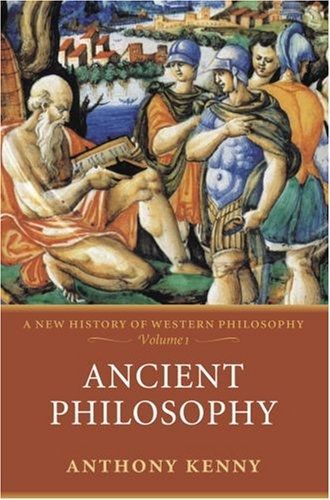
Sir Anthony Kenny here tells the fascinating story of the birth of philosophy and its remarkable flourishing in the ancient Mediterranean world. This is the initial volume of a four-book set in which Kenny will unfold a magisterial new history of Western philosophy, the first major single-author history of philosophy to appear in decades. Ancient Philosophy spans over a thousand years and brings to life the great minds of the past, from Thales, Pythagoras, and Parmenides, to Socrates, Epictetus, Marcus Aurelius, and Augustine. The book’s great virtue is that it is written by one of the world’s leading authorities on the subject. Instead of an uncritical, straightforward recitation of known facts–Plato and his cave of shadows, Aristotle’s ethics, Augustine’s City of God–we see the major philosophers through the eyes of a man who has spent a lifetime contemplating their work. Thus we do not simply get an overview of Aristotle, for example, but a penetrating and insightful critique of his thought. Kenny offers an illuminating account of the various schools of thought, from the Pre-Socratics to the Epicureans. He examines the development of logic and reason, ancient ideas about physics (“how things happen”), metaphysics and ethics, and the earliest thinking about the soul and god. Vividly written, but serious and deep enough to offer a genuine understanding of the great philosophers, Kenny’s lucid and stimulating history will become the definitive work for anyone interested in the people and ideas that shaped the course of Western thought.
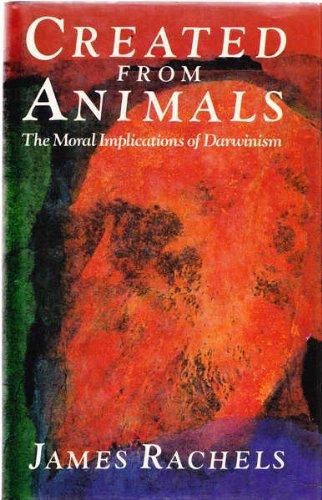
From Bishop Wilberforce in the 1860s to the advocates of “creation science” today, defenders of traditional mores have condemned Darwin’s theory of evolution as a threat to society’s values. Darwin’s defenders, like Stephen Jay Gould, have usually replied that there is no conflict between science and religion–that values and biological facts occupy separate realms. But as James Rachels points out in this thought-provoking study, Darwin himself would disagree with Gould. Darwin, who had once planned on being a clergyman, was convinced that natural selection overthrew our age-old religious beliefs. Created from Animals offers a provocative look at how Darwinian evolution undermines many tenets of traditional philosophy and religion. James Rachels begins by examining Darwin’s own life and work, presenting an astonishingly vivid and compressed biography. We see Darwin’s studies of the psychological links in evolution (such as emotions in dogs, and the “mental powers” of worms), and how he addressed the moral implications of his work, especially in his concern for the welfare of animals. Rachels goes on to present a lively and accessible survey of the controversies that followed in Darwin’s wake, ranging from Herbert Spencer’s Social Darwinism to Edward O. Wilson’s sociobiology, and discusses how the work of such influential intellects as Descartes, Hume, Kant, T.H. Huxley, Henri Bergson, B.F. Skinner, and Stephen Jay Gould has contributed to–or been overthrown by–evolutionary science. Western philosophy and religion, Rachels argues, have been shaken by the implications of Darwin’s work, most notably the controversial idea that humans are simply a more complex kind of animal. Rachels assesses a number of studies that suggest how closely humans are linked to other primates in behavior, and then goes on to show how this idea undercuts the work of many prominent philosophers. Kant’s famous argument that suicide reduces one to the level of an animal, for instance, is meaningless if humans are, in fact, animals. Indeed, humanity’s membership in the animal kingdom calls into question the classic notions of human dignity and the sacredness of human life. What we need now, Rachels contends, is a philosophy that does not discriminate between different species, one that addresses each being on an individual basis. With this sweeping survey of the arguments, the philosophers, and the deep implications surrounding Darwinism, Rachels lays the foundations for a new view of morality. Vibrantly written and provocatively argued, Created from Animals offers a new perspective on issues ranging from suicide to euthanasia to animal rights.
ما از اخلاق چه انتظاری داریم؟ این سوال شاید تاحدودی برای عموم مردم و یا متخصصان این رشته قابل پاسخ باشد؛ اینکه خوب بودن را به ما بیاموزد و در تنظیم روابط فردی م...

جشن کتاب تهران به ایستگاه سی و یکم رسیده است. حال و احوال نشر کتاب خوب نیست و باید فرهنگدوستان را به خرید و هدیه دادن کتاب ترغیب نمود. خانه اخلاقپژوهان جوان ب...

بنیاد کتابهای اخلاق اسلامی عمدتا پالایش جان از آلودگیها و آراستن آن به زیباییها است. اندیشه محوری این قبیل کتابها آن است که انسان فعلی آنی نیست که باید باشد...

-
0 Comments