Notice: تابع WP_Block_Type_Registry::register به طورنادرست فراخوانی شد. نامهای نوع بلوک نباید حروف بزرگ داشته باشند. لطفاً برای اطلاعات بیشتر، اشکال زدایی در وردپرس را مشاهده کنید. (این پیام در نگارش 5.0.0 افزوده شده است.) in /home/ethicsho/public_html/wp-includes/functions.php on line 5313
Warning: Use of undefined constant TDC_PATH_LEGACY - assumed 'TDC_PATH_LEGACY' (this will throw an Error in a future version of PHP) in /home/ethicsho/public_html/wp-content/plugins/td-composer/td-composer.php on line 109
Warning: Use of undefined constant TDSP_THEME_PATH - assumed 'TDSP_THEME_PATH' (this will throw an Error in a future version of PHP) in /home/ethicsho/public_html/wp-content/plugins/td-composer/td-composer.php on line 113 بایگانیهای BV4647.F55 .Z34 2010 - خانه اخلاق پژوهان جوان Notice: Trying to access array offset on value of type bool in /home/ethicsho/public_html/wp-content/plugins/wp-ulike/inc/general-functions.php on line 807
A companion volume to Free Will: A Philosophical Study, this new anthology collects influential essays on free will, including both well-known contemporary classics and exciting recent work. Agency and Responsibility: Essays on the Metaphysics of Freedom is divided into three parts. The essays in the first section address metaphysical issues concerning free will and causal determinism. The second section groups papers presenting a positive account of the nature of free action, including competing compatibilist and incompatibilist analyses. The third section concerns free will and moral responsibility, including theories of moral responsibility and the challenge to an alternative possibilities condition posed by Frankurt-type scenarios. Distinguished by its balance and consistently high quality, the volume presents papers selected for their significance, innovation, and clarity of expression. Contributors include Harry Frankfurt, Peter van Inwagen, David Lewis, Elizabeth Anscombe, John Martin Fischer, Michael Bratman, Roderick Chisholm, Robert Kane, Peter Strawson, and Susan Wolf. The anthology serves as an up-to-date resource for scholars as well as a useful text for courses in ethics, philosophy of religion, or metaphysics. In addition, paired with Free Will: A Philosophical Study, it would form an excellent upper-level undergraduate or graduate-level course in free will, responsibility, motivation, or action theory.
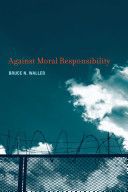
In Against Moral Responsibility, Bruce Waller launches a spirited attack on a system that is profoundly entrenched in our society and its institutions, deeply rooted in our emotions, and vigorously defended by philosophers from ancient times to the present. Waller argues that, despite the creative defenses of it by contemporary thinkers, moral responsibility cannot survive in our naturalistic-scientific system. The scientific understanding of human behavior and the causes that shape human character, he contends, leaves no room for moral responsibility. Waller argues that moral responsibility in all its forms–including criminal justice, distributive justice, and all claims of just deserts–is fundamentally unfair and harmful and that its abolition will be liberating and beneficial. What we really want–natural human free will, moral judgments, meaningful human relationships, creative abilities–would survive and flourish without moral responsibility. In the course of his argument, Waller examines the origins of the basic belief in moral responsibility, proposes a naturalistic understanding of free will, offers a detailed argument against moral responsibility and critiques arguments in favor of it, gives a general account of what a world without moral responsibility would look like, and examines the social and psychological aspects of abolishing moral responsibility. Waller not only mounts a vigorous, and philosophically rigorous, attack on the moral responsibility system, but also celebrates the benefits that would result from its total abolition.
For courses in Business Ethics or Business and Society. Scholarly and well-researched, this unique exploration of the values, ethics, and beliefs of American business begins with the history of the free market system; explains how the values of the organization can influence the values of the individual; and helps students discover their own personal values and goals. Drawing on insights from moral philosophy, economics, social history, psychology, and sociology, it presents both traditional business values and the contemporary challenges to these values, and offers comparisons from a global perspective.
This is the only environmental casebook of its kind, presenting current and classic cases with the detail required for students to experience serious and complex issues. The authors present cases of immediate interest to students in a balanced and impartial manner.
Essays on Aristotle’s Rhetoric offers a fresh and comprehensive assessment of a classic work. Aristotle’s influence on the practice and theory of rhetoric, as it affects political and legal argumentation, has been continuous and far-reaching. This anthology presents Aristotle’s Rhetoric in its original context, providing examples of the kind of oratory whose success Aristotle explains and analyzes.The contributors–eminent philosophers, classicists, and critics–assess the role and the techniques of rhetorical persuasion in philosophic discourse and in the public sphere. They connect Aristotle’s Rhetoric to his other work on ethics and politics, as well as to his ideas on logic, psychology, and philosophy of language. The collection as a whole invites us to reassess the place of rhetoric in intellectual and political life. Essays on Aristotle’s Rhetoric offers a fresh and comprehensive assessment of a classic work. Aristotle’s influence on the practice and theory of rhetoric, as it affects political and legal argumentation, has been continuous and far-reaching. This anthology presents Aristotle’s Rhetoric in its original context, providing examples of the kind of oratory whose success Aristotle explains and analyzes.The contributors–eminent philosophers, classicists, and critics–assess the role and the techniques of rhetorical persuasion in philosophic discourse and in the public sphere. They connect Aristotle’s Rhetoric to his other work on ethics and politics, as well as to his ideas on logic, psychology, and philosophy of language. The collection as a whole invites us to reassess the place of rhetoric in intellectual and political life.
ما از اخلاق چه انتظاری داریم؟ این سوال شاید تاحدودی برای عموم مردم و یا متخصصان این رشته قابل پاسخ باشد؛ اینکه خوب بودن را به ما بیاموزد و در تنظیم روابط فردی م...

جشن کتاب تهران به ایستگاه سی و یکم رسیده است. حال و احوال نشر کتاب خوب نیست و باید فرهنگدوستان را به خرید و هدیه دادن کتاب ترغیب نمود. خانه اخلاقپژوهان جوان ب...

بنیاد کتابهای اخلاق اسلامی عمدتا پالایش جان از آلودگیها و آراستن آن به زیباییها است. اندیشه محوری این قبیل کتابها آن است که انسان فعلی آنی نیست که باید باشد...

-
0 Comments