Notice: تابع WP_Block_Type_Registry::register به طورنادرست فراخوانی شد. نامهای نوع بلوک نباید حروف بزرگ داشته باشند. لطفاً برای اطلاعات بیشتر، اشکال زدایی در وردپرس را مشاهده کنید. (این پیام در نگارش 5.0.0 افزوده شده است.) in /home/ethicsho/public_html/wp-includes/functions.php on line 5313
Warning: Use of undefined constant TDC_PATH_LEGACY - assumed 'TDC_PATH_LEGACY' (this will throw an Error in a future version of PHP) in /home/ethicsho/public_html/wp-content/plugins/td-composer/td-composer.php on line 109
Warning: Use of undefined constant TDSP_THEME_PATH - assumed 'TDSP_THEME_PATH' (this will throw an Error in a future version of PHP) in /home/ethicsho/public_html/wp-content/plugins/td-composer/td-composer.php on line 113 بایگانیهای BJ1481 .W65 2006 - خانه اخلاق پژوهان جوان Notice: Trying to access array offset on value of type bool in /home/ethicsho/public_html/wp-content/plugins/wp-ulike/inc/general-functions.php on line 807
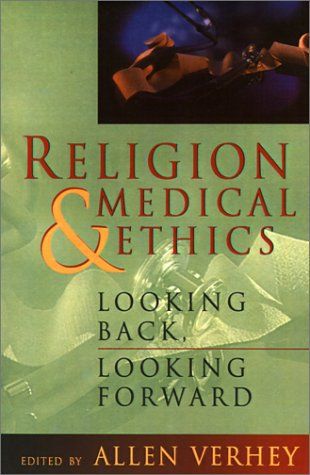
This collection of essays looks back at the contributions of theology to medical ethics in the past and sets an agenda for theological reflection on medical ethics in the future.
“Islam and Morality considers how Islam, the Qur’an, and other Islamic texts have approached the ethics of a variety of contemporary and historical issues. Oliver Leaman provides a varied, balanced, and thought-provoking account of how Islamic thinkers discussed medical ethics, wealth, poverty, the environment, and law. He explores the work of a range of Islamic thinkers, including Rumi, Ibn al-‘Arabi, al-Ghazali, Mutahhari and Barlas, while taking into consideration the different branches of Islam and Islamic theology and law. The book also considers how Islam understands the concept of free will, the relationship between good and evil, and far less abstract topics like what we should eat and drink. Aimed at upper level undergraduates, postgraduates, and researchers working in Islamic Studies and ethics, this is one of the first books to provide a sustained reading of the importance of ethics within Islam”–
Aristotle’s view of philosophical method and the substantive conclusions he reaches by using his methods are of permanent interest. His views display both development and internal tensions; but his main line of argument is both coherent and philosophically challenging. This book explores Aristotle’s philosophical method, and the merits of his conclusions. Since a proper understanding of Aristotle’s method requires emphasis on the systematic character of his philosophy, Terence Irwin examines questions in several different areas of Aristotle’s philosophy – especially metaphysics, epistemology, philosophy of mind, and ethics – and stresses the connections between doctrines and issues that are often discussed piecemeal.
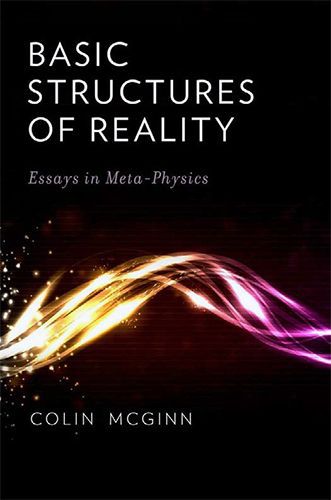
In Basic Structures of Reality, Colin McGinn deals with questions of metaphysics, epistemology, and philosophy of mind from the vantage point of physics. Combining general philosophy with physics, he covers such topics as the definition of matter, the nature of space, motion, gravity, electromagnetic fields, the character of physical knowledge, and consciousness and meaning. Throughout, McGinn maintains an historical perspective and seeks to determine how much we really know of the world described by physics. He defends a version of “structuralism”: the thesis that our knowledge is partial and merely abstract, leaving a large epistemological gap at the center of physics.
McGinn then connects this element of mystery to parallel mysteries in relation to the mind. Consciousness emerges as just one more mystery of physics. A theory of matter and space is developed, according to which the impenetrability of matter is explained as the deletion of volumes of space. McGinn proposes a philosophy of science that distinguishes physics from both psychology and biology, explores the ontology of energy, and considers the relevance of physics to seemingly remote fields such as the theory of meaning. In the form of a series of aphorisms, the author presents a metaphysical system that takes laws of nature as fundamental. With its broad scope and deep study of the fundamental questions at the heart of philosophy of physics, this book is not intended primarily for specialists, but for the general philosophical reader interested in how physics and philosophy intersect.
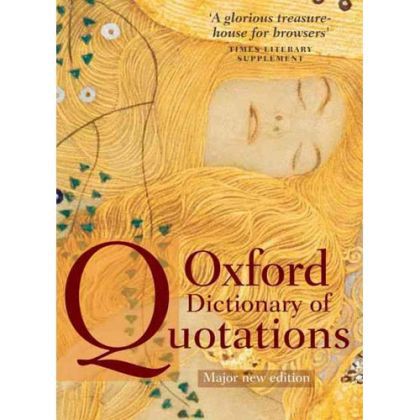
Here is a major new edition of the most authoritative dictionary of quotations available, bringing you the wit and wisdom of past and present–from the ancient adages of East and West to today’s most memorable lines. This new edition is a paradise of over 20,000 quotations for all occasions, comprehensively indexed by keyword. Whether you lean towards the words of Jane Austen: “Think only of the past as its remembrance gives you pleasure,” or the advice of Paris Hilton: “Dress cute wherever you go. Life is too short to blend in,” the Oxford Dictionary of Quotations provides the ultimate answer to the questions “Who said that?” and “What’s been said about this?” Drawing on Oxford’s unrivalled dictionary research program and unique language monitoring, this Seventh Edition offers almost a thousand new quotations, from over 500 authors. These include classic quotations from established names for which new evidence of current usage has been found as well as earlier quotations used by well-known literary authors from around the English-speaking world, ranging from the maxim of Confucius for a ruler, “If you desire what is good, the people will be good” (quoted by Thoreau), and the view of the Stoic philosopher Epictetus that “Not things, but opinions about things, trouble men” (Laurence Sterne). Now featuring a ribbon-marker, enhanced cross-referencing, a new crystal-clear text design, and an expanded introduction, The Oxford Dictionary of Quotations is an invaluable addition to every home library as well as the working libraries of all professional speakers and writers.
ما از اخلاق چه انتظاری داریم؟ این سوال شاید تاحدودی برای عموم مردم و یا متخصصان این رشته قابل پاسخ باشد؛ اینکه خوب بودن را به ما بیاموزد و در تنظیم روابط فردی م...

جشن کتاب تهران به ایستگاه سی و یکم رسیده است. حال و احوال نشر کتاب خوب نیست و باید فرهنگدوستان را به خرید و هدیه دادن کتاب ترغیب نمود. خانه اخلاقپژوهان جوان ب...

بنیاد کتابهای اخلاق اسلامی عمدتا پالایش جان از آلودگیها و آراستن آن به زیباییها است. اندیشه محوری این قبیل کتابها آن است که انسان فعلی آنی نیست که باید باشد...

-
0 Comments