Notice: تابع WP_Block_Type_Registry::register به طورنادرست فراخوانی شد. نامهای نوع بلوک نباید حروف بزرگ داشته باشند. لطفاً برای اطلاعات بیشتر، اشکال زدایی در وردپرس را مشاهده کنید. (این پیام در نگارش 5.0.0 افزوده شده است.) in /home/ethicsho/public_html/wp-includes/functions.php on line 5313
Warning: Use of undefined constant TDC_PATH_LEGACY - assumed 'TDC_PATH_LEGACY' (this will throw an Error in a future version of PHP) in /home/ethicsho/public_html/wp-content/plugins/td-composer/td-composer.php on line 109
Warning: Use of undefined constant TDSP_THEME_PATH - assumed 'TDSP_THEME_PATH' (this will throw an Error in a future version of PHP) in /home/ethicsho/public_html/wp-content/plugins/td-composer/td-composer.php on line 113 بایگانیهای BJ1451 .C64 1991 - خانه اخلاق پژوهان جوان Notice: Trying to access array offset on value of type bool in /home/ethicsho/public_html/wp-content/plugins/wp-ulike/inc/general-functions.php on line 807
“This collection is devoted to questions in meta-ethics and moral psychology arising from the work of David Hume. The collection focuses on questions arising from Humes views on reason, motivation and virtue including new essays from notable Hume scholars
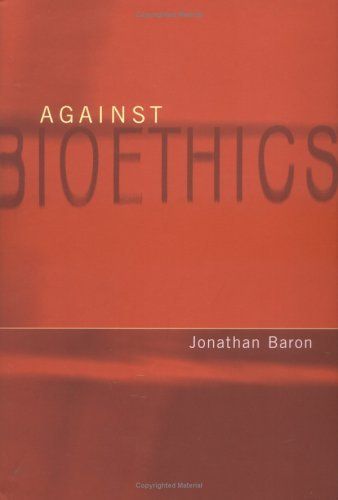
Governments, health professionals, patients, research institutions, and research subjects look to bioethicists for guidance in making important decisions about medical treatment and research. And yet, argues Jonathan Baron in Against Bioethics, applied bioethics lacks the authority of a coherent guiding theory and is based largely on intuitive judgments. Baron proposes an alternative, arguing that bioethics could have a coherent theory based on utilitarianism and decision analysis. Utilitarianism holds that the best option is the one that does the most expected good. Decision analysis provides a way of thinking about the risks and trade-offs of specific options. Like economics, utilitarian decision analysis makes predictions of expected good in complex situations, using data when possible, and focusing human judgment on the issues relevant to consequences. With such a guiding theory, bioethics would never yield decisions that clearly go against the expected good of those involved, as some do now. Baron discusses issues in bioethics that can be illuminated by such analysis, including “enhancements” to nature in the form of genetics, drugs, and mind control; reproduction; death and end-of-life issues, including advance directives, euthanasia, and organ donation; coercion and consent; conflict of interest and the reform of internal review boards; and drug research. Although Baron opposes current practice in bioethics, he argues that by combining utilitarianism and decision analysis, bioethics can achieve its aims of providing authoritative guidance in resolving thorny medical and ethical issues.
It is axiomatic that every valuation of a business or business interest must contain a definition or standard of value. Each standard of value contains numerous assumptions, and there can be significant variation in the application of a particular standard of value and its underlying assumptions. Standards of Value addresses many of the ambiguities inherent in applying common standards of value. Written by Jay Fishman, Shannon Pratt, and William Morrison–three renowned valuation practitioners who deal with these issues on a daily basis–this book discusses the interaction between valuation theory and its judicial and regulatory application. A must-read for appraisers, accountants, judges, attorneys, and appraisal users, this insightful book addresses standards of value as applied in four distinct contexts: estate and gift taxation; shareholder dissent and oppression; divorce; and financial reporting. Here, practitioners will discover some of the intricacies of performing services in these venues, and appraisers will find this book helpful in understanding why the practitioners are asking such questions. Providing expert direction on interpreting and applying standards of value, this guide includes: Valuations for estate and gift tax, shareholder dissent and oppression, and divorce matters presented within their respective judicial frameworksCase-by-case reasoning behind appraisal-related decisionsState-by-state analyses that provide a clearer idea of how a state’s established case law may give insight on the standard of valueA general overview of the concepts of value, cost, and priceFair market value in estate and gift tax valuationsFair value in dissenting and oppressed shareholder mattersThe premises and standards of value used when valuing a business in divorceCurrent and proposed standards for the reporting of assets and liabilities for corporations as established by the Financial Accounting Standards Board (FASB) of the AICPA
“Now available in English for the first time, Norwegian philosopher Arne Naess’s meditation on the art of living is an exhortation to preserve the environment and biodiversity. Like a “universal great-grandfather,” he offers a bright and bold perspective on the power of feelings to move us away from ecological and cultural degradation toward sound, future-focused policy and action.”.
ما از اخلاق چه انتظاری داریم؟ این سوال شاید تاحدودی برای عموم مردم و یا متخصصان این رشته قابل پاسخ باشد؛ اینکه خوب بودن را به ما بیاموزد و در تنظیم روابط فردی م...

جشن کتاب تهران به ایستگاه سی و یکم رسیده است. حال و احوال نشر کتاب خوب نیست و باید فرهنگدوستان را به خرید و هدیه دادن کتاب ترغیب نمود. خانه اخلاقپژوهان جوان ب...

بنیاد کتابهای اخلاق اسلامی عمدتا پالایش جان از آلودگیها و آراستن آن به زیباییها است. اندیشه محوری این قبیل کتابها آن است که انسان فعلی آنی نیست که باید باشد...

-
0 Comments