Notice: تابع WP_Block_Type_Registry::register به طورنادرست فراخوانی شد. نامهای نوع بلوک نباید حروف بزرگ داشته باشند. لطفاً برای اطلاعات بیشتر، اشکال زدایی در وردپرس را مشاهده کنید. (این پیام در نگارش 5.0.0 افزوده شده است.) in /home/ethicsho/public_html/wp-includes/functions.php on line 5313
Warning: Use of undefined constant TDC_PATH_LEGACY - assumed 'TDC_PATH_LEGACY' (this will throw an Error in a future version of PHP) in /home/ethicsho/public_html/wp-content/plugins/td-composer/td-composer.php on line 109
Warning: Use of undefined constant TDSP_THEME_PATH - assumed 'TDSP_THEME_PATH' (this will throw an Error in a future version of PHP) in /home/ethicsho/public_html/wp-content/plugins/td-composer/td-composer.php on line 113 بایگانیهای BJ1419 .M53 2006 - خانه اخلاق پژوهان جوان Notice: Trying to access array offset on value of type bool in /home/ethicsho/public_html/wp-content/plugins/wp-ulike/inc/general-functions.php on line 807
Everywhere we hear talk of decline, of a world that was better once, maybe fifty years ago, maybe centuries ago, but certainly before modernity drew us along its dubious path. While some lament the slide of Western culture into relativism and nihilism and others celebrate the trend as a liberating sort of progress, Charles Taylor calls on us to face the moral and political crises of our time, and to make the most of modernity’s challenges.At the heart of the modern malaise, according to most accounts, is the notion of authenticity, of self-fulfillment, which seems to render ineffective the whole tradition of common values and social commitment. Though Taylor recognizes the dangers associated with modernity’s drive toward self realization, he is not as quick as others to dismiss it. He calls for a freeze on cultural pessimism.In a discussion of ideas and ideologies from Friedrich Nietzsche to Gail Sheehy, from Allan Bloom to Michel Foucault, Taylor sorts out the good from the harmful in the modern cultivation of an authentic self. He sets forth the entire network of thought and morals that link our quest for self-creation with our impulse toward self-fashioning, and shows how such efforts must be conducted against an existing set of rules, or a gridwork of moral measurement. Seen against this network, our modern preoccupations with expression, rights, and the subjectivity of human thought reveal themselves as assets, not liabilities.By looking past simplistic, one-sided judgments of modern culture, by distinguishing the good and valuable from the socially and politically perilous, Taylor articulates the promise of our age. His bracing and provocative book gives voice to the challenge of modernity, and calls on all of us to answer it.
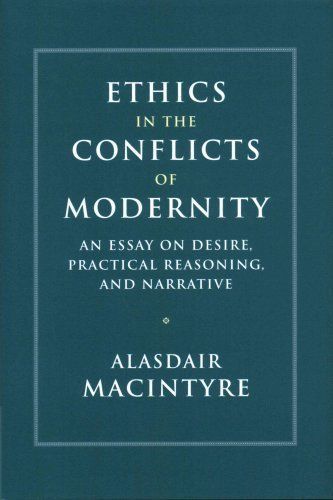
“This essay is divided into five chapters. In the first the questions initially posed about our desires and how we should think about them are questions that plain non philosophical persons often find themselves asking. When however they carry their attempt to answer these questions a little further, they find that they have, perhaps inadvertently, become philosophers, and that they need some at least of the conceptual and argumentative resources which professional philosophers provide. So their enquiry, like this one, becomes philosophical. But philosophy in our culture has become an almost exclusively specialized academic discipline whose practitioners for the most part address only each other rather than the educated lay person. Moreover those same practitioners have for the last fifty years been harassed by the academic system into publishing more and more as a condition for academic survival, so that on most topics of philosophical interest there is by now an increasingly large, an often unmanageable large body of literature that has to be read as a prologue before adding to it one more item. Readers should be warned that my references to this literature are selective and few. Had I conscientiously attempted not only to find my way through all the relevant published writing in the philosophy of mind and in ethics, but then also explained how I had come to terms with the claims advanced by its authors, I would have had to write at impossible length and in a format that would have made this essay inaccessible to the lay reader for whom it is written”–
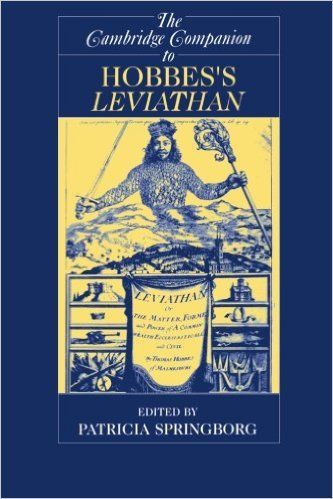
This Companion makes a new departure in Hobbes scholarship, addressing a philosopher whose impact was as great on Continental European theories of state and legal systems as it was at home. This volume is a systematic attempt to incorporate work from both the Anglophone and Continental traditions, bringing together newly commissioned work by scholars from ten different countries in a topic-by-topic sequence of essays that follows the structure of Leviathan, re-examining the relationship among Hobbes’s physics, metaphysics, politics, psychology, and religion. Collectively they showcase important revisionist scholarship that re-examines both the context for Leviathan and its reception, demonstrating the degree to which Hobbes was indebted to the long tradition of European humanist thought. This Cambridge Companion shows that Hobbes’s legacy was never lost and that he belongs to a tradition of reflection on political theory and governance that is still alive, both in Europe and in the diaspora.
ما از اخلاق چه انتظاری داریم؟ این سوال شاید تاحدودی برای عموم مردم و یا متخصصان این رشته قابل پاسخ باشد؛ اینکه خوب بودن را به ما بیاموزد و در تنظیم روابط فردی م...

جشن کتاب تهران به ایستگاه سی و یکم رسیده است. حال و احوال نشر کتاب خوب نیست و باید فرهنگدوستان را به خرید و هدیه دادن کتاب ترغیب نمود. خانه اخلاقپژوهان جوان ب...

بنیاد کتابهای اخلاق اسلامی عمدتا پالایش جان از آلودگیها و آراستن آن به زیباییها است. اندیشه محوری این قبیل کتابها آن است که انسان فعلی آنی نیست که باید باشد...

-
0 Comments