Notice: تابع WP_Block_Type_Registry::register به طورنادرست فراخوانی شد. نامهای نوع بلوک نباید حروف بزرگ داشته باشند. لطفاً برای اطلاعات بیشتر، اشکال زدایی در وردپرس را مشاهده کنید. (این پیام در نگارش 5.0.0 افزوده شده است.) in /home/ethicsho/public_html/wp-includes/functions.php on line 5313
Warning: Use of undefined constant TDC_PATH_LEGACY - assumed 'TDC_PATH_LEGACY' (this will throw an Error in a future version of PHP) in /home/ethicsho/public_html/wp-content/plugins/td-composer/td-composer.php on line 109
Warning: Use of undefined constant TDSP_THEME_PATH - assumed 'TDSP_THEME_PATH' (this will throw an Error in a future version of PHP) in /home/ethicsho/public_html/wp-content/plugins/td-composer/td-composer.php on line 113 بایگانیهای BJ1251 .B54 2004 - خانه اخلاق پژوهان جوان Notice: Trying to access array offset on value of type bool in /home/ethicsho/public_html/wp-content/plugins/wp-ulike/inc/general-functions.php on line 807
What makes people cosmopolitan? How is cosmopolitanism shaping everyday life experiences and the practices of ordinary people?Making use of empirical research, “Cosmopolitanism in Practice” examines the concrete settings in which individuals display cosmopolitan sensibilities and dispositions, illustrating the ways in which cosmopolitan self-transformations can be used as an analytical tool to explain a variety of identity outlooks and practices. The manner in which both past and present cosmopolitanisms compete with meta-narratives such as nationalism, multiculturalism and religion is also investigated, alongside the employment of cosmopolitan ideas in situations of tension and conflict.With an international team of contributors, including Ulrich Beck, Steven Vertovec, Rob Kroes and Natan Sznaider, this book draws on a variety of intellectual disciplines and international contexts to show how people embrace and make use of cosmopolitan ideas and attitudes.
From world-renowned psychologist and bestselling author of The Soul’s Code, a profound examination of the roots of man’s primal love/hate relationship with war. War is a timeless force in the human imagination-and, indeed, in daily life. If recent events have taught us anything, it is that peacetime is not nearly so constant and attainable as wartime. During the 5,600 years of recorded history, 14,600 wars have been fought-2 to 3 for every year of human history. War is a constant thing. And yet no one really understands why that is. In A Terrible Love of War, James Hillman, one of the central figures in psychology in the twentieth and twenty-first centuries, fills this great void and undertakes a groundbreaking examination of the origins, needs, and rewards of war. Moreover, in this brilliant inquiry, Hillman explores many other essential questions, such as: Is war a necessary part of our human soul and, therefore, a necessary part of our lives? Why do we need enemies? What scars does warfare carve on the psyche of its soldiers? And why does it have such a permanent effect? If war is such a “normal” part of our existence, why do we fear it so much? And alternately, how could we ever embrace a force so destructive, so wanton, and so inhuman? Can the impulse to engage in war be tamed? Hillman asserts that “if we want war’s horror to be abated so that life may go on, it is necessary to understand and imagine.” A Terrible Love of Waris a crucial tool to understanding war-a crucial book for us all.
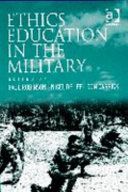
With formal ethics education programmes being a rarity in most countries’ armed forces, there is a growing importance for servicemen to undergo additional military ethics training. But how do we ensure that soldiers learn the right lessons from it? Furthermore, how can we achieve a uniformity of approach? The current lack of uniformity about what constitutes ethical behaviour and how troops should be educated in it is potentially a cause for serious alarm.This book advances knowledge and understanding of the issues associated with this subject by bringing together experts from around the world to analyze the content, mode of instruction, theoretical underpinnings, and the effect of cultural and national differences within current ethics programmes. It also explores whether such programmes are best run by military officers, chaplains or academic philosophers, and reflects whether it is feasible to develop common principles and approaches for the armed forces of all Western countries.This is an invaluable volume for military academies and staff colleges to enhance understanding of a matter which requires much further thought and which is becoming a vital force in influencing outcomes on the battlefields of the twenty-first century. The book will primarily be of interest to military officers and others directly involved in ethics education in the military, as well as to philosophers and students of military affairs.
ما از اخلاق چه انتظاری داریم؟ این سوال شاید تاحدودی برای عموم مردم و یا متخصصان این رشته قابل پاسخ باشد؛ اینکه خوب بودن را به ما بیاموزد و در تنظیم روابط فردی م...

جشن کتاب تهران به ایستگاه سی و یکم رسیده است. حال و احوال نشر کتاب خوب نیست و باید فرهنگدوستان را به خرید و هدیه دادن کتاب ترغیب نمود. خانه اخلاقپژوهان جوان ب...

بنیاد کتابهای اخلاق اسلامی عمدتا پالایش جان از آلودگیها و آراستن آن به زیباییها است. اندیشه محوری این قبیل کتابها آن است که انسان فعلی آنی نیست که باید باشد...

-
0 Comments