Notice: تابع WP_Block_Type_Registry::register به طورنادرست فراخوانی شد. نامهای نوع بلوک نباید حروف بزرگ داشته باشند. لطفاً برای اطلاعات بیشتر، اشکال زدایی در وردپرس را مشاهده کنید. (این پیام در نگارش 5.0.0 افزوده شده است.) in /home/ethicsho/public_html/wp-includes/functions.php on line 5313
Warning: Use of undefined constant TDC_PATH_LEGACY - assumed 'TDC_PATH_LEGACY' (this will throw an Error in a future version of PHP) in /home/ethicsho/public_html/wp-content/plugins/td-composer/td-composer.php on line 109
Warning: Use of undefined constant TDSP_THEME_PATH - assumed 'TDSP_THEME_PATH' (this will throw an Error in a future version of PHP) in /home/ethicsho/public_html/wp-content/plugins/td-composer/td-composer.php on line 113 بایگانیهای BJ1188 .M39 2010 - خانه اخلاق پژوهان جوان Notice: Trying to access array offset on value of type bool in /home/ethicsho/public_html/wp-content/plugins/wp-ulike/inc/general-functions.php on line 807
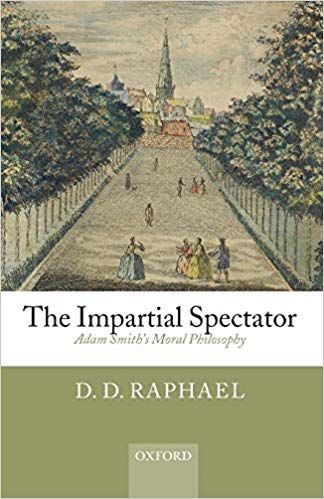
D. D. Raphael provides a critical account of the moral philosophy of Adam Smith, presented in his first book, The Theory of Moral Sentiments. Whilst it does not have the same prominence in its field as his work on economics, The Wealth of Nations, Smith’s writing on ethics is of continuing importance and interest today, especially for its theory of conscience. Smith sees the origin of conscience in the sympathetic and antipathetic feelings of spectators. As spectators of the actions of other people, we can imagine how we would feel in their situation. If we would share their motives, we approve of their action. If not, we disapprove. When we ourselves take an action, we know from experience what spectators would feel, approval or disapproval. That knowledge forms conscience, an imagined impartial spectator who tells us whether an action is right or wrong. In describing the content of moral judgment, Smith is much influenced by Stoic ethics, with an emphasis on self-command, but he voices criticism as well as praise. His own position is a combination of Stoic and Christian values. There is a substantial difference between the first five editions of the Moral Sentiments and the sixth. Failure to take account of this has led some commentators to mistaken views about the supposed youthful idealism of the Moral Sentiments as contrasted with the mature realism of The Wealth of Nations. A further source of error has been the supposition that Smith treats sympathy as the motive of moral action, as contrasted with the supposedly universal motive of self-interest in The Wealth of Nations.
In this book John Kekes examines the indispensable role enjoyment plays in a good life. The key to it is the development of a style of life that combines an attitude and a manner of living and acting that jointly express one’s deepest concerns. Since such styles vary with characters and circumstances, a reasonable understanding of them requires attending to the particular and concrete details of individual lives. Reflection on works of literature is a better guide to this kind of understanding than the futile search for general theories and principles that preoccupies much of contemporary moral thought. Enjoyment proceeds by the detailed examination of particular cases, shows how this kind of reflection can be reasonably conducted, and how the quest for universality and impartiality is misguided in this context. Central to the argument is a practical, particular, pluralistic, and yet objective conception of reason that rejects the pervasive contemporary tendency to regard reasons as good only if they are binding on all who aspire to live reasonably and morally. Reason in morality is neither theoretical nor general. Reasons for living and acting in particular ways are individually variable and none the worse for that. Kekes aims to reorient moral thought from deontological, contractarian, and consequentialist preoccupations toward a reasonable but pluralistic reflection on what individuals can do to make their lives better.
Antirealist views about morality claim that moral facts or truths do not exist. Does this imply that other types of normative facts, such as epistemic facts, do not exist? The Normative Web develops a positive answer to this question. Terence Cuneo argues that moral and epistemic facts are sufficiently similar so that, if moral facts do not exist, then epistemic facts do not exist. But epistemic facts do exist: to deny their existence would commit us to an extreme version of epistemological scepticism. Therefore, Cuneo concludes, moral facts do exist. And if moral facts exist, then moral realism is true. It is sometimes said that moral realists rarely offer arguments for their position, settling instead for mere defenses of a view they find intuitively plausible. By contrast, The Normative Web provides not merely a defense of robust realism in ethics, but a positive argument for this position. In so doing, it engages with a range of antirealist positions in epistemology such as error theories, expressivist views, and reductionist views of epistemic reasons. These positions, Cuneo claims, come at a prohibitively high theoretical cost. Given this cost, it follows that realism about both epistemic and moral facts is a position that we should find highly attractive.
This volume reflects on the effects of recent discoveries in genetics on a broad range of scientific fields. In addition to neuroscience, evolutionary biology, anthropology and medicine, contributors analyze the effects of genetics on theories of health, law, epistemology and philosophy of biology. Social and moral concerns about the relationship between genetics, society and the individual also figure prominently. Genetic discoveries fuel central contemporary public policy debates concerning, for example, human cloning, equitable access to healthcare or the role of genetics in medicine. Perhaps more fundamentally, advances in genetics are altering our perception of human life and death.An interview with François Jacob by Anne Fagot-Largeault opens the volume. In this interview, Jacob, who shared a Nobel Prize with André Lwoff and Jacques Monod for their discoveries concerning genetic control of enzyme and virus synthesis, addresses many of the central methodological epistemological and ethical questions covered in the volume. The dynamic interdisciplinary character of this volume makes it relevant to scholars from many disciplines, from biology, philosophy and the social sciences.
ما از اخلاق چه انتظاری داریم؟ این سوال شاید تاحدودی برای عموم مردم و یا متخصصان این رشته قابل پاسخ باشد؛ اینکه خوب بودن را به ما بیاموزد و در تنظیم روابط فردی م...

جشن کتاب تهران به ایستگاه سی و یکم رسیده است. حال و احوال نشر کتاب خوب نیست و باید فرهنگدوستان را به خرید و هدیه دادن کتاب ترغیب نمود. خانه اخلاقپژوهان جوان ب...

بنیاد کتابهای اخلاق اسلامی عمدتا پالایش جان از آلودگیها و آراستن آن به زیباییها است. اندیشه محوری این قبیل کتابها آن است که انسان فعلی آنی نیست که باید باشد...

-
0 Comments