Notice: تابع WP_Block_Type_Registry::register به طورنادرست فراخوانی شد. نامهای نوع بلوک نباید حروف بزرگ داشته باشند. لطفاً برای اطلاعات بیشتر، اشکال زدایی در وردپرس را مشاهده کنید. (این پیام در نگارش 5.0.0 افزوده شده است.) in /home/ethicsho/public_html/wp-includes/functions.php on line 5313
Warning: Use of undefined constant TDC_PATH_LEGACY - assumed 'TDC_PATH_LEGACY' (this will throw an Error in a future version of PHP) in /home/ethicsho/public_html/wp-content/plugins/td-composer/td-composer.php on line 109
Warning: Use of undefined constant TDSP_THEME_PATH - assumed 'TDSP_THEME_PATH' (this will throw an Error in a future version of PHP) in /home/ethicsho/public_html/wp-content/plugins/td-composer/td-composer.php on line 113 بایگانیهای BJ1012 .C588 1999 - خانه اخلاق پژوهان جوان Notice: Trying to access array offset on value of type bool in /home/ethicsho/public_html/wp-content/plugins/wp-ulike/inc/general-functions.php on line 807
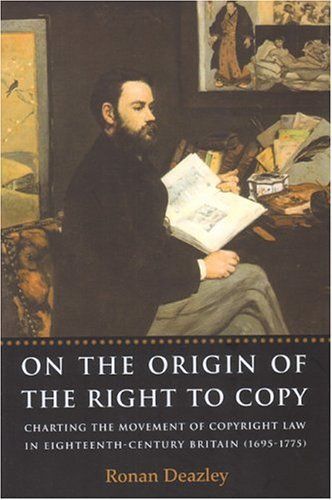
Taking as its point of departure the lapse of the Licensing Act 1662 in 1695, this book examines the lead up to the passage of the Statute of Anne 1709 and charts the movement of copyright law throughout the eighteenth century, culminating in the House of Lords decision in Donaldson v Becket (1774). The established reading of copyright’s development throughout this period, from the 1709 Act to the pronouncement in Donaldson, is that it was transformed from a publisher’s right to an author’s right; that is, legislation initially designed to regulate the marketplace of the bookseller and publisher evolved into an instrument that functioned to recognise the proprietary inevitability of an author’s intellectual labours. The historical narrative which unfolds within this book presents a challenge to that accepted orthodoxy. The traditional analysis of the development of copyright in eighteenth-century Britain is revealed as exhibiting the character of long-standing myth, and the centrality of the modern proprietary author as the raison d’être of the copyright regime is displaced.
This timely reader in moral philosophy addresses a controversy that strongly affected recent European reflections on the relevance of ethics for theories of democratic institutions and democratic legitimacy. The debate centers around the idea of a communicative ethics as articulated by Jurgen Habermas and Karl-Otto Apel, and it is representative both of recent attempts to bridge the gap between Continental and Anglo-American philosophy and of the turn to language that has characterized much of recent philosophy.The Communicative Ethics Controversy illustrates philosophical dialogue in action, moving from theses to counterarguments to rejoinders. Theoretical statements by Habermas, Apel, and two of their leading students, Dietrich Bohler and Robert Alexy, are followed by a series of five arguments by their leading critics, who represent viewpoints ranging from Kantian idealism to Wittgensteinian ordinary-language theory. Fred Dallmayr’s introduction and Seyla Benhabib’s incisive conclusion place the debate in perspective, bringing it up to date and relating it to the Anglo-American context.Seyla Benhabib is Associate Professor of Philosophy and Women’s Studies at the State University of New York, Stony Brook. Fred Dallmayr is Packey Dee Professor of Government at the University of Notre Dame.Contributors: Robert Alexy. Karl-Otto Apel. Seyla Benhabib. Dietrich Bohler. Jurgen Habermas. Otfried Hoffe. KarlHeinz Ilting. Hermann Lubbe. Herbert Schnadelbach. Albrecht Wellmer.
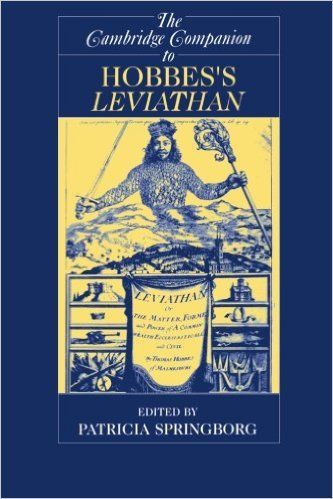
This Companion makes a new departure in Hobbes scholarship, addressing a philosopher whose impact was as great on Continental European theories of state and legal systems as it was at home. This volume is a systematic attempt to incorporate work from both the Anglophone and Continental traditions, bringing together newly commissioned work by scholars from ten different countries in a topic-by-topic sequence of essays that follows the structure of Leviathan, re-examining the relationship among Hobbes’s physics, metaphysics, politics, psychology, and religion. Collectively they showcase important revisionist scholarship that re-examines both the context for Leviathan and its reception, demonstrating the degree to which Hobbes was indebted to the long tradition of European humanist thought. This Cambridge Companion shows that Hobbes’s legacy was never lost and that he belongs to a tradition of reflection on political theory and governance that is still alive, both in Europe and in the diaspora.
(۳)۴z(BThis book is a comprehensive and comprehensible coverage of the philosophical underpinning of the integrity construct as reflected in the Western literature—a must read for researchers and scholars interested in integrity assessments. The authors have integrated insights from several disciplines, and have written in a clear and engaging style. The Czech historical sketch gives an interesting background to these discussions.(3)4y (BProfessor Vish C. Viswesvaran, Florida International University, USA This book discusses outcomes of a study by the National Institute of Mental Health, Czech Republic, examining moral integrity in the post-communist Czech-speaking environment. Chapters map the history of the Euro-Atlantic ethical disciplines from moral philosophy and psychology to evolutionary neuroscience and socio-biology. The authors emphasize the biological and social conditionality of ethics and call for greater differentiation of both research and applied psychological standards in today’s globalised world. Using a non-European ethical system – Theravada Buddhism – as a case study, the authors explore the differences in English and Czech interpretations of the religion. They analyse cognitive styles and language as central variables in formatting and interpreting moral values, with important consequences for cultural transferability of psychological instruments. This book will appeal to academics and other specialists in psychology, psychiatry, sociology and related fields, as well as to readers interested in the psychology of ethics. .
ما از اخلاق چه انتظاری داریم؟ این سوال شاید تاحدودی برای عموم مردم و یا متخصصان این رشته قابل پاسخ باشد؛ اینکه خوب بودن را به ما بیاموزد و در تنظیم روابط فردی م...

جشن کتاب تهران به ایستگاه سی و یکم رسیده است. حال و احوال نشر کتاب خوب نیست و باید فرهنگدوستان را به خرید و هدیه دادن کتاب ترغیب نمود. خانه اخلاقپژوهان جوان ب...

بنیاد کتابهای اخلاق اسلامی عمدتا پالایش جان از آلودگیها و آراستن آن به زیباییها است. اندیشه محوری این قبیل کتابها آن است که انسان فعلی آنی نیست که باید باشد...

-
0 Comments