Notice: تابع WP_Block_Type_Registry::register به طورنادرست فراخوانی شد. نامهای نوع بلوک نباید حروف بزرگ داشته باشند. لطفاً برای اطلاعات بیشتر، اشکال زدایی در وردپرس را مشاهده کنید. (این پیام در نگارش 5.0.0 افزوده شده است.) in /home/ethicsho/public_html/wp-includes/functions.php on line 5313
Warning: Use of undefined constant TDC_PATH_LEGACY - assumed 'TDC_PATH_LEGACY' (this will throw an Error in a future version of PHP) in /home/ethicsho/public_html/wp-content/plugins/td-composer/td-composer.php on line 109
Warning: Use of undefined constant TDSP_THEME_PATH - assumed 'TDSP_THEME_PATH' (this will throw an Error in a future version of PHP) in /home/ethicsho/public_html/wp-content/plugins/td-composer/td-composer.php on line 113 بایگانیهای B72 .W365 2011 - خانه اخلاق پژوهان جوان Notice: Trying to access array offset on value of type bool in /home/ethicsho/public_html/wp-content/plugins/wp-ulike/inc/general-functions.php on line 807
Evil has long fascinated psychologists, philosophers, novelists and playwrights but remains an incredibly difficult concept to talk about. On Evilis a compelling and at times disturbing tour of the many faces of evil. What is evil, and what makes people do awful things? If we can explain evil, do we explain it away? Can we imagine the mind of a serial killer, or does such evil defy description? Does evil depend on a contrast with good, as religion tells us, or can there be evil for evil’s sake? Adam Morton argues that any account of evil must help us understand three things: why evil occurs; why evil often arises out of banal or everyday situations; and how wecan be seen as evil. Drawing on fascinating examples as diverse as Augustine, Buffy the Vampire Slayer, psychological studies of deviant behaviour and profiles of serial killers, Adam Morton argues that evil occurs when internal, mental barriers against it simply break down. He also introduces us to some nightmare people, such as Adolf Eichmann and Hannibal Lecter, reminding us that understanding their actions as humans brings us closer to understanding evil. Exciting and thought-provoking, On Evilis essential reading for anyone interested in a topic that attracts and repels us in equal measure.
From world-renowned psychologist and bestselling author of The Soul’s Code, a profound examination of the roots of man’s primal love/hate relationship with war. War is a timeless force in the human imagination-and, indeed, in daily life. If recent events have taught us anything, it is that peacetime is not nearly so constant and attainable as wartime. During the 5,600 years of recorded history, 14,600 wars have been fought-2 to 3 for every year of human history. War is a constant thing. And yet no one really understands why that is. In A Terrible Love of War, James Hillman, one of the central figures in psychology in the twentieth and twenty-first centuries, fills this great void and undertakes a groundbreaking examination of the origins, needs, and rewards of war. Moreover, in this brilliant inquiry, Hillman explores many other essential questions, such as: Is war a necessary part of our human soul and, therefore, a necessary part of our lives? Why do we need enemies? What scars does warfare carve on the psyche of its soldiers? And why does it have such a permanent effect? If war is such a “normal” part of our existence, why do we fear it so much? And alternately, how could we ever embrace a force so destructive, so wanton, and so inhuman? Can the impulse to engage in war be tamed? Hillman asserts that “if we want war’s horror to be abated so that life may go on, it is necessary to understand and imagine.” A Terrible Love of Waris a crucial tool to understanding war-a crucial book for us all.
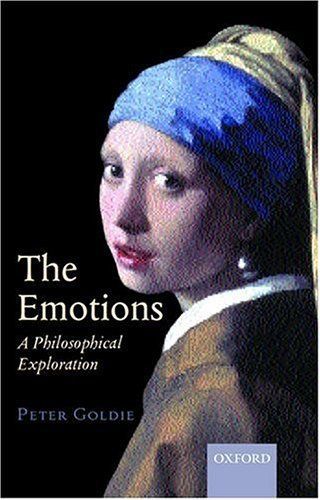
Peter Goldie opens the path to a deeper understanding of our emotional lives through a lucid philosophical exploration of this surprisingly neglected topic. He illuminates the phenomena of emotion by drawing not only on philosophy but also on literature and science. He considers the roles of culture and evolution in the development of our emotional capabilities. He examines the links between emotion, mood, and character, and places the emotions in the context of such related phenomena as consciousness, thought, feeling, and imagination. He explains how it is that we are able to make sense of our own and other people’s emotions, and how we can explain the very human things which emotions lead us to do. A key theme of The Emotions is the idea of a personal perspective or point of view, contrasted with the impersonal stance of the empirical sciences. Goldie argues that it is only from the personal point of view that thoughts, reasons, feelings, and actions come into view. He suggests that there is a tendency for philosophers to over-intellectualize the emotions, and investigates how far it is possible to explain emotions in terms of rationality. Over-intellectualizing can also involve neglecting the centrality of feelings, and Goldie shows how to put them where they belong, as part of the intentionality of emotional experience, directed towards the world from a point of view. Goldie argues that the various elements of emotional experience—including thought, feeling, bodily change, and expression—are tied together in a narrative structure. To make sense of one’s emotional life one has to see it as part of a larger unfolding narrative. The narrative is not simply an interpretative framework of a life: it is what that life is. Goldie concludes by applying these ideas in a close study of one particular emotion: jealousy. This fascinating book gives an accessible but penetrating exploration of a subject that is important but mysterious to all of us. Any reader interested in emotion, and its role in our understanding of our lives, will find much to think about here.
This book responds to the Bush Administration position on the “war on terror.” It examines preemption within the context of “just war”; justification for the United States-led invasion of Iraq, with some authors charging that its tactics serve to increase terror; global terrorism; and concepts such as reconciliation, Islamic identity, nationalism, and intervention.
This book is a systematic and constructive treatment of a number of traditional issues at the foundations of ethics. These issues concern the objectivity of ethics, the possibility and nature of moral knowledge, the relationship between the moral point of view and a scientific or naturalist world-view, the nature of moral value and obligation, and the role of morality in a person’s rational lifeplan. In striking contrast to traditional and more recent work in the field, David Brink offers an integrated defense of the objectivity of ethics.
ما از اخلاق چه انتظاری داریم؟ این سوال شاید تاحدودی برای عموم مردم و یا متخصصان این رشته قابل پاسخ باشد؛ اینکه خوب بودن را به ما بیاموزد و در تنظیم روابط فردی م...

جشن کتاب تهران به ایستگاه سی و یکم رسیده است. حال و احوال نشر کتاب خوب نیست و باید فرهنگدوستان را به خرید و هدیه دادن کتاب ترغیب نمود. خانه اخلاقپژوهان جوان ب...

بنیاد کتابهای اخلاق اسلامی عمدتا پالایش جان از آلودگیها و آراستن آن به زیباییها است. اندیشه محوری این قبیل کتابها آن است که انسان فعلی آنی نیست که باید باشد...

-
0 Comments