Notice: تابع WP_Block_Type_Registry::register به طورنادرست فراخوانی شد. نامهای نوع بلوک نباید حروف بزرگ داشته باشند. لطفاً برای اطلاعات بیشتر، اشکال زدایی در وردپرس را مشاهده کنید. (این پیام در نگارش 5.0.0 افزوده شده است.) in /home/ethicsho/public_html/wp-includes/functions.php on line 5313
Warning: Use of undefined constant TDC_PATH_LEGACY - assumed 'TDC_PATH_LEGACY' (this will throw an Error in a future version of PHP) in /home/ethicsho/public_html/wp-content/plugins/td-composer/td-composer.php on line 109
Warning: Use of undefined constant TDSP_THEME_PATH - assumed 'TDSP_THEME_PATH' (this will throw an Error in a future version of PHP) in /home/ethicsho/public_html/wp-content/plugins/td-composer/td-composer.php on line 113 بایگانیهای 9781853028151 - خانه اخلاق پژوهان جوان Notice: Trying to access array offset on value of type bool in /home/ethicsho/public_html/wp-content/plugins/wp-ulike/inc/general-functions.php on line 807
Here is the concluding volume of Sir Anthony Kenny’s monumental four-volume history of philosophy, the first major single-author narrative history to appear for several decades. In this volume, Kenny tells the fascinating story of the development of philosophy in the modern world, from the early nineteenth century to the end of the millennium. Alongside (and intertwined with) extraordinary scientific advances, cultural changes, and political upheavals, the last two centuries have seen some of the most intriguing and original developments in philosophical thinking, which have transformed our understanding of ourselves and our world. In the first part of the book, Kenny offers a lively narrative introducing the major thinkers in their historical context. Among those we meet are the great figures of continental European philosophy, from Schopenhauer, Kierkegaard, and Nietzsche to Heidegger, Sartre, and Derrida; the Pragmatists such as C.S. Pierce and William James, who first developed a distinctively American philosophical tradition; Marx, Darwin, and Freud, the non-philosophers whose influence on philosophy was immense; and Wittgenstein and Russell, friends and colleagues who set the agenda for analytic philosophy in the twentieth century. Kenny then proceeds to guide the reader lucidly through the nine main areas of philosophical work in the period, offering a serious engagement with ideas and arguments about logic, language, epistemology, metaphysics, ethics, aesthetics, politics, and the existence of God. Graced with many beautiful illustrations, Philosophy in the Modern World concludes Kenny’s stimulating history of the intellectual development of Western civilization, allowing readers to trace the birth and growth of philosophy from antiquity to the present day.
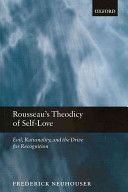
This book is the first comprehensive study of Rousseau’s rich and complex theory of the type of self-love (amour propre ) that, for him, marks the central difference between humans and the beasts. Amour propre is the passion that drives human individuals to seek the esteem, approval, admiration, or love–the recognition –of their fellow beings. Neuhouser reconstructs Rousseau’s understanding of what the drive for recognition is, why it is so problematic, and how its presence opens up far-reaching developmental possibilities for creatures that possess it. One of Rousseau’s central theses is that amour propre in its corrupted, manifestations–pride or vanity–is the principal source of an array of evils so widespread that they can easily appear to be necessary features of the human condition: enslavement, conflict, vice, misery, and self-estrangement. Yet Rousseau also argues that solving these problems depends not on suppressing or overcoming the drive for recognition but on cultivating it so that it contributes positively to the achievement of freedom, peace, virtue, happiness, and unalienated selfhood. Indeed, Rousseau goes so far as to claim that, despite its many dangers, the need for recognition is a condition of nearly everything that makes human life valuable and that elevates it above mere animal existence: rationality, morality, freedom–subjectivity itself–would be impossible for humans if it were not for amour propre and the relations to others it impels us to establish.
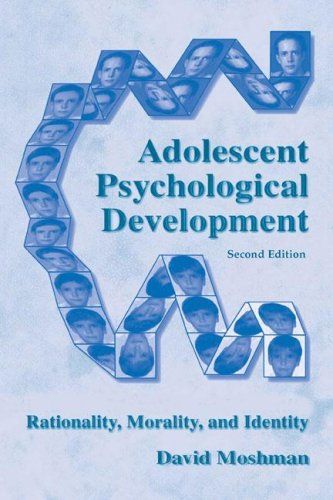
The huge and fractured literature on adolescence challenges both students and scholars. For students there is too much to learn and too little coherence across topics to enable deeper understanding. For scholars, there are few integrative visions to connect minitheories, research programs, and practical concerns. In the first edition of this advanced text, Moshman provided a constructivist synthesis of the literatures of cognitive, moral, and identity development, from the classic universalist theories of Piaget, Kohlberg, and Erikson through the more pluralist research and theorizing of the late 20th century. Without assuming any prior knowledge of psychology, he introduced and coordinated basic concepts to enable students to wrestle with the questions of concern to experts and help experts see those concerns from a larger perspective. In this thoroughly updated second edition, Moshman develops his conceptualization of advanced psychological development in adolescence and early adulthood and proposes–in a new chapter–a conception of rational moral identity as a developmental ideal. Unlike the prototypical changes of early childhood, advanced psychological development cannot be understood as progress through universal stages to a universally achieved state of maturity. Progress is possible, however, through rational processes of reflection, coordination, and social interaction.
ما از اخلاق چه انتظاری داریم؟ این سوال شاید تاحدودی برای عموم مردم و یا متخصصان این رشته قابل پاسخ باشد؛ اینکه خوب بودن را به ما بیاموزد و در تنظیم روابط فردی م...

جشن کتاب تهران به ایستگاه سی و یکم رسیده است. حال و احوال نشر کتاب خوب نیست و باید فرهنگدوستان را به خرید و هدیه دادن کتاب ترغیب نمود. خانه اخلاقپژوهان جوان ب...

بنیاد کتابهای اخلاق اسلامی عمدتا پالایش جان از آلودگیها و آراستن آن به زیباییها است. اندیشه محوری این قبیل کتابها آن است که انسان فعلی آنی نیست که باید باشد...

-
0 Comments