Notice: تابع WP_Block_Type_Registry::register به طورنادرست فراخوانی شد. نامهای نوع بلوک نباید حروف بزرگ داشته باشند. لطفاً برای اطلاعات بیشتر، اشکال زدایی در وردپرس را مشاهده کنید. (این پیام در نگارش 5.0.0 افزوده شده است.) in /home/ethicsho/public_html/wp-includes/functions.php on line 5313
Warning: Use of undefined constant TDC_PATH_LEGACY - assumed 'TDC_PATH_LEGACY' (this will throw an Error in a future version of PHP) in /home/ethicsho/public_html/wp-content/plugins/td-composer/td-composer.php on line 109
Warning: Use of undefined constant TDSP_THEME_PATH - assumed 'TDSP_THEME_PATH' (this will throw an Error in a future version of PHP) in /home/ethicsho/public_html/wp-content/plugins/td-composer/td-composer.php on line 113 بایگانیهای 9781402043130 - خانه اخلاق پژوهان جوان Notice: Trying to access array offset on value of type bool in /home/ethicsho/public_html/wp-content/plugins/wp-ulike/inc/general-functions.php on line 807
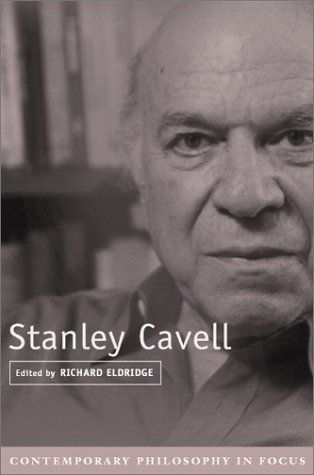
Stanley Cavell has been one of the most creative and independent of contemporary philosophical voices. At the core of his thought is the view that skepticism is not a theoretical position to be refuted by philosophical theory but is a reflection of the fundamental limits of human knowledge of the self, of others and of the external world that must be accepted. This volume is the first attempt systematically and accessibly to describe and assess the full range of Cavell’s work. There are new accounts of Cavell’s contribution to the philosophy of mind and language, the theory of action, ethics, aesthetics, Romanticism, American philosophy. Richard Eldridge is Professor of Philosophy and Chair of the Philsophy Department at Swarthmore College. He is author of The Persistence of Romanticism (Cambridge, 2001), On Moral Personhood: Philosophy, Literature, Criticism, and Self-Understanding (Chicago, 1989) and Leading a Human Life: Wittengenstein, Intentionality, and Romanticism (Chicago, 1997), which won the 1998 Jean-Pierre Barricelli Book Prize awarded by the American Conference on Romanticism. He is the editor of Beyond Representation: Philosophy and Poetic Imagination (Cambridge, 1996).
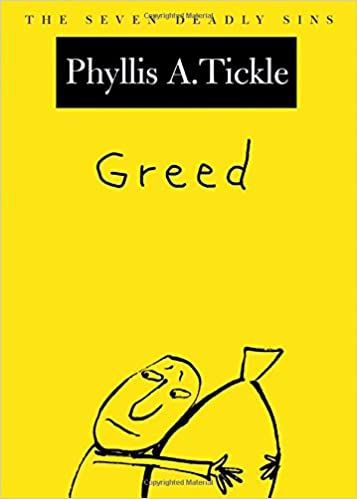
Grasping. Avarice. Covetousness. Miserliness. Insatiable cupidity. Overreaching ambition. Desire spun out of control. The deadly sin of Greed goes by many names, appears in many guises, and wreaks havoc on individuals and nations alike. In this lively and generous book, Phyllis A. Tickle argues that Greed is “the Matriarch of the Deadly Clan,” the ultimate source of Pride, Envy, Sloth, Gluttony, Lust, and Anger. She shows that the major faiths, from Hinduism and Taoism to Buddhism and Christianity regard Greed as the greatest calamity humans can indulge in, engendering further sins and eviscerating all virtues. As the Sikh holy book Adi Granth asks: “Where there is greed, what love can there be?” Tickle takes a long view of Greed, from St. Paul to the present, focusing particularly on changing imaginative representations of Greed in Western literature and art. Looking at such works as the Psychomachia, or “Soul Battle” of the fifth-century poet Aurelius Clemens Prudentius, the paintings of Peter Bruegel and Hieronymous Bosch, the 1987 film Wall Street, and the contemporary Italian artist Mario Donizetti, Tickle shows how our perceptions have evolved from the medieval understanding of Greed as a spiritual enemy to a nineteenth-century sociological construct to an early twentieth-century psychological deficiency, and finally to a new view, powerfully articulated in Donizetti’s mystical paintings, of Greed as both tragic and beautiful. Engaging, witty, brilliantly insightful, Greed explores the full range of this deadly sin’s subtle, chameleon-like qualities, and the enormous destructive power it wields, evidenced all too clearly in the world today.
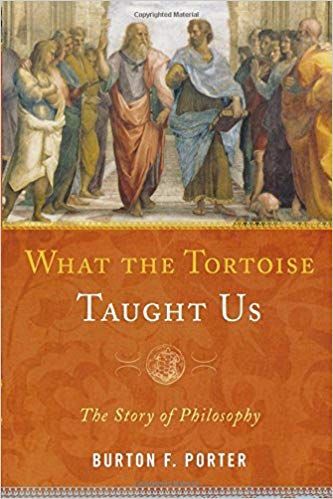
What the Tortoise Taught Us offers a lively, concise journey through Western philosophy that explores the lives of major philosophers, their ideas, and how their thinking continues to influence our lives today. Using a chronological approach, Burton F. Porter shows how various philosophers address life’s big questions. By putting each philosopher and their ideas into historical context, he helps us understand how certain ideas developed based on the thinking of the time and how those ideas have influenced our modern perspectives.Using familiar language and interesting anecdotes, Porter provides an extremely readable and lively history that takes themes that characterize each age to reflect on the greater human experience. The book includes the philosophies and lives of the ancient philosophers such as Socrates, Plato, and Aristotle and continues through time into the Middle Ages with St. Thomas Aquinas to the Renaissance and beyond. Porter explores the metaphysics of Descartes and Hobbes, the epistemology of Hume and Berkeley, and the ethics of Kant and Mill among others. Finally he concludes with contemporary issues, including racism, abortion, and modern feminism.
ما از اخلاق چه انتظاری داریم؟ این سوال شاید تاحدودی برای عموم مردم و یا متخصصان این رشته قابل پاسخ باشد؛ اینکه خوب بودن را به ما بیاموزد و در تنظیم روابط فردی م...

جشن کتاب تهران به ایستگاه سی و یکم رسیده است. حال و احوال نشر کتاب خوب نیست و باید فرهنگدوستان را به خرید و هدیه دادن کتاب ترغیب نمود. خانه اخلاقپژوهان جوان ب...

بنیاد کتابهای اخلاق اسلامی عمدتا پالایش جان از آلودگیها و آراستن آن به زیباییها است. اندیشه محوری این قبیل کتابها آن است که انسان فعلی آنی نیست که باید باشد...

-
0 Comments