Notice: تابع WP_Block_Type_Registry::register به طورنادرست فراخوانی شد. نامهای نوع بلوک نباید حروف بزرگ داشته باشند. لطفاً برای اطلاعات بیشتر، اشکال زدایی در وردپرس را مشاهده کنید. (این پیام در نگارش 5.0.0 افزوده شده است.) in /home/ethicsho/public_html/wp-includes/functions.php on line 5313
Warning: Use of undefined constant TDC_PATH_LEGACY - assumed 'TDC_PATH_LEGACY' (this will throw an Error in a future version of PHP) in /home/ethicsho/public_html/wp-content/plugins/td-composer/td-composer.php on line 109
Warning: Use of undefined constant TDSP_THEME_PATH - assumed 'TDSP_THEME_PATH' (this will throw an Error in a future version of PHP) in /home/ethicsho/public_html/wp-content/plugins/td-composer/td-composer.php on line 113 بایگانیهای 9780765706676 - خانه اخلاق پژوهان جوان Notice: Trying to access array offset on value of type bool in /home/ethicsho/public_html/wp-content/plugins/wp-ulike/inc/general-functions.php on line 807
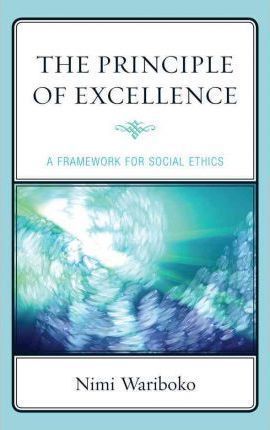
In The Principle of Excellence, Nimi Wariboko deconstructs the traditional, depoliticized meaning of virtue, providing a thorough reading of the debates, conceptual struggles, and ambiguities used by virtue ethicists to produce today’s conception of excellence. He presents a new meaning of excellence, explaining the ways communities can use excellence as the organizing principle for their political and economic development, and exploring how large-scale modern societies can be better administered in environments characterized by contingency and possibilities.
The Ethics of Aesthetics in Japanese Cinema and Literatureis a study of the ethics of modern Japanese aesthetics from the 1930s, through WWII and into the postwar period. What makes this book unique is that Nina Cornyetz opens up the field in new and controversial ways by exploring the tensions and harmonies between psychoanalytic ethics of the drive and socio-political ethics of relation to the other. Rejecting the convention of viewing these as contradictory, Cornyetz insists that the exemplars of psychoanalytic ethics are to the contrary, simultaneously politically ethical. Cornyetz embarks on innovative and unprecedented readings of some of the most significant literary and film texts of the Japanese canon, including works by Kawabata Yasunari, Mishima Yukio, Abe Kôbô and Shinoda Masahiro, all renowned for their texts’ aesthetic and philosophic brilliance. The study looks at how relations between individuals and communities in these texts either reiterate or transcend stereotypes, andhow desire is or is not limited by sociocultural norms. Cornyetz argues that these authors’ and filmmakers’ concepts of beauty and relation to others were, in fact, deeply impacted by political and social factors. Ranging from a discussion of fascist aesthetics to heterosexism in modern Japan,The Ethics of Aesthetics in Japanese Cinema and Literatureshows how certain changing political, intellectual and artistic issues, as well as sociocultural norms, variously nuanced these texts’ depictions of desire and the ‘other’. Through her analysis of cultural texts such as the filmsWoman in the DunesandDouble Suicide, Cornyetz challenges the convention that praises the universality of their artistic, existential or intellectual achievements. Rather she seeks to reorient these within a specifically Japanese historical context to give a new and insightful interpretation to the work. This ground breaking study is truly interdisciplinary and will appeal to students and scholars of Japaneseliterature, film, gender, culture, history and even psychoanalytic theory.
Introduction.Part I: Philosophy of Language.1. On Sense and Reference. (Gottlob Frege).2. Thought. (Gottlob Frege).3. On Denoting. (Bertrand Russell).4. On Referring. (P. F. Strawson).5. Meaning. (H. P. Grice).6. Truth and Meaning. (Donald Davidson).7. Identity and Necessity. (Saul Kripke).8. Meaning and Reference. (Hilary Putnam).Further Reading in Philosophy of Language.Part II: Metaphysics.9. On the Relations of Universals and Particulars. (Bertrand Russell).10. From the Tractatus Logico-Philosophicus. (Ludwig Wittgenstein).11. Particular and General. (P. F. Strawson).12. On What There Is. (W. V. Quine).13. The Identity of Indiscernibles. (Max Black).Further Reading in Metaphysics.Part III: Epistemology.14. Four Forms of Skepticism. (G. E. Moore).15. From On Certainty. (Ludwig Wittgenstein).16. Knowledge by Acquaintance and Knowledge by Description. (Bertrand Russell).17. The Problem of the Criterion. (Roderick Chisholm).18. Is Knowledge Justified True Belief? (Edmund Gettier).19. Aspects of Scientific Explanation. (Carl Hempel).20. The New Riddle of Induction. (Nelson Goodman).21. Epistemology Naturalized. (W. V. Quine).Further Reading in Epistemology.Part IV: Philosophy of Mind.22. The Nature of Mind. (David Armstrong).23. The Nature of Mental States. (Hilary Putnam).24. Mental Events. (Donald Davidson).25. What is it Like to Be a Bat? (Thomas Nagel).26. Mad Pain and Martian Pain. (David Lewis).27. Can Computers Think? (John Searle).Further Reading in Philosophy of Mind.Part V: Freedom and Personal Identity.28. The Conceivability of Mechanism. (Norman Malcolm).29. Freedom and Resentment. (P. F. Strawson).30. Human Freedom and the Self. (Roderick Chisholm).31. The Self and the Future. (Bernard Williams).32. Action, Reasons, and Causes. (Donald Davidson).Further Reading in Freedom and Personal Identity.Part VI: Ethics.33. The Subject Matter of Ethics. (G. E. Moore).34. The Emotive Meaning of Ethical Terms. (C. L. Stevenson).35. Justice as Fairness. (John Rawls).36. Modern Moral Philosophy. (G. E. M. Anscombe).37. Morality as a System of Hypothetical Imperatives. (Philippa Foot).Further Reading in Ethics.Part VII: Methodology.38. The Notion of Analysis in Moore’s Philosophy. (C. H. Langford).39. Reply to Langford. (G. E. Moore).40. The Elimination of Metaphysics. (A. J. Ayer).41. Empiricism, Semantics, and Ontology. (Rudolf Carnap).42. A Plea for Excuses. (J. L. Austin).43. Two Dogmas of Empiricism. (W. V. Quine).44. In Defense of a Dogma. (H. P. Grice and P. F. Strawson.45. Philosophy and the Scientific Image of Man. (Wilfrid Sellars).46. From The Blue and the Brown Books. (Ludwig Wittgenstein).Further Reading in Methodology.Index.
Copyright, Contracts, Creators presents an exhaustive and thoroughly researched and documented treatment of copyright protection for independent authors, or freelancers. AALL Spectrum This hardback publication is an interesting exposition on the application of copyright law to the protection of the rights of freelancers. . . Within this subject the book is thoroughly and professionally written and easy to read. It would actually serve as a good introduction to the application of copyright law to literary works as it contains some useful summaries of current law particularly in the UK and the United States. . . If you are interested in copyright law as it applies to author such as freelancers, or just generally want to learn more about the exploitation of copyright works in the digital age I thoroughly recommend this book. Clive Davies, Communications Law . . . deserves the widest possible circulation. . . . much of what [D Agostino] outlines and the solutions she suggests should be read by every freelancer, agency, editor and publishers. . . . D Agostino s writing is quite sprightly and she resists the temptation to be mealy-mouthed and obscure about the issues. D.B. Scott, canadianmags.blogspot.com Copyright, Contracts, Creators provides a new and original analysis on the relationship between owners and creators and recommendations for legislative change to re-balance the relationship. It is a must read for the intellectual property legal community and anyone interested in the promotion of creative works. Marshall Rothstein, Justice of the Supreme Court of Canada Dr Giuseppina D Agostino is a protector of the arts, and her work on intellectual property is designed not only to bring law and order to our digital universe but to bring hope to the artists, poets and writers whose only hope of pursuing their artistry is to earn income for their craft. A wonderful book by one of the most wonderful and forward thinking minds in this subject area. Tony Chapman, Founder and CEO, Capital C, Canada Dr D Agostino has produced an important, carefully documented and courageous study that deserves to be widely read and discussed and (dare one say?) even to have its message heeded. David Vaver, Emeritus Professor of Intellectual Property & IT Law, University of Oxford, UK The digital world has put content within arm s reach of desire. No longer can an author be satisfied that her intellectual property is safely encased in a bound book, nor can a photographer know where his work will be displayed or shared, nor can a writer rest assured that her article will be consumed in the intended magazine or newspaper. The Internet-fueled recycling of existing works into new media is the greatest challenge to copyright law. Copyright, Contracts, Creators evaluates the efficacy of current copyright law to address the contracting and use of creative works. It looks in particular at freelance works and argues that their copyright treatment on a national and international level is inadequate to resolve ambiguities in the contracting and uses of the work. Giuseppina D Agostino discusses how historically laws and courts were more sympathetic to creators, and how the Internet revolution has shifted the scales to favor owners. Consequently, creators often find themselves at opposing ends with copyright owners, and in a disproportionately weaker bargaining position that places tremendous strain on their livelihoods. She argues that this predicament puts society at risk of losing its most valued asset: professional creators. The author calls for a new framework to justify legislative provisions and resolve ambiguities while suggesting principles and mechanisms to address the inadequate treatment of freelance work. Scholars and students of law, cultural studies, and intellectual property will find this volume a critical addition to their libraries. Beyond these, policymakers, lawyers and anyone concerned with the blurring lines of intellectual prope
This work is an investigation of the ongoing methodical reconstruction of Catholic moral theology. As such it is based on and honors the work of Norbert Rigali, S.J., one of the most important contributors to this reconstruction.The decisive break from the traditional manual approach to moral theology represented by Vatican II reoriented moral theology away from universal natural law morality based on the commandments to a morality based on specifically Christian sources. This reorientation, however, was not an either/or but a both/and proposition. Father Norbert Rigali, S.J. has been an inspiration and a challenge to moral theologians working toward reconstruction. This essays in this collection address four questions in the renewal movement: an investigation of normative methods, a clarification of sources, an investigation of the tension between natural law morality and Christian ethics and/or morality, and a combination of methodical insights of philosophy and traditional Christian sources in their investigation of biomedical ethical issues.
ما از اخلاق چه انتظاری داریم؟ این سوال شاید تاحدودی برای عموم مردم و یا متخصصان این رشته قابل پاسخ باشد؛ اینکه خوب بودن را به ما بیاموزد و در تنظیم روابط فردی م...

جشن کتاب تهران به ایستگاه سی و یکم رسیده است. حال و احوال نشر کتاب خوب نیست و باید فرهنگدوستان را به خرید و هدیه دادن کتاب ترغیب نمود. خانه اخلاقپژوهان جوان ب...

بنیاد کتابهای اخلاق اسلامی عمدتا پالایش جان از آلودگیها و آراستن آن به زیباییها است. اندیشه محوری این قبیل کتابها آن است که انسان فعلی آنی نیست که باید باشد...

-
0 Comments