Notice: تابع WP_Block_Type_Registry::register به طورنادرست فراخوانی شد. نامهای نوع بلوک نباید حروف بزرگ داشته باشند. لطفاً برای اطلاعات بیشتر، اشکال زدایی در وردپرس را مشاهده کنید. (این پیام در نگارش 5.0.0 افزوده شده است.) in /home/ethicsho/public_html/wp-includes/functions.php on line 5313
Warning: Use of undefined constant TDC_PATH_LEGACY - assumed 'TDC_PATH_LEGACY' (this will throw an Error in a future version of PHP) in /home/ethicsho/public_html/wp-content/plugins/td-composer/td-composer.php on line 109
Warning: Use of undefined constant TDSP_THEME_PATH - assumed 'TDSP_THEME_PATH' (this will throw an Error in a future version of PHP) in /home/ethicsho/public_html/wp-content/plugins/td-composer/td-composer.php on line 113 بایگانیهای 9780691134109 - خانه اخلاق پژوهان جوان Notice: Trying to access array offset on value of type bool in /home/ethicsho/public_html/wp-content/plugins/wp-ulike/inc/general-functions.php on line 807
In the Fall of 1930 Will Durant found himself outside his home in Lake Hill, New York, raking leaves. He was approached by a well-dressed man who told him in a quiet tone that he was going to kill himself unless the philosopher could give him a valid reason not to. Not having the time to wax philosophic on the matter, Durant did his best to furnish the man with reasons to continue his existence. Haunted by the encounter with the despondent stranger, Durant contacted 100 luminaries in the arts, politics, religion and sciences, challenging them to respond not only to the fundamental question of life’s meaning (in the abstract) but also to relate how they each (in the particular) found meaning, purpose and fulfillment in their own lives. Durant turned their answers and his own into a book entitled “On The Meaning Of Life,” which was released to the general public in 1932. Unpromoted, the litte treasure found its way into few hands, and almost no copies of the book exist today. Now available for a new generation through Promethean Press, “On The Meaning Of Life” is a powerful book on a very powerful topic. In this book Will Durant has fashioned an unprecedented “dream team” of luminaries that is both profound and diverse: poets, philosophers, saints, inmates, athletes, Nobel Prize winners, college professors, psychologists, entertainers, musicians, authors and leaders. Within their varied insights, despite their uniqueness as individuals and the very different lives they led, the reader will note a consistent thread running through their viewpoints, revealing a commonality among human beings who not only seek meaning in life, but who actually achieve it.
Philips defends a middle ground between the view that there is a set of standards binding on rational beings as such (universalism) and the view that differences in morals reduce ultimately to matters of taste (skepticism). He begins with a sustained critique of universalist moral theories and of certain familiar approaches to concrete moral questions that presuppose them (most appeals to intuitions, respect-for-persons moralities, and versions of contractarianism and wide reflective equilibrium). He goes on to criticize major recent attempts to develop nonuniversalist alternatives to skepticism, arguing that they rely on excessively abstract and philosophically indefensible preference satisfaction theories of the good. According to Philips’s positive alternative, ethics as social artifact, moral codes are social instruments and they are justified to the extent that they effectively do their jobs, which is to promote reasonably valued ways of life. Accordingly, he argues that different standards may be justified for different societies, depending on their circumstances, traditions, and current institutions. His account of a reasonably valued way of life depends on a “falsifiability” approach to reasonable values according to which existing values are treated as reasonable unless good arguments can be made against them. He describes many strategies for making such arguments, the upshot being an approach to the justification of moral standards that is sufficiently “grounded” to settle many controversies and to mark off areas in which rational persons are free to disagree. It also explains why the weight of a moral consideration may vary reasonably from one “domain” of social life toanother. An original approach to the uses and limits of reason in ethics, Between Universalism and Skepticism provides a theoretical basis for approaching actual moral controversies and questions of applied and professional ethics in a systematic way.
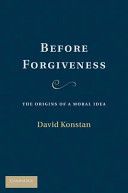
“In this book, David Konstan argues that the modern concept of interpersonal forgiveness, in the full sense of the term, did not exist in ancient Greece and Rome. Even more startlingly, it is not fully present in the Hebrew Bible, nor again in the New Testament, or in the early Jewish and Christian commentaries on the Holy Scriptures. It would still be centuries– many centuries– before the idea of interpersonal forgiveness, with its accompanying ideas of apology, remorse, and a change of heart on thepart of the wrongdoer, would emerge. For all its vast importance today in religion, law, politics, and psychotherapy, interpersonal forgiveness is creation of the 18th and 19th centuries, when the Christian concept of divine forgiveness was finally secularized. Forgiveness was God’s province, and it took a revolution in thought to bring it to earth and make it a human trait”–
ما از اخلاق چه انتظاری داریم؟ این سوال شاید تاحدودی برای عموم مردم و یا متخصصان این رشته قابل پاسخ باشد؛ اینکه خوب بودن را به ما بیاموزد و در تنظیم روابط فردی م...

جشن کتاب تهران به ایستگاه سی و یکم رسیده است. حال و احوال نشر کتاب خوب نیست و باید فرهنگدوستان را به خرید و هدیه دادن کتاب ترغیب نمود. خانه اخلاقپژوهان جوان ب...

بنیاد کتابهای اخلاق اسلامی عمدتا پالایش جان از آلودگیها و آراستن آن به زیباییها است. اندیشه محوری این قبیل کتابها آن است که انسان فعلی آنی نیست که باید باشد...

-
0 Comments