Notice: تابع WP_Block_Type_Registry::register به طورنادرست فراخوانی شد. نامهای نوع بلوک نباید حروف بزرگ داشته باشند. لطفاً برای اطلاعات بیشتر، اشکال زدایی در وردپرس را مشاهده کنید. (این پیام در نگارش 5.0.0 افزوده شده است.) in /home/ethicsho/public_html/wp-includes/functions.php on line 5313
Warning: Use of undefined constant TDC_PATH_LEGACY - assumed 'TDC_PATH_LEGACY' (this will throw an Error in a future version of PHP) in /home/ethicsho/public_html/wp-content/plugins/td-composer/td-composer.php on line 109
Warning: Use of undefined constant TDSP_THEME_PATH - assumed 'TDSP_THEME_PATH' (this will throw an Error in a future version of PHP) in /home/ethicsho/public_html/wp-content/plugins/td-composer/td-composer.php on line 113 بایگانیهای 9780521833011 - خانه اخلاق پژوهان جوان Notice: Trying to access array offset on value of type bool in /home/ethicsho/public_html/wp-content/plugins/wp-ulike/inc/general-functions.php on line 807
Whether it’s in a cockpit at takeoff or the planning of an offensive war, a romantic relationship or a dispute at the office, there are many opportunities to lie and self-deceive?but deceit and self-deception carry the costs of being alienated from reality and can lead to disaster. So why does deception play such a prominent role in our everyday lives? In short, why do we deceive? In his bold new work, prominent biological theorist Robert Trivers unflinchingly argues that self-deception evolved in the service of deceit?the better to fool others. We do it for biological reasons?in order to help us survive and procreate. From viruses mimicking host behavior to humans misremembering (sometimes intentionally) the details of a quarrel, science has proven that the deceptive one can always outwit the masses. But we undertake this deception at our own peril. Trivers has written an ambitious investigation into the evolutionary logic of lying and the costs of leaving it unchecked.
What is a stem cell? We have a basic working definition, but the way we observe a stem cell function in a dish may not represent how it functions in a living organism. Only this is clear: Stem cells are the engine room of multicelluar organisms-both plants and animals. However, controversies, breakthroughs, and frustration continue to swirl in eternal storms through this rapidly moving area of research. But what does the average person make of all this, and how can an interested scholar probe this vast sea of information?The Encyclopedia of Stem Cell Research provides a clear understanding of the basic concepts in stem cell biology and addresses the politics, ethics, and challenges currently facing the field. While stem cells are exciting alone, they are also clearly fueling the traditional areas of developmental biology and the field of regenerative medicine. These two volumes present more than 320 articles that explore major topics related to the emerging science of stem cell research and therapy. Key Features· Describes the different types of stem cells that have been reported so far and, where possible, tries to explain for each age, tissue, and species what is known about the biology of the cells and their history· Captures a strong sense of stem cell biology as it stands today and provides the reader with a reference manual to probe the mysteries of the field· Considers various religious, legal, and political perspectives· Includes selected reprints of major journal articles that pertain to the milestones achieved in stem cell research· Elucidates stem cell terminology for the nonscientist.Key Themes· Biology· Clinical Trials· Countries· Diseases· Ethics· History and Technology· Industry· Institutions · Legal· Organizations· People· Politics· Religion· StatesWith contributions from scholars and institutional experts in the stem cell and social sciences, this Encyclopedia provides a primarily nonscientific resource to understanding the complexities of stem cell research for academic and public libraries.
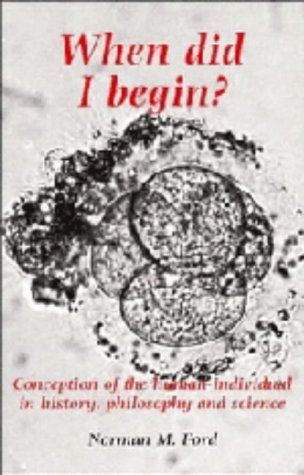
When Did I Begin? investigates the theoretical, moral and biological issues surrounding the debate over the beginning of human life. With the continuing controversy over the use of in vitro fertilization techniques and experimentation with human embryos, these issues have been forced into the arena of public debate. The answer to the question, āWhen did I begin?ā draws on both scientific evidence, and on the philosophical concepts of the presence of the human individaul. As a leading theologian and moral philosopher, thoroughly conversant with modern embryology, Norman Ford, a Salesian priest, is well qualified to bridge the gap between the biological and philosophical point of view. Dr Ford argues that a human individual could not begin before definitive individuation occurs with the appearance of the primative streak about two weeks after fertilisation. While he does not specifically address any moral issues regarding the treatment of human embryos, the author views reading of this book as an essential prerequisite for such moral considerations. The implications of Dr Fordās answer to the question posed in the title will be crucially important for fully evaluating such problems as embryo experimentation and contraception, for a range of readers from embryologists and physicians to moral philosophers and theologians. The book has already stimulated considerable interest and debate, and is now available in paperback for the first time.
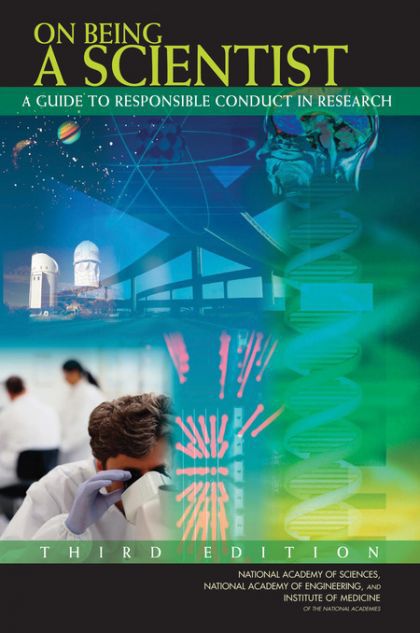
The scientific research enterprise is built on a foundation of trust. Scientists trust that the results reported by others are valid. Society trusts that the results of research reflect an honest attempt by scientists to describe the world accurately and without bias. But this trust will endure only if the scientific community devotes itself to exemplifying and transmitting the values associated with ethical scientific conduct. On Being a Scientist was designed to supplement the informal lessons in ethics provided by research supervisors and mentors. The book describes the ethical foundations of scientific practices and some of the personal and professional issues that researchers encounter in their work. It applies to all forms of research–whether in academic, industrial, or governmental settings-and to all scientific disciplines.
ما از اخلاق چه انتظاری داریم؟ این سوال شاید تاحدودی برای عموم مردم و یا متخصصان این رشته قابل پاسخ باشد؛ اینکه خوب بودن را به ما بیاموزد و در تنظیم روابط فردی م...

جشن کتاب تهران به ایستگاه سی و یکم رسیده است. حال و احوال نشر کتاب خوب نیست و باید فرهنگدوستان را به خرید و هدیه دادن کتاب ترغیب نمود. خانه اخلاقپژوهان جوان ب...

بنیاد کتابهای اخلاق اسلامی عمدتا پالایش جان از آلودگیها و آراستن آن به زیباییها است. اندیشه محوری این قبیل کتابها آن است که انسان فعلی آنی نیست که باید باشد...

-
0 Comments