Notice: تابع WP_Block_Type_Registry::register به طورنادرست فراخوانی شد. نامهای نوع بلوک نباید حروف بزرگ داشته باشند. لطفاً برای اطلاعات بیشتر، اشکال زدایی در وردپرس را مشاهده کنید. (این پیام در نگارش 5.0.0 افزوده شده است.) in /home/ethicsho/public_html/wp-includes/functions.php on line 5313
Warning: Use of undefined constant TDC_PATH_LEGACY - assumed 'TDC_PATH_LEGACY' (this will throw an Error in a future version of PHP) in /home/ethicsho/public_html/wp-content/plugins/td-composer/td-composer.php on line 109
Warning: Use of undefined constant TDSP_THEME_PATH - assumed 'TDSP_THEME_PATH' (this will throw an Error in a future version of PHP) in /home/ethicsho/public_html/wp-content/plugins/td-composer/td-composer.php on line 113 بایگانیهای 9780521768443 - خانه اخلاق پژوهان جوان Notice: Trying to access array offset on value of type bool in /home/ethicsho/public_html/wp-content/plugins/wp-ulike/inc/general-functions.php on line 807
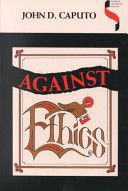
” . . . one of the most important works on philosophical ethics written in recent years. . . . Caputo speaks with a passion and a concern that are rare in academic philosophy. His profound sense of humor deepens the passion of the viewpoints he develops.Oacute; Ntilde;Mark C. Taylor Ograve; . . . a counterethics whose multiple voices will be heard long after the trivializing arguments of many analytic ethicists have vanished and the arcane formulations of many postmoderns jettisoned. . . . The either/or of this dialogue is shown as the topos of a postmodern ethics.Oacute; Ntilde;Edith Wyschogrod In Against Ethics John D. Caputo undertakes a passionate, poetic, and satiric search for the basis of an ethics in the postmodern situation. Restaging Fear and Trembling, Caputo defends the notion of obligation without ethics, of responsibility without the support of ethical foundations. Retelling the story of Abraham and Isaac, Caputo strikes the pose of a postmodern-day Johannes de Silentio, accompanied by communications from such startling figures as Johanna de Silentio, Felix Sineculpa, and Magdalena de la Cruz. In dialogue with the thought of Kierkegaard, Nietzsche, Levinas, Derrida, and Lyotard, Caputo forges a challenging, original account of what is possible and what is not possible for a continentalist ethics today.
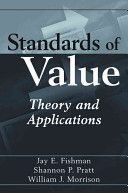
It is axiomatic that every valuation of a business or business interest must contain a definition or standard of value. Each standard of value contains numerous assumptions, and there can be significant variation in the application of a particular standard of value and its underlying assumptions. Standards of Value addresses many of the ambiguities inherent in applying common standards of value. Written by Jay Fishman, Shannon Pratt, and William Morrison–three renowned valuation practitioners who deal with these issues on a daily basis–this book discusses the interaction between valuation theory and its judicial and regulatory application. A must-read for appraisers, accountants, judges, attorneys, and appraisal users, this insightful book addresses standards of value as applied in four distinct contexts: estate and gift taxation; shareholder dissent and oppression; divorce; and financial reporting. Here, practitioners will discover some of the intricacies of performing services in these venues, and appraisers will find this book helpful in understanding why the practitioners are asking such questions. Providing expert direction on interpreting and applying standards of value, this guide includes: Valuations for estate and gift tax, shareholder dissent and oppression, and divorce matters presented within their respective judicial frameworksCase-by-case reasoning behind appraisal-related decisionsState-by-state analyses that provide a clearer idea of how a state’s established case law may give insight on the standard of valueA general overview of the concepts of value, cost, and priceFair market value in estate and gift tax valuationsFair value in dissenting and oppressed shareholder mattersThe premises and standards of value used when valuing a business in divorceCurrent and proposed standards for the reporting of assets and liabilities for corporations as established by the Financial Accounting Standards Board (FASB) of the AICPA
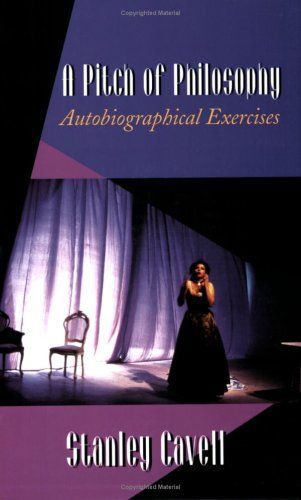
What is the pitch of philosophy? Something thrown, for us to catch? A lurch, meant to unsettle us? The relative position of a tone on a scale? A speech designed to persuade? This book is an invitation to the life of philosophy in the United States, as Emerson once lived it and as Stanley Cavell now lives it – in all its topographical ambiguity. Cavell talks about his vocation in connection with what he calls voice – the tone of philosophy – and his right to take that tone, and to describe an anecdotal journey toward the discovery of his own voice. Cavell asks how the voice of philosophy can be heard amid the commerce of everyday life. His autobiographical exercises begin at home with his parents, his father an accidental pawnbroker and accomplished raconteur, his mother a trained and talented musician. In the course of showing us his certain steps in the discovery of his trade, he conveys the sense of what it means to learn to walk on one’s own, with a Thoreauvian deliberateness. He pays suitableattention to a serious ally and antagonist to the task of philosophy as he understands it, namely, Jacques Derrida – yet Derrida has mounted a full-scale attack on “voice” and other concepts that Cavell has held open for much of a lifetime. The chapters are interwoven with intense family reminiscences in Cavell’s discovery of J. L. Austin, his understanding of Wittgenstein, his raising of Emerson to the philosophical canon, his fascination with film (images of women in a medium for women), the revelation that film and opera are the media of otherness for women. And the voice at the end: hearing in himself the voice of his mother, which is music. Complex, sentimental, witty, A Pitch ofPhilosophy is for anyone who cares to take on philosophy, under whatever name it goes.
This seminal contribution to Kant studies, originally published in 1982, was the first to present a thorough survey and evaluation of Kant’s theory of mind. Ameriks focuses on Kant’s discussion of the Paralogisms in the Critique of Pure Reason, and examines how the themes raised there are treated in the rest of Kant’s writings. Ameriks demonstrates that Kant developed a theory of mind that is much more rationalistic and defensible than most interpreters have allowed.
ما از اخلاق چه انتظاری داریم؟ این سوال شاید تاحدودی برای عموم مردم و یا متخصصان این رشته قابل پاسخ باشد؛ اینکه خوب بودن را به ما بیاموزد و در تنظیم روابط فردی م...

جشن کتاب تهران به ایستگاه سی و یکم رسیده است. حال و احوال نشر کتاب خوب نیست و باید فرهنگدوستان را به خرید و هدیه دادن کتاب ترغیب نمود. خانه اخلاقپژوهان جوان ب...

بنیاد کتابهای اخلاق اسلامی عمدتا پالایش جان از آلودگیها و آراستن آن به زیباییها است. اندیشه محوری این قبیل کتابها آن است که انسان فعلی آنی نیست که باید باشد...

-
0 Comments