Notice: تابع WP_Block_Type_Registry::register به طورنادرست فراخوانی شد. نامهای نوع بلوک نباید حروف بزرگ داشته باشند. لطفاً برای اطلاعات بیشتر، اشکال زدایی در وردپرس را مشاهده کنید. (این پیام در نگارش 5.0.0 افزوده شده است.) in /home/ethicsho/public_html/wp-includes/functions.php on line 5313
Warning: Use of undefined constant TDC_PATH_LEGACY - assumed 'TDC_PATH_LEGACY' (this will throw an Error in a future version of PHP) in /home/ethicsho/public_html/wp-content/plugins/td-composer/td-composer.php on line 109
Warning: Use of undefined constant TDSP_THEME_PATH - assumed 'TDSP_THEME_PATH' (this will throw an Error in a future version of PHP) in /home/ethicsho/public_html/wp-content/plugins/td-composer/td-composer.php on line 113 بایگانیهای 9780521766234 - خانه اخلاق پژوهان جوان Notice: Trying to access array offset on value of type bool in /home/ethicsho/public_html/wp-content/plugins/wp-ulike/inc/general-functions.php on line 807
The position of rational egoism centres upon the thought that the rational thing to do must be to pursue one’s own self-interest. Focusing on the work of Hobbes and Sidgwick, this book is an extensive history and evaluation of rational egoism. They are, after the ancients, the foremost exponents of rational egoism. He also considers other figures – Grotius, Samuel Clarke, John Clarke, Butler, Hume, Reid, Kant, Paley and Bentham – and a related position: the instrumental theory of rationality. Robert Shaver’s conclusion is that none of the arguments for rational egoism or the instrumental theory are cogent. This is an important book not just for historians of philosophy but for all readers in philosophy or the social sciences interested in theories of morality and rationality.
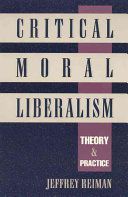
In this important book, Jeffrey Reiman responds to recent assaults on liberal theory by proposing a “critical moral liberalism.” It is liberal in maintaining the emphasis of classical liberalism on individual freedom, moral in adhering to a distinctive vision of the good life rather than professing neutrality, and critical in taking seriously the objection-raised by feminists and Marxists, among others-that liberal theories often serve as ideological cover for oppression of one group by others. Critical moral liberalism has a conception of ideology, and resources for testing the suspicion that arrangements that look free are really oppressive. Reiman sets forth the basic arguments for the liberal moral obligation to maximize people’s ability to govern their own lives, and for the conception of the good life that goes with this. He considers and answers objections to the liberal project, and defends liberal conceptions of privacy, moral virtue, economic justice, and Constitutional interpretation. Reiman then takes up specific policy issues, among them abortion, infanticide, euthanasia, moral education, capital punishment, and threats to privacy from modern information technology. Critical Moral Liberalism will be of interest to scholars and students of ethics, social and political philosophy, political theory, and public policy.
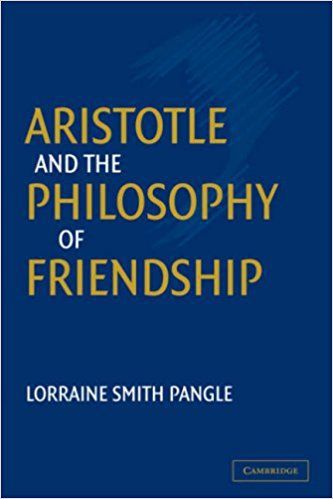
This is the first book to offer a comprehensive account of the major philosophical works on friendship and its relationship to self-love. The book gives central place to Aristotle’s searching examination of friendship in the Nicomachean Ethics. Lorraine Pangle argues that the difficulties surrounding this discussion are soon dispelled once one understands the purpose of the Ethics as both a source of practical guidance for life and a profound, theoretical investigation into human nature. The book also provides fresh interpretations of works on friendship by Plato, Cicero, Epicurus, Seneca, Montaigne and Bacon. The author shows how each of these thinkers sheds light on central questions of moral philosophy: is human sociability rooted in neediness or strength? is the best life chiefly solitary, or dedicated to a community with others? Clearly structured and engagingly written, this book will appeal to a broad swathe of readers across philosophy, classics and political science.
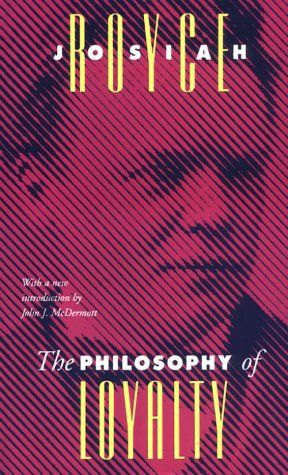
Josiah Royce (1855-1916), one of the outstanding classical American philosophers, is regarded by many as the foremost American idealist. A transitional book in the development of Royce’s thought, The Philosophy of Loyalty is a key to understanding his influence on the development of pragmatism. Royce’s basic argument is clear. Individual wills are a given, and social training is a natural aspect of community. But the two are not fully compatible, and conflicts naturally emerge. Loyalty to a cause unites many individuals into a community, but fanatical loyalty to causes often has inimical results. Long out of print and never before available in paperback, The Philosophy of Loyalty has many beneficial implications for understanding contemporary social passions and outlooks, especially for our own fragmented American culture. As Royce himself asserted nearly ninety years ago, in the preface of this book, “I am writing…not merely and not mainly for philosophers, but for all those who love…ideals, and also for those who love…their country – a country so ripe at present for idealism, and so confused, nevertheless, by the vastness and the complication of its social and political problems.” Royce speaks to these continuing concerns in a voice that is perceptive, learned, and sensitive to the human situation, and he offers powerful conceptual tools for our own troubled times.
ما از اخلاق چه انتظاری داریم؟ این سوال شاید تاحدودی برای عموم مردم و یا متخصصان این رشته قابل پاسخ باشد؛ اینکه خوب بودن را به ما بیاموزد و در تنظیم روابط فردی م...

جشن کتاب تهران به ایستگاه سی و یکم رسیده است. حال و احوال نشر کتاب خوب نیست و باید فرهنگدوستان را به خرید و هدیه دادن کتاب ترغیب نمود. خانه اخلاقپژوهان جوان ب...

بنیاد کتابهای اخلاق اسلامی عمدتا پالایش جان از آلودگیها و آراستن آن به زیباییها است. اندیشه محوری این قبیل کتابها آن است که انسان فعلی آنی نیست که باید باشد...

-
0 Comments