Notice: تابع WP_Block_Type_Registry::register به طورنادرست فراخوانی شد. نامهای نوع بلوک نباید حروف بزرگ داشته باشند. لطفاً برای اطلاعات بیشتر، اشکال زدایی در وردپرس را مشاهده کنید. (این پیام در نگارش 5.0.0 افزوده شده است.) in /home/ethicsho/public_html/wp-includes/functions.php on line 5313
Warning: Use of undefined constant TDC_PATH_LEGACY - assumed 'TDC_PATH_LEGACY' (this will throw an Error in a future version of PHP) in /home/ethicsho/public_html/wp-content/plugins/td-composer/td-composer.php on line 109
Warning: Use of undefined constant TDSP_THEME_PATH - assumed 'TDSP_THEME_PATH' (this will throw an Error in a future version of PHP) in /home/ethicsho/public_html/wp-content/plugins/td-composer/td-composer.php on line 113 بایگانیهای 9780520239418 - خانه اخلاق پژوهان جوان Notice: Trying to access array offset on value of type bool in /home/ethicsho/public_html/wp-content/plugins/wp-ulike/inc/general-functions.php on line 807
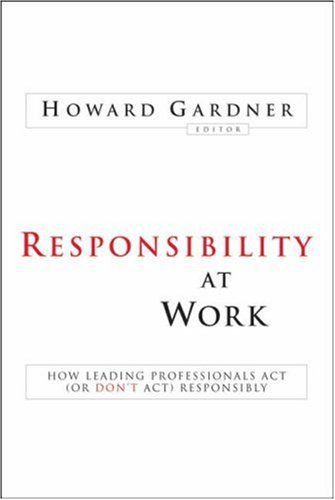
Responsibilityat WorkMost persons strive to produce work that is of excellent technical quality, is pursued in an ethical and socially responsible way, and has the qualities of being engaging and meaningful. How can we attain this ideal of good work in a world that changes so rapidly and all too often features an ethically compromised milieu? Filled with original essays by Howard Gardner, William Damon, Mihaly Csikszentmihalyi, and Jeanne Nakamura and based on a large-scale research project, the GoodWork(R) Project, Responsibility at Work reflects the information gleaned from in-depth interviews with more than 1,200 people from nine different professions–journalism, genetics, theatre, higher education, philanthropy, law, medicine, business, and precollegiate education. The book reveals how motivation, culture, and professional norms can intersect to produce work that is personally, socially, and economically beneficial.?At the heart of the study is the revelation that the key to good work is responsibilty–taking ownership for one’s work and its wider impact.The authors examine how responsibility for work is shaped by both personal and professional components and explore the factors that cause a sense of responsibility, the obstacles that lead to compromised work, and the educational interventions that can lead to a greater sense of responsibility. Most important, this volume provides strategies for cultivating greater responsibility in both seasoned workers as well as the young people who will one day enter the workplace.?
This unique introduction to comparative philosophy brings together Chinese, Indian, and Western philosophers of roughly the same sort, of comparable stature, on the same philosophical topics and issues. Discussions are arranged in traditional clusters — logic, epistemology, metaphysics, ethics, and social and political philosophy. Compares equals to equals — logicians with logicians, metaphysicians with metaphysicians, ethicists with ethicists — e.g., compares Indian, Chinese and Western empiricists, utilitarians, hedonists, egoists, atheists, theists, monists, pluralists, idealists, materialists, dualists, skeptics, relativists, political realists, etc. Treats the strictly philosophical arguments as roughly similar across cultures, but presents the larger cultural contexts in which they occur as considerably different. For anyone interested in comparative philosophy.
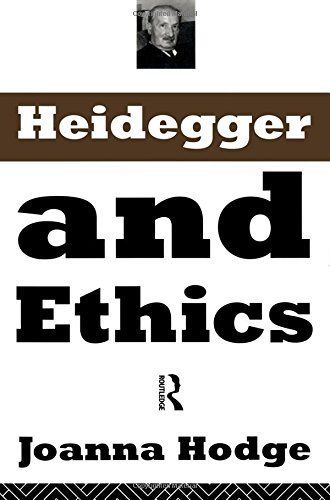
Heidegger and ethics is a contentious conjunction of terms. Martin Heidegger himself rejected the notion of ethics, while his endorsement of Nazism is widely seen as unethical. This major study examines the complex and controversial issues involved in bringing Heidegger and ethics together. Working backwards through his work, from his 1964 claim that philosophy has been completed to his first major book,Being and Time,Joanna Hodge questions Heidegger’s denial that his inquiries were concerned with ethics. She discovers a form of ethics in Heidegger’s thinking which elucidates his important distinction between metaphysics and philosophy. Opposing many contemporary views, Hodge proposes that ethics can be retrieved and questions the relation between ethics and metaphysics that Heidegger made so pervasive.
“Thoreau’s Living Ethics is the first full, rigorous account of Henry Thoreau’s ethical philosophy. Focused on “Walden but ranging widely across his writings, the study situates Thoreau within a long tradition of ethical thinking in the West, from the ancients to the romantics and on to the present day. Philip Cafaro shows Thoreau grappling with important ethical questions that agitated his own society and discusses his value for those seeking to understand contemporary ethical issues. Cafaro’s particular interest is in Thoreau’s treatment of virtue ethics: the branch of ethics centered on personal and social flourishing. Ranging across the central elements of Thoreau’s philosophy–life, virtue, economy, solitude and society, nature, and politics–Cafaro shows Thoreau developing a comprehensive virtue ethics, less based in ancient philosophy than many recent efforts and more grounded in modern life and experience. He presents Thoreau’s evolutionary, experimental ethics as superior to the more static foundational efforts of current virtue ethicists. Another main focus is Thoreau’s environmental ethics. The book shows Thoreau not only anticipating recent arguments for wild nature’s intrinsic value, but also demonstrating how a personal connection to nature furthers self-development, moral character, knowledge, and creativity. Thoreau’s life and writings, argues Cafaro, present a positive, life-affirming environmental ethics, combining respect and restraint with an appreciation for human possibilities for flourishing within nature.
ما از اخلاق چه انتظاری داریم؟ این سوال شاید تاحدودی برای عموم مردم و یا متخصصان این رشته قابل پاسخ باشد؛ اینکه خوب بودن را به ما بیاموزد و در تنظیم روابط فردی م...

جشن کتاب تهران به ایستگاه سی و یکم رسیده است. حال و احوال نشر کتاب خوب نیست و باید فرهنگدوستان را به خرید و هدیه دادن کتاب ترغیب نمود. خانه اخلاقپژوهان جوان ب...

بنیاد کتابهای اخلاق اسلامی عمدتا پالایش جان از آلودگیها و آراستن آن به زیباییها است. اندیشه محوری این قبیل کتابها آن است که انسان فعلی آنی نیست که باید باشد...

-
0 Comments