Notice: تابع WP_Block_Type_Registry::register به طورنادرست فراخوانی شد. نامهای نوع بلوک نباید حروف بزرگ داشته باشند. لطفاً برای اطلاعات بیشتر، اشکال زدایی در وردپرس را مشاهده کنید. (این پیام در نگارش 5.0.0 افزوده شده است.) in /home/ethicsho/public_html/wp-includes/functions.php on line 5313
Warning: Use of undefined constant TDC_PATH_LEGACY - assumed 'TDC_PATH_LEGACY' (this will throw an Error in a future version of PHP) in /home/ethicsho/public_html/wp-content/plugins/td-composer/td-composer.php on line 109
Warning: Use of undefined constant TDSP_THEME_PATH - assumed 'TDSP_THEME_PATH' (this will throw an Error in a future version of PHP) in /home/ethicsho/public_html/wp-content/plugins/td-composer/td-composer.php on line 113 بایگانیهای 9780415378550 - خانه اخلاق پژوهان جوان Notice: Trying to access array offset on value of type bool in /home/ethicsho/public_html/wp-content/plugins/wp-ulike/inc/general-functions.php on line 807
“For Michael Sandel, justice is not a spectator sport,” “The Nation”‘s reviewer of “Justice “remarked. In his acclaimed book–based on his legendary Harvard course–Sandel offers a rare education in thinking through the complicated issues and controversies we face in public life today. It has emerged as a most lucid and engaging guide for those who yearn for a more robust and thoughtful public discourse. “In terms we can all understand,” wrote Jonathan Rauch in “The New York Times,” “Justice “”confronts us with the concepts that lurk . . . beneath our conflicts.” Affirmative action, same-sex marriage, physician-assisted suicide, abortion, national service, the moral limits of markets–Sandel relates the big questions of political philosophy to the most vexing issues of the day, and shows how a surer grasp of philosophy can help us make sense of politics, morality, and our own convictions as well. “Justice “is lively, thought-provoking, and wise–an essential new addition to the small shelf of books that speak convincingly to the hard questions of our civic life. Michael J. Sandel is the Anne T. and Robert M. Bass Professor of Government at Harvard University, where he has taught since 1980, and the author of many books. He lives in Brookline, Massachusetts. Affirmative action, same-sex marriage, physician-assisted suicide, abortion, national service, patriotism and dissent, the moral limits of markets–Sandel dramatizes the challenge of thinking through these conflicts, and shows how a surer grasp of philosophy can help us make sense of politics, morality, and our own convictions as well. Michael J. Sandel’s “Justice” course is one of the most popular and influential at Harvard. Up to a thousand students pack the campus theater to hear Sandel relate the big questions of political philosophy to the most vexing issues of the day. “Justice “offers readers the same journey that captivates Harvard students. This book is an exploration of the meaning of justice, one that invites readers of all political persuasions to consider familiar controversies in fresh and illuminating ways. What are our obligations to others as people in a free society? Should government tax the rich to help the poor? Is the free market fair? Is it sometimes wrong to tell the truth? Is killing sometimes morally required? Is it possible, or desirable, to legislate morality? Do individual rights and the common good conflict? “Justice “is thought-provoking and wise–an essential work that speaks convincingly to the hard questions of our civic life. “Michael J. Sandel is one of this generation’s most important philosophers because he combines a relentlessly inquiring spirit with a profound commitment to the idea of a common good. “Justice “is Sandel at his finest: no matter what your views are, his delightful style will draw you in, and he’ll then force you to rethink your assumptions and challenge you to question accepted ways of thinking. But Sandel does not leave you marooned on an island of skepticism. He calls us to a better way of doing politics, and a more enriching way of living our lives.”–E. J. Dionne, Jr. “This book is absolutely indispensable for anyone who wants to be a good citizen. It shows how to balance competing values, a talent our nation desperately needs nowadays.”–Walter Isaacson, author of “Benjamin Franklin: An American Life” “Michael J. Sandel is one of this generation’s most important philosophers because he combines a relentlessly inquiring spirit with a profound commitment to the idea of a common good. “Justice “is Sandel at his finest: no matter what your views are, his delightful style will draw you in, and he’ll then force you to rethink your assumptions and challenge you to question accepted ways of thinking. But Sandel does not leave you marooned on an island of skepticism. He calls us to a better way of doing politics, and a more enriching way of living our lives.”–E. J. Dionne, Jr. “Michael J. Sandel, political philosopher and public intellectual, is a liberal, but not the annoying sort. His aim is not to boss people around but to bring them around to the pleasures of thinking clearly about large questions of social policy. Reading this lucid book is like taking his famous undergraduate course ‘Justice’ without the tiresome parts, such as term papers and exams.”–George F. Will “A Harvard law professor explores the meaning of justice and invites readers on a journey of moral and political reflection, ‘to figure out what they think, and why.’ Does a veteran suffering from post-traumatic stress disorder ‘deserve’ the Purple Heart? Should the U.S. government formally apologize and make reparations for slavery? Is it wrong to lie to a murderer? Following the taxpayer bailout of the company, are executives at insurance giant A.I.G. still entitled to their bonuses? Should a professional golfer afflicted with a severe circulatory condition be allowed to use a golf cart during tournaments? Are you obliged to surrender your criminal brother to the FBI? Although Sandel concedes that answering the many questions he poses, bound up ‘with competing notions of honor and virtue, pride and recognition, ‘ is never easy and inevitably contentious, it’s necessary for a healthy democracy. ‘Justice, ‘ he writes, ‘is inescapably judgmental.’ Using three approaches to justice–maximizing welfare, respecting freedom and promoting virtue–the author asks readers to ponder the meaning of the good life, the purpose of politics, how laws should be constructed and how society should be organized. Using a compelling, entertaining mix of hypotheticals, news stories, episodes from history, pop-culture tidbits, literary examples, legal cases and teachings from the great philosophers–principally, Aristotle, Kant, Bentham, Mill and Rawls–Sandel takes on a variety of controversial issues-abortion, same-sex marriage, affirmative action-and forces us to confront our own assumptions, biases and lazy thought. The author has a talent for making the difficult–Kant’s ‘categorical imperative’ or Rawls’s ‘difference principle’–readily comprehensible, and his relentless, though never oppressive, reason shines throughout the narrative. Sparkling commentary from the professor we all wish we had.”–“Kirkus Review” “Harvard government professor Sandel dazzles in this sweeping survey of hot topics–the recent government bailouts, the draft, surrogate pregnancies, same-sex marriage, immigration reform and reparations for slavery–that situates various sides in the debates in the context of timeless philosophical questions and movements. Sandel takes utilitarianism, Kant’s categorical imperative and Rawls’s theory of justice out of the classroom, dusts them off and reveals how crucial these theories have been in the construction of Western societies–and how they inform almost every issue at the center of our modern-day polis. The content is dense but elegantly presented, and Sandel has a rare gift for making complex issues comprehensible, even entertaining (see his sections entitled ‘Shakespeare versus the Simpsons’ and ‘What Ethics Can Learn from Jack Benny and Miss Manners’), without compromising their gravity. With exegeses of Winnie the Pooh, transcripts of Bill Clinton’s impeachment hearing and the works of almost every major political philosopher, Sandel reveals how even our most knee-jerk responses bespeak our personal conceptions of the rights and obligations of the individual and society at large. Erudite, conversational and deeply humane, this is truly transformative reading.”–“Publishers Weekly”
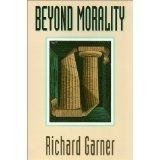
“Morality and religion have failed because they are based on duplicity and fantasy. We need something new….” With this startling statement, Richard Garner begins to define a system of behavior that will nurture our capabilities for love and language, for creation and cooperation.The satisfying personal and social strategy for living Garner proposes is “informed, compassionate amoralism.” To do without morality, he argues, is to reject the idea that there are intrinsic values, objective duties, and natural rights. Leaving illusions behind us and learning to listen to others and to ourselves may be what we need to lead us out of the darkness.Garner builds his case on a survey of moral definitions and arguments from ancient Greece forward. Beyond Morality revisits the tenets of Christianity and Eastern religious, providing readers with a meaningful overview of the history of moral thought.Quotations illuminate and illustrate the text, adding to the value of Beyond Morality as a textbook for ethics courses. Author note: Richard Garner is Professor of Philosophy at The Ohio State University.
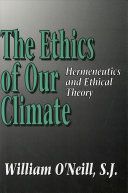
In this book, William O’Neill, S.J., offers an interpretation of the nature and scope of practical reasoning in light of postmodern philosophical criticism. He charts a via media between the abstract formalism of neo-Kantian morality and relativist interpretations of neo-Aristotelian ethics. The three parts of the book treat the eclipse of the classical Aristotelian conception of practical reason; the Kantian heritage in the modern moral theories of John Rawls and R.M. Hare; and the hermeneutical retrieval of a moral interpretation of the world. Drawing upon the philosophical hermeneutics of Hans-Georg Gadamer, modern analytical philosophy, and the discourse ethics of Jurgen Habermas, O’Neill offers a critical reconstruction of practical reason which upholds the primacy of moral community while recognizing the ethical import of historical and cultural difference. The final chapter applies the preceding hermeneutical critique to the question of the distinctiveness of Christian ethics in the writings of Karl Barth, Hans Urs von Balthasar, Josef Fuchs, and Bruno Schuller. This original contribution will be of special interest to students and teachers of moral philosophy and theology.
As the first book to explore the confluence of three emerging yet critical fields of study, this work sets an exacting standard. The editors’ aim was to produce the most authoritative guide for ecojustice, place-based education, and indigenous knowledge in education. Aimed at a wide audience that includes, but is not restricted to, science educators and policymakers, Cultural Studies and Environmentalism starts from the premise that schooling is a small part of the larger educational domain in which we live and learn. Informed by this overarching notion, the book opens up ways in which home-grown talents, narratives, and knowledge can be developed, and eco-region awareness and global relationships can be facilitated. Incorporating a diversity of perspectives that include photography, poetry and visual art, the work provides a nuanced lens for evaluating educational problems and community conditions while protecting and conserving the most threatened and vulnerable narratives. Editors and contributors share the view that the impending loss of these narratives should be discussed much more widely than is currently the case, and that both teachers and children can take on some of the responsibility for their preservation. The relevance of ecojustice to this process is clear. Ecojustice philosophy is a way of learning about how we frame, or perceive, the world around us—and why that matters. Although it is not synonymous with social or environmental justice, the priorities of ecojustice span the globe in the same way. It incorporates a deep recognition of the appropriateness and significance of learning from place-based experiences and indigenous knowledge systems rather than depending on some urgent (3)4z(Becological crises(3)4y (Bto advocate for school and societal change. With a multiplicity of diverse voices coming together to explore its key themes, this book is an important starting point for educators in many arenas. It brings into better focus a vital role for the Earth’s ecosystems in the context of ecosociocultural theory and participatory democracy alike. (3)4z(BEncompassing theoretical, empirical, and experiential standpoints concerning place-based knowledge systems, this unique book argues for a transformation of (science) education’s intellectual tradition of thinking that emphasizes individual cognition. In its place, the book offers a wisdom tradition of thinking, living, and being that emphasizes community survival in harmony within itself and with Mother Earth.(3)4y (BGlen Aikenhead.
ما از اخلاق چه انتظاری داریم؟ این سوال شاید تاحدودی برای عموم مردم و یا متخصصان این رشته قابل پاسخ باشد؛ اینکه خوب بودن را به ما بیاموزد و در تنظیم روابط فردی م...

جشن کتاب تهران به ایستگاه سی و یکم رسیده است. حال و احوال نشر کتاب خوب نیست و باید فرهنگدوستان را به خرید و هدیه دادن کتاب ترغیب نمود. خانه اخلاقپژوهان جوان ب...

بنیاد کتابهای اخلاق اسلامی عمدتا پالایش جان از آلودگیها و آراستن آن به زیباییها است. اندیشه محوری این قبیل کتابها آن است که انسان فعلی آنی نیست که باید باشد...

-
0 Comments