Notice: تابع WP_Block_Type_Registry::register به طورنادرست فراخوانی شد. نامهای نوع بلوک نباید حروف بزرگ داشته باشند. لطفاً برای اطلاعات بیشتر، اشکال زدایی در وردپرس را مشاهده کنید. (این پیام در نگارش 5.0.0 افزوده شده است.) in /home/ethicsho/public_html/wp-includes/functions.php on line 5313
Warning: Use of undefined constant TDC_PATH_LEGACY - assumed 'TDC_PATH_LEGACY' (this will throw an Error in a future version of PHP) in /home/ethicsho/public_html/wp-content/plugins/td-composer/td-composer.php on line 109
Warning: Use of undefined constant TDSP_THEME_PATH - assumed 'TDSP_THEME_PATH' (this will throw an Error in a future version of PHP) in /home/ethicsho/public_html/wp-content/plugins/td-composer/td-composer.php on line 113 بایگانیهای 9780415342360 - خانه اخلاق پژوهان جوان Notice: Trying to access array offset on value of type bool in /home/ethicsho/public_html/wp-content/plugins/wp-ulike/inc/general-functions.php on line 807
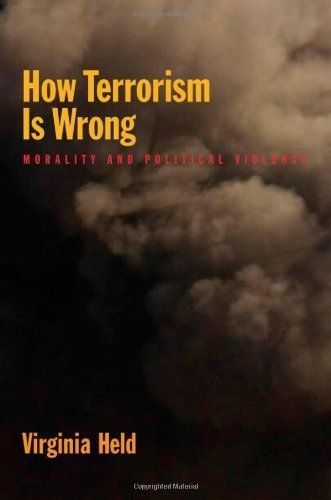
What is terrorism? How is it different from other kinds of political violence? Why exactly is it wrong? Why is war often thought capable of being justified? On what grounds should we judge when the use of violence is morally acceptable? It is often thought that using violence to uphold and enforce the rule of law can be justified, that violence used in self-defense is acceptable, and that some liberation movements can be excused for using violence–but that terrorism is always wrong. How persuasive are these arguments, and on what bases should we judge them? How Terrorism is Wrong collects articles by Virginia Held along with much new material. It offers a moral assessment of various forms of political violence, with terrorism the focus of much of the discussion. Here and throughout, Held examines possible causes discussed, including the connection between terrorism and humiliation. Held also considers military intervention, conventional war, intervention to protect human rights, violence to prevent political change, and the status and requirements of international law. She looks at the cases of Rwanda, Kosovo, Iraq, and the Israeli/Palestinian conflict. Finally, she explores questions of who has legitimate authority to engage in justifiable uses of violence, whether groups can be responsible for ethnic violence, and how the media should cover terrorism. Held discusses appropriate ways of engaging in moral evaluation and improving our moral recommendations concerning the uses of violence. Just war theory has been developed for violence between the military forces of conflicting states, but much contemporary political violence is not of this kind. Held considers the guidance offered by such traditional moral theories as Kantian ethics and utilitarianism, and also examines what the newer approach of the ethics of care can contribute to our evaluations of violence. Care is obviously antithetical to violence since violence destroys what care takes pains to build; but the ethics of care recognizes that violence is not likely to disappear from human affairs, and can offer realistic understandings of how best to reduce it.
Democracy is not naturally plausible. Why turn such important matters over to masses of people who have no expertise? Many theories of democracy answer by appealing to the intrinsic value of democratic procedure, leaving aside whether it makes good decisions. In Democratic Authority, David Estlund offers a groundbreaking alternative based on the idea that democratic authority and legitimacy must depend partly on democracy’s tendency to make good decisions. Just as with verdicts in jury trials, Estlund argues, the authority and legitimacy of a political decision does not depend on the particular decision being good or correct. But the “epistemic value” of the procedure–the degree to which it can generally be accepted as tending toward a good decision–is nevertheless crucial. Yet if good decisions were all that mattered, one might wonder why those who know best shouldn’t simply rule. Estlund’s theory–which he calls “epistemic proceduralism”–avoids epistocracy, or the rule of those who know. He argues that while some few people probably do know best, this can be used in political justification only if their expertise is acceptable from all reasonable points of view. If we seek the best epistemic arrangement in this respect, it will be recognizably democratic–with laws and policies actually authorized by the people subject to them.
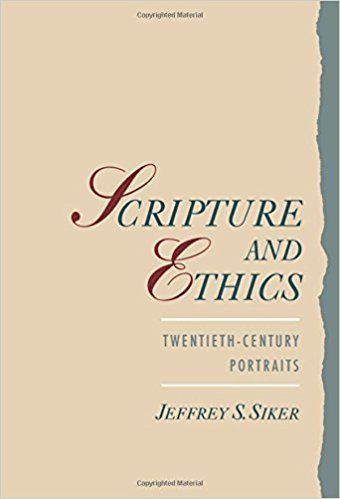
How should the Bible be used in Christian ethics? Although this question has been addressed many times, little attention has gone to how the Bible actually has functioned in constructing theological ethics. In this book, Siker describes and analyzes the Bible’s various uses in the theology and ethics of eight of the twentieth century’s most important and influential Christian theologians: Reinhold Niebuhr, H. Richard Niebuhr, Bernhard Haring, Paul Ramsey, Stanley Hauerwas, Gustavo Gutierrez, James Cone, and Rosemary Radford Ruether. Of each author Siker asks five related questions: which biblical texts does the author in fact use; in what ways are the texts used; how does the author envision the authority of the Bible; what kind of hermeneutic does the author employ; and what has each author’s approach to the Bible yielded in terms of Christian ethics? Siker ends each chapter with a critical evaluation of the various problems and prospects for the author’s use of Scripture, and concludes the study with a comparison and contrast of the authors’ respective appropriations of the Sermon on the Mount.
Purpose of this book is to provide a text and a resource for the study of engineering ethics and to help future engineers be prepared for confronting and resolving ethical dilemmas that they might encounter during their professional careers. It is part of Prentice Hall’s ESource program, a comprehensive, customizable introductory engineering and computing library.Engineering professionalism; Ethical theories; Ethical problem solving techniques; Applications; and Codes of ethics of major engineering societies.For professionals in General Engineering or Computer Science fields.
ما از اخلاق چه انتظاری داریم؟ این سوال شاید تاحدودی برای عموم مردم و یا متخصصان این رشته قابل پاسخ باشد؛ اینکه خوب بودن را به ما بیاموزد و در تنظیم روابط فردی م...

جشن کتاب تهران به ایستگاه سی و یکم رسیده است. حال و احوال نشر کتاب خوب نیست و باید فرهنگدوستان را به خرید و هدیه دادن کتاب ترغیب نمود. خانه اخلاقپژوهان جوان ب...

بنیاد کتابهای اخلاق اسلامی عمدتا پالایش جان از آلودگیها و آراستن آن به زیباییها است. اندیشه محوری این قبیل کتابها آن است که انسان فعلی آنی نیست که باید باشد...

-
0 Comments