Notice: تابع WP_Block_Type_Registry::register به طورنادرست فراخوانی شد. نامهای نوع بلوک نباید حروف بزرگ داشته باشند. لطفاً برای اطلاعات بیشتر، اشکال زدایی در وردپرس را مشاهده کنید. (این پیام در نگارش 5.0.0 افزوده شده است.) in /home/ethicsho/public_html/wp-includes/functions.php on line 5313
Warning: Use of undefined constant TDC_PATH_LEGACY - assumed 'TDC_PATH_LEGACY' (this will throw an Error in a future version of PHP) in /home/ethicsho/public_html/wp-content/plugins/td-composer/td-composer.php on line 109
Warning: Use of undefined constant TDSP_THEME_PATH - assumed 'TDSP_THEME_PATH' (this will throw an Error in a future version of PHP) in /home/ethicsho/public_html/wp-content/plugins/td-composer/td-composer.php on line 113 بایگانیهای 9780271032542 - خانه اخلاق پژوهان جوان Notice: Trying to access array offset on value of type bool in /home/ethicsho/public_html/wp-content/plugins/wp-ulike/inc/general-functions.php on line 807
In this significant contribution to Hegel scholarship, Robert Williams develops the most comprehensive account to date of Hegel’s concept of recognition (Anerkennung). Fichte introduced the concept of recognition as a presupposition of both Rousseau’s social contract and Kant’s ethics. Williams shows that Hegel appropriated the concept of recognition as the general pattern of his concept of ethical life, breaking with natural law theory yet incorporating the Aristotelian view that rights and virtues are possible only within a certain kind of community.He explores Hegel’s intersubjective concept of spirit (Geist) as the product of affirmative mutual recognition and his conception of recognition as the right to have rights. Examining Hegel’s Jena manuscripts, his Philosophy of Right, the Phenomenology of Spirit, and other works, Williams shows how the concept of recognition shapes and illumines Hegel’s understandings of crime and punishment, morality, the family, the state, sovereignty, international relations, and war. A concluding chapter on the reception and reworking of the concept of recognition by contemporary thinkers including Derrida, Levinas, and Deleuze demonstrates Hegel’s continuing centrality to the philosophical concerns of our age.
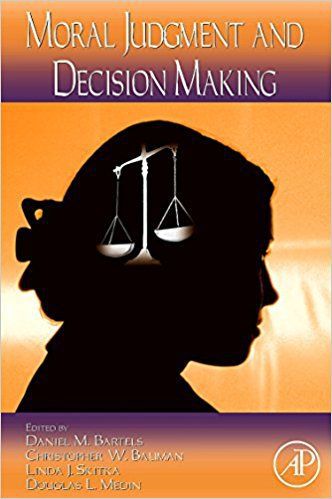
This volume presents a variety of perspectives from within and outside moral psychology. Recently there has been an explosion of research in moral psychology, but it is one of the subfields most in need of bridge-building, both within and across areas. Interests in moral phenomena have spawned several separate lines of research that appear to address similar concerns from a variety of perspectives. The contributions to this volume examine key theoretical and empirical issues these perspectives share that connect these issues with the broader base of theory and research in social and cognitive psychology. The first two chapters discuss the role of mental representation in moral judgment and reasoning. Sloman, Fernbach, and Ewing argue that causal models are the canonical representational medium underlying moral reasoning, and Mikhail offers an account that makes use of linguistic structures and implicates legal concepts. Bilz and Nadler follow with a discussion of the ways in which laws, which are typically construed in terms of affecting behavior, exert an influence on moral attitudes, cognition, and emotions. Baron and Ritov follow with a discussion of how people’s moral cognition is often driven by law-like rules that forbid actions and suggest that value-driven judgment is relatively less concerned by the consequences of those actions than some normative standards would prescribe. Iliev et al. argue that moral cognition makes use of both rules and consequences, and review a number of laboratory studies that suggest that values influence what captures our attention, and that attention is a powerful determinant of judgment and preference. Ginges follows with a discussion of how these value-related processes influence cognition and behavior outside the laboratory, in high-stakes, real-world conflicts. Two subsequent chapters discuss further building blocks of moral cognition. Lapsley and Narvaez discuss the development of moral characters in children, and Reyna and Casillas offer a memory-based account of moral reasoning, backed up by developmental evidence. Their theoretical framework is also very relevant to the phenomena discussed in the Sloman et al., Baron and Ritov, and Iliev et al. chapters. The final three chapters are centrally focused on the interplay of hot and cold cognition. They examine the relationship between recent empirical findings in moral psychology and accounts that rely on concepts and distinctions borrowed from normative ethics and decision theory. Connolly and Hardman focus on bridge-building between contemporary discussions in the judgment and decision making and moral judgment literatures, offering several useful methodological and theoretical critiques. Ditto, Pizarro, and Tannenbaum argue that some forms of moral judgment that appear objective and absolute on the surface are, at bottom, more about motivated reasoning in service of some desired conclusion. Finally, Bauman and Skitka argue that moral relevance is in the eye of the perceiver and emphasize an empirical approach to identifying whether people perceive a given judgment as moral or non-moral. They describe a number of behavioral implications of people’s reported perception that a judgment or choice is a moral one, and in doing so, they suggest that the way in which researchers carve out the moral domain a priori might be dubious.
This textbook for instruction in biomedical research ethics can also serve as a valuable reference for professionals in the field of bioethics. The 149 cases included in the book are grouped in nine chapters, each of which covers a key area of debate in the field. Some of the case studies are classics, including the famous cases of the Tuskegee Syphilis Study (in which subjects with syphilis were not given treatment) and the Willowbrook hepatitis studies (in which institutionalized subjects were intentionally exposed to hepatitis). Others focus on such current issues as human embryonic stem cell research, cloning by somatic nuclear transfer, and the design and function of institutional review boards. Each chapter begins with a brief introduction that places the issues raised in context; this is followed by a number of cases (each of which is no more than a few pages). Study questions meant to encourage further discussion follow each case.After an introductory discussion of the history and tenets of ethics in medical research, the book’s chapters cover the topics of oversight and study design; informed consent; the selection of subjects; conflicts of interest; the social effects of research; embryos, fetuses, and children; genetic research; the use of animals; and authorship and publication. Following these chapters are appendixes with the texts of the Nuremburg Code and the World Declaration of Geneva, two key documents in the establishment of bioethical standards for research. Also included are a glossary, a table of cases by general category, and an alphabetical listing of cases.
ما از اخلاق چه انتظاری داریم؟ این سوال شاید تاحدودی برای عموم مردم و یا متخصصان این رشته قابل پاسخ باشد؛ اینکه خوب بودن را به ما بیاموزد و در تنظیم روابط فردی م...

جشن کتاب تهران به ایستگاه سی و یکم رسیده است. حال و احوال نشر کتاب خوب نیست و باید فرهنگدوستان را به خرید و هدیه دادن کتاب ترغیب نمود. خانه اخلاقپژوهان جوان ب...

بنیاد کتابهای اخلاق اسلامی عمدتا پالایش جان از آلودگیها و آراستن آن به زیباییها است. اندیشه محوری این قبیل کتابها آن است که انسان فعلی آنی نیست که باید باشد...

-
0 Comments