Notice: تابع WP_Block_Type_Registry::register به طورنادرست فراخوانی شد. نامهای نوع بلوک نباید حروف بزرگ داشته باشند. لطفاً برای اطلاعات بیشتر، اشکال زدایی در وردپرس را مشاهده کنید. (این پیام در نگارش 5.0.0 افزوده شده است.) in /home/ethicsho/public_html/wp-includes/functions.php on line 5313
Warning: Use of undefined constant TDC_PATH_LEGACY - assumed 'TDC_PATH_LEGACY' (this will throw an Error in a future version of PHP) in /home/ethicsho/public_html/wp-content/plugins/td-composer/td-composer.php on line 109
Warning: Use of undefined constant TDSP_THEME_PATH - assumed 'TDSP_THEME_PATH' (this will throw an Error in a future version of PHP) in /home/ethicsho/public_html/wp-content/plugins/td-composer/td-composer.php on line 113 بایگانیهای 9780262541961 - خانه اخلاق پژوهان جوان Notice: Trying to access array offset on value of type bool in /home/ethicsho/public_html/wp-content/plugins/wp-ulike/inc/general-functions.php on line 807
Zoos and animal rights seem utterly opposed to each other. In this controversial and timely book, Stephen Bostock argues that they can develop a more harmonious relationship. He examines the diverse ethical and technical issues involved, including human cruelty, human domination over animals, the well-being of wild animals outside their natural habitat, and the nature of wild and domestic animals. In his analysis, Bostock draws attention to the areas which give rise to misconceptions. This book explores the long history of zoos, as well as current philosophical debates, to argue for a conservational view of their role in the modern world. Anyone concerned with humanity’s relationship with other animals and the natural world will find this to be thought-provoking and rewarding reading.
“What implications do recent empirical findings from the fields of biology, primatology, anthropology, psychology and history have for metaethical theories about moral objectivity? I defend the thesis that these findings detract from the plausibility of a realist account of moral objectivity but leave room for a more moderate, antirealist account of objectivity, framed in terms of stance-invariance. The dissertation consists of six articles written for publication in academic journals. In these articles I present two novel, empirically informed challenges to moral realism, and point out some shortcomings of existing challenges. One of the novel challenges builds on the second horn of Sharon Street’s ‘Darwinian Dilemma’, according to which moral realists are committed to an implausible evolutionary hypothesis, and extends this criticism to the historical realm. The other novel challenge is fuelled by theoretical and experimental work in moral psychology, and takes issue with the presumed advantages of moral realism in explaining the qualities of our moral experience. Apart from criticizing moral realism, I also develop and defend an alternative account of moral objectivity in antirealist terms and argue that it is as least as successful as a realist account in capturing the objectivist commitments of ordinary moral discourse.”– Page 14.
Two essays on utilitarianism, written from opposite points of view, by J. J. C. Smart and Bernard Williams. In the first part of the book Professor Smart advocates a modern and sophisticated version of classical utilitarianism; he tries to formulate a consistent and persuasive elaboration of the doctrine that the rightness and wrongness of actions is determined solely by their consequences, and in particular their consequences for the sum total of human happiness. This is a revised version of Professor Smart’s famous essay ‘an outline of a system of utilitarian ethics’, first published in 1961 but long unobtainable. In Part II Bernard Williams offers a sustained and vigorous critique of utilitarian assumptions, arguments and ideals. He finds inadequate the theory of action implied by utilitarianism, and he argues that utilitarianism fails to engage at a serious level with the real problems of moral and political philosophy, and fails to make sense of notions such as integrity, or even human happiness itself. Both authors are agreed on utilitarianism’s importance: it cuts across a number of different philosophical disputes and combines a systematic account of mata-ethical problems with a distinctive and substantive moral stand. It thus is, or involves, philosophy in both the traditional and the narrower, professional sense of the word, and is a key topic (often the first topic) in introductory philosophy courses. This book should also be of interest to welfare economists, political scientists and decision-theorists.
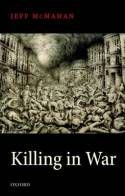
The dominant view throughout history has been that mere participation in an unjust war is not wrong. Soldiers are not to blame for the unjustness of the military actions into which their leaders throw them. The principles governing what is permissible in war apply equally to any combatants.Jeff McMahan argues powerfully that this dominant view must be overturned. Combatants who fight for an unjust cause are acting wrongly and are themselves morally responsible for their own wrongdoings. If a soldier fighting for an unjust cause kills an opposing soldier, he is killing an innocentperson and is morally responsible for that killing.This is a highly controversial view, which threatens to undermine the moral standing of military personnel in many contexts around the world today. McMahan shows that the view is nevertheless one which common sense can see to be demanded by our basic moral intuitions. We must rethink our attitudesto the moral role of the individual in war.
In Unlimited Love: Altruism, Compassion, and Service, author Stephen Post presents an argument for the creation of a new interdisciplinary field for the study of love from a scientific perspective. These insights are essential to our future; in fact, Teilhard de Chardin noted that the discovery of the scientific understanding of the power of unselfish love would be as significant in human history as the discovery of fire. In order to fully explore these ideas, Post established the Institute for Research on Unlimited Love, whose mission is to fund high-level scientific research, develop a dialogue between science and religion on the topic, and disseminate the results of these studies. In this book, he outlines the challenges of exploring the intersection of science, human experience, and the underlying metaphysics of divine love. Book jacket.
ما از اخلاق چه انتظاری داریم؟ این سوال شاید تاحدودی برای عموم مردم و یا متخصصان این رشته قابل پاسخ باشد؛ اینکه خوب بودن را به ما بیاموزد و در تنظیم روابط فردی م...

جشن کتاب تهران به ایستگاه سی و یکم رسیده است. حال و احوال نشر کتاب خوب نیست و باید فرهنگدوستان را به خرید و هدیه دادن کتاب ترغیب نمود. خانه اخلاقپژوهان جوان ب...

بنیاد کتابهای اخلاق اسلامی عمدتا پالایش جان از آلودگیها و آراستن آن به زیباییها است. اندیشه محوری این قبیل کتابها آن است که انسان فعلی آنی نیست که باید باشد...

-
0 Comments