Notice: تابع WP_Block_Type_Registry::register به طورنادرست فراخوانی شد. نامهای نوع بلوک نباید حروف بزرگ داشته باشند. لطفاً برای اطلاعات بیشتر، اشکال زدایی در وردپرس را مشاهده کنید. (این پیام در نگارش 5.0.0 افزوده شده است.) in /home/ethicsho/public_html/wp-includes/functions.php on line 5313
Warning: Use of undefined constant TDC_PATH_LEGACY - assumed 'TDC_PATH_LEGACY' (this will throw an Error in a future version of PHP) in /home/ethicsho/public_html/wp-content/plugins/td-composer/td-composer.php on line 109
Warning: Use of undefined constant TDSP_THEME_PATH - assumed 'TDSP_THEME_PATH' (this will throw an Error in a future version of PHP) in /home/ethicsho/public_html/wp-content/plugins/td-composer/td-composer.php on line 113 بایگانیهای 9780226026763 - خانه اخلاق پژوهان جوان Notice: Trying to access array offset on value of type bool in /home/ethicsho/public_html/wp-content/plugins/wp-ulike/inc/general-functions.php on line 807
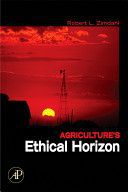
What are the goals of agricultural science? What should the goals of agricultural science be? How do and how should the practitioners of agriculture address complex ethical questions? These questions are explored in this monumental book so that those in agriculture will begin an open dialoge on the ethics of agriculture. Discussion of foundational values, of why we practice agriculture as we do, should become a central, rather than peripheral, part of agricultural practice and education. If agricultural scientists do not venture forth to understand and shape the ethical base of the future, it will be imposed by others. Largely autobiographical, this book covers topics such as scientific truth and myth, what agricultural research should be done, an introduction to ethics, moral confidence in agriculture, the relevance of ethics to agriculture, sustainability, and biotechnology. * Written by an expert who has been engaged in agricultural education and research for over 35 years * Content is easily understandable by non-philosophers * The concepts of scientific truth and myth are contrasted and compared * Chapter sidebars highlight important concepts and can be used to engage students in further discussion * Companion website will accompany the book with further teaching aids and a discussion board
‘It’s all relative’. In a world of increasing cultural diversity, it can seem that everything is indeed relative. But should we concede that there is no such thing as right and wrong, and no objective truth? Can we reconcile relativism and pluralism? Relativism surveys the different varieties of relativism and the arguments for and against them, and examines why relativism has survived for two thousand years despite all the criticisms levelled against it. Beginning with a historical overview of relativism, from Pythagoras in ancient Greece to Derrida and postmodernism, Maria Baghramian explores the resurgence of relativism throughout the history of philosophy. She then turns to the arguments for and against the many subdivisions of relativism, including Kuhn and Feyerabend’s ideas of relativism in science, Rorty’s relativism about truth, and the conceptual relativism of Quine and Putnam. Baghramian questions whether moral relativism leads to moral indifference or even nihilism, and whether feminist epistemology’s concerns about the very notion of objectivity can be considered a form of relativism. She concludes the relativism debate by assessing the recent criticisms such as Quine’s argument from translation and Davidson’s claim that even the motivations behind relativism are unintelligible. Finding these criticisms lacking, Baghramian proposes a moderate form of pluralism which addresses the legitimate worries that give rise to relativism without incurring charges of nihilism or anarchy. Relativism is essential reading for anyone interested in contemporary philosophy, sociology and politics.
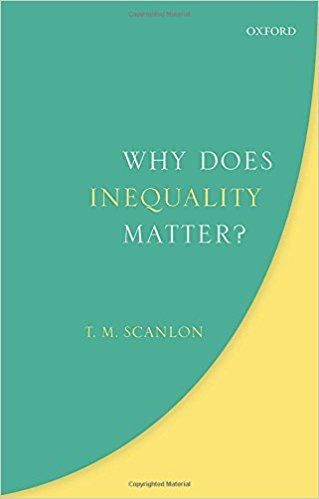
Inequality is widely regarded as morally objectionable: T. M. Scanlon investigates why it matters to us. Demands for greater equality can seem puzzling, because it can be unclear what reason people have for objecting to the difference between what they have and what others have, as opposed simply to wanting to be better off. This book examines six such reasons. Inequality can be objectionable because it arises from a failure of some agent to give equal concern to the interests of different parties to whom it is obligated to provide some good. It can be objectionable because it involves or gives rise to objectionable inequalities in status. It can be objectionable because it gives the rich unacceptable forms of control over the lives of those who have less. It can be objectionable because it interferes with the procedural fairness of economic institutions, or because it deprives some people of substantive opportunity to take part in those institutions. Inequality can be objectionable because it interferes with the fairness of political institutions. Finally, inequality in wealth and income can be objectionable because it is unfair: the institutional mechanisms that produce it cannot be justified in the relevant way. Scanlon’s aims is to provide a moral anatomy of these six reasons, and the ideas of equality that they involve. He also examines objections to the pursuit of equality on the ground that it involves objectionable interference with individual liberty, and argues that ideas of desert do not provide a basis either for justifying significant economic inequality or for objecting to it.
This is a major new study of Kants ethics that will transform the way students and scholars approach the subject in future. Allen Wood argues that Kants ethical vision is grounded in the idea of the dignity of the rational nature of every human being. Undergoing both natural competitiveness and social antagonism the human species, according to Kant, develops the rational capacity to struggle against its impulses towards a human community in which the ends of all are to harmonize and coincide. The distinctive features of the book are twofold. First, it focuses for the first time on the central role played in Kants ethical theory by the value of rational nature as an end itself. Second, it shows the importance of Kants systematic theory of human nature and history, and its implications for the structure, formulation, and application of Kants moral principles. This comprehensive study will be of critical importance to students of moral philosophy, the history of ideas, political theory, and religious studies.
ما از اخلاق چه انتظاری داریم؟ این سوال شاید تاحدودی برای عموم مردم و یا متخصصان این رشته قابل پاسخ باشد؛ اینکه خوب بودن را به ما بیاموزد و در تنظیم روابط فردی م...

جشن کتاب تهران به ایستگاه سی و یکم رسیده است. حال و احوال نشر کتاب خوب نیست و باید فرهنگدوستان را به خرید و هدیه دادن کتاب ترغیب نمود. خانه اخلاقپژوهان جوان ب...

بنیاد کتابهای اخلاق اسلامی عمدتا پالایش جان از آلودگیها و آراستن آن به زیباییها است. اندیشه محوری این قبیل کتابها آن است که انسان فعلی آنی نیست که باید باشد...

-
0 Comments