Notice: تابع WP_Block_Type_Registry::register به طورنادرست فراخوانی شد. نامهای نوع بلوک نباید حروف بزرگ داشته باشند. لطفاً برای اطلاعات بیشتر، اشکال زدایی در وردپرس را مشاهده کنید. (این پیام در نگارش 5.0.0 افزوده شده است.) in /home/ethicsho/public_html/wp-includes/functions.php on line 5313
Warning: Use of undefined constant TDC_PATH_LEGACY - assumed 'TDC_PATH_LEGACY' (this will throw an Error in a future version of PHP) in /home/ethicsho/public_html/wp-content/plugins/td-composer/td-composer.php on line 109
Warning: Use of undefined constant TDSP_THEME_PATH - assumed 'TDSP_THEME_PATH' (this will throw an Error in a future version of PHP) in /home/ethicsho/public_html/wp-content/plugins/td-composer/td-composer.php on line 113 بایگانیهای 9780199970957 - خانه اخلاق پژوهان جوان Notice: Trying to access array offset on value of type bool in /home/ethicsho/public_html/wp-content/plugins/wp-ulike/inc/general-functions.php on line 807
The dominant view throughout history has been that mere participation in an unjust war is not wrong. Soldiers are not to blame for the unjustness of the military actions into which their leaders throw them. The principles governing what is permissible in war apply equally to any combatants.Jeff McMahan argues powerfully that this dominant view must be overturned. Combatants who fight for an unjust cause are acting wrongly and are themselves morally responsible for their own wrongdoings. If a soldier fighting for an unjust cause kills an opposing soldier, he is killing an innocentperson and is morally responsible for that killing.This is a highly controversial view, which threatens to undermine the moral standing of military personnel in many contexts around the world today. McMahan shows that the view is nevertheless one which common sense can see to be demanded by our basic moral intuitions. We must rethink our attitudesto the moral role of the individual in war.
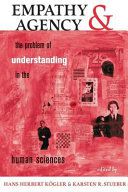
How do we, as interpreters and theorists in the human and social sciences, understand agency? What are the methods, models, and mediating theoretical frameworks that allow us to give a reliable and adequate account of beliefs, actions, and cultural practices? More specifically, how can we as interpretive analysts employ our own cognitive capacities so as to render the beliefs, intentions, and actions of other human beings intelligible? These are the leading questions that a group of well-established social philosophers explore in this volume in light of the most recent (and hotly debated) findings in cognitive science, developmental psychology, and philosophy of mind. In particular, the debate concerning simulation — whether agents interpret others by means of implicit theoretical assumptions, or whether they rather simulate their behavior by putting themselves in their shoes — has produced a wide set of important empirical and philosophical insights. This book takes up those insights and discusses their impact in the context of their most important paradigms in social methodology today.A systematic introduction pertaining to the understanding-explanation debate sets the stage, followed by eleven chapters representing the different approaches tot he field. The paradigms include Wittgensteinian, Davidsonian and Diltheyan approaches, hermeneutics and critical theory, game theory, naturalized epistemology, philosophy of history and twentieth-century social theory, as well as simulation approach proper. As stake are the relation between everyday and social-scientific interpretation, the role of empathy (or role-taking) in understanding human agency, the implications of attributing rationality in the course of interpretation, as well as the relation between rational and causal models in social explanation. The discussions cut across well-established disciplinary boundaries so that the book appeals to both analytic and hermeneutic traditions within philosophy. In addition, the book speaks to all who are engaged in interpreting or explaining human agency in the cultural and social sciences.
A distinguished moral philosopher and a leading interpreter of Kant’s ethics, Barbara Herman draws on Kant to address timeless issues in ethical theory as well as ones arising from current moral problems, such as obligations to distant need, the history of slavery as it bears on affirmative action, and the moral costs of reparative justice. Challenging various Kantian orthodoxies, Herman offers a view of moral competency as a complex achievement, governed by rational norms and dependent on supportive social conditions. She argues that the objectivity of duties and obligations does not rule out the possibility of or need for moral invention. Her goal is not to revise Kant but to explore the issues and ask the questions that he did not consider. Some of the essays involve explicit interpretation of Kant, and others are prompted by ground-level questions. For example, how should we think about moral character given what we know about the fault lines in normal development? If ordinary moral life is saturated by the content of local institutions, how should our accounts of moral obligation and judgment accommodate this?
Das Standardwerk der Motivationspsychologie liefert einen umfassenden Uberblick uber den aktuellen Stand der Motivationsforschung. Die 4. Auflage wurde uberarbeitet und um ein Kapitel zu evolutions- und biopsychologischen Aspekten erganzt. Modelle, Theorien und die Ubersicht uber empirische Arbeiten wurden aktualisiert. Kapitelzusammenfassungen, Anwendungsbeispiele sowie Fragen und Antworten zur Wissensuberprufung erleichtern das Lesen und Lernen fur die Prufung. Die begleitende Website bietet Lerntools fur Studierende und Foliensatze fur Dozenten.
ما از اخلاق چه انتظاری داریم؟ این سوال شاید تاحدودی برای عموم مردم و یا متخصصان این رشته قابل پاسخ باشد؛ اینکه خوب بودن را به ما بیاموزد و در تنظیم روابط فردی م...

جشن کتاب تهران به ایستگاه سی و یکم رسیده است. حال و احوال نشر کتاب خوب نیست و باید فرهنگدوستان را به خرید و هدیه دادن کتاب ترغیب نمود. خانه اخلاقپژوهان جوان ب...

بنیاد کتابهای اخلاق اسلامی عمدتا پالایش جان از آلودگیها و آراستن آن به زیباییها است. اندیشه محوری این قبیل کتابها آن است که انسان فعلی آنی نیست که باید باشد...

-
0 Comments