Notice: تابع WP_Block_Type_Registry::register به طورنادرست فراخوانی شد. نامهای نوع بلوک نباید حروف بزرگ داشته باشند. لطفاً برای اطلاعات بیشتر، اشکال زدایی در وردپرس را مشاهده کنید. (این پیام در نگارش 5.0.0 افزوده شده است.) in /home/ethicsho/public_html/wp-includes/functions.php on line 5313
Warning: Use of undefined constant TDC_PATH_LEGACY - assumed 'TDC_PATH_LEGACY' (this will throw an Error in a future version of PHP) in /home/ethicsho/public_html/wp-content/plugins/td-composer/td-composer.php on line 109
Warning: Use of undefined constant TDSP_THEME_PATH - assumed 'TDSP_THEME_PATH' (this will throw an Error in a future version of PHP) in /home/ethicsho/public_html/wp-content/plugins/td-composer/td-composer.php on line 113 بایگانیهای 9780198250050 - خانه اخلاق پژوهان جوان Notice: Trying to access array offset on value of type bool in /home/ethicsho/public_html/wp-content/plugins/wp-ulike/inc/general-functions.php on line 807
Transcendental phenomenology presumed to have overcome the classic mind-body dichotomy in terms of consciousness, yet, according to progress in scientific studies, the biological functions of the brain seem to appropriate significant functions attributed traditionally to consciousness. Should we indeed dissolve the specificity of human consciousness by explaining human experience in its multiple sense-giving modalities through the physiological functions of the brain? The present collection of studies addresses this crucial question challenging such “naturalizing” reductionism from multiple angles. In search for the roots of “The Specifically Human Experience” (Bombala), moving along the line of “Animality and Intellection”(Gosetti-Ferencei), “Naturalistic Attitude and Personalistic Attitude”(Villela-Petit), and numerous other perspectives, we arrive at a novel proposal to explain the scholar functional differentiation of conscious modalities. We reach their source in the ontopoietic thread conducting the Logos of Life in its stepwise “Evolutive Unfolding”(Carmen Cozma), and in “sentience” as its quintessential core of further irreducible continuity (Tymieniecka) dispelling dichotomies and reductionisms. Papers by: Grahame Lock, Anna-Teresa Tymieniecka, Daniela Verducci, Ted Toadvine, Mary Trachsel, Martin Holt, Mary Jeanne Larrabee, Leszek Pyra, Bronislaw Bombala, Konrad Rokstad, Ilja Maso, Nancy Mardas, Jennifer Anna Gosetti-Ferencei, Maria Villela-Petit, Mara Stafecka, Carmen Cozma, Francesco Totaro, Andreas Brenner, Sinan Kadir Celik, Osvaldo Rossi, Maria Manuela Brinto Martins, Elga Freiberga, Klymet Selvi, J.C. Couciero-Bueno, Patricia Trutty-Coohill, Walter Lammi, Ljudmila Molodkina, Martin Nkafu Nkemnkia.
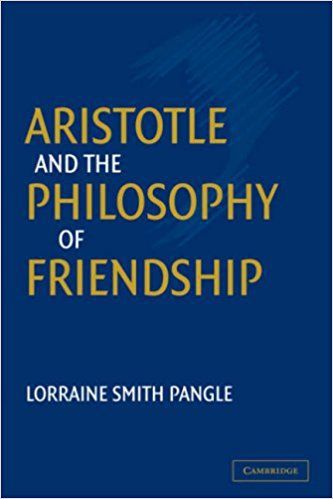
This is the first book to offer a comprehensive account of the major philosophical works on friendship and its relationship to self-love. The book gives central place to Aristotle’s searching examination of friendship in the Nicomachean Ethics. Lorraine Pangle argues that the difficulties surrounding this discussion are soon dispelled once one understands the purpose of the Ethics as both a source of practical guidance for life and a profound, theoretical investigation into human nature. The book also provides fresh interpretations of works on friendship by Plato, Cicero, Epicurus, Seneca, Montaigne and Bacon. The author shows how each of these thinkers sheds light on central questions of moral philosophy: is human sociability rooted in neediness or strength? is the best life chiefly solitary, or dedicated to a community with others? Clearly structured and engagingly written, this book will appeal to a broad swathe of readers across philosophy, classics and political science.
What does it mean to lead a moral life? In her first extended study of moral philosophy, Judith Butler offers aprovocative outline for a new ethical practice–one responsive to the need for critical autonomy and grounded in a new sense of the human subject. Butler takes as her starting point one’s ability to answer the questions ocirc;What have I done?ouml; and ocirc;What ought I to do?ouml; She shows that these question can be answered only by asking a prior question, ocirc;Who is this aelig;I’ who is under an obligation to give an account of itself and to act in certain ways?ouml; Because I find that I cannot give an account of myself without accounting for the social conditions under which I emerge, ethical reflection requires a turn to social theory. In three powerfully crafted and lucidly written chapters, Butler demonstrates how difficult it is to give an account of oneself, and how this lack of self-transparency and narratibility is crucial to an ethical understanding of the human. In brilliant dialogue with Adorno, Levinas, Foucault, and other thinkers, she eloquently argues the limits, possibilities, and dangers of contemporary ethical thought. Butler offers a critique of the moral self, arguing that the transparent, rational, and continuous ethical subject is an impossible construct that seeks to deny the specificity of what it is to be human. We can know ourselves only incompletely, and only in relation to a broader social world that has always preceded us and already shaped us in ways we cannot grasp. If inevitably we are partially opaque to ourselves, how can giving an account of ourselves define the ethical act? And doesn’t an ethical system that holds us impossibly accountable for full self-knowledge and self-consistency inflict a kind of psychic violence, leading to a culture of self-beratement and cruelty? How does the turn to social theory offer us a chance to understand the specifically social character of our own unknowingness about ourselves? In this invaluable book, by recasting ethics as a project in which being ethical means becoming critical of norms under which we are asked to act, but which we can never fully choose, Butler illuminates what it means for us as ocirc;fallible creaturesouml; to create and share an ethics of vulnerability, humility, and ethical responsiveness.
ما از اخلاق چه انتظاری داریم؟ این سوال شاید تاحدودی برای عموم مردم و یا متخصصان این رشته قابل پاسخ باشد؛ اینکه خوب بودن را به ما بیاموزد و در تنظیم روابط فردی م...

جشن کتاب تهران به ایستگاه سی و یکم رسیده است. حال و احوال نشر کتاب خوب نیست و باید فرهنگدوستان را به خرید و هدیه دادن کتاب ترغیب نمود. خانه اخلاقپژوهان جوان ب...

بنیاد کتابهای اخلاق اسلامی عمدتا پالایش جان از آلودگیها و آراستن آن به زیباییها است. اندیشه محوری این قبیل کتابها آن است که انسان فعلی آنی نیست که باید باشد...

-
0 Comments