Notice: تابع WP_Block_Type_Registry::register به طورنادرست فراخوانی شد. نامهای نوع بلوک نباید حروف بزرگ داشته باشند. لطفاً برای اطلاعات بیشتر، اشکال زدایی در وردپرس را مشاهده کنید. (این پیام در نگارش 5.0.0 افزوده شده است.) in /home/ethicsho/public_html/wp-includes/functions.php on line 5313
Warning: Use of undefined constant TDC_PATH_LEGACY - assumed 'TDC_PATH_LEGACY' (this will throw an Error in a future version of PHP) in /home/ethicsho/public_html/wp-content/plugins/td-composer/td-composer.php on line 109
Warning: Use of undefined constant TDSP_THEME_PATH - assumed 'TDSP_THEME_PATH' (this will throw an Error in a future version of PHP) in /home/ethicsho/public_html/wp-content/plugins/td-composer/td-composer.php on line 113 بایگانیهای 9780198238966 - خانه اخلاق پژوهان جوان Notice: Trying to access array offset on value of type bool in /home/ethicsho/public_html/wp-content/plugins/wp-ulike/inc/general-functions.php on line 807
This book evaluates the claim that in order to explore the changing social foundations of global power relations today, we need to include in our analysis an understanding of global civil society, particularly if we also wish to raise ethical questions about the changing political and institutional practices of transnational governance. The authors engage directly with the notion of global civil society in order to examines the ethical, social, and political conditions that make certain kinds of globalizing practices a reality today. They explore and utilize the normative dimensions of the civil discourse to further debate about the meaning of citizenship in a world of multi-level governance, as well as the changing characteristics of political community and democracy. Bridging the normative concerns of political theorists with the historical and institutional focus of scholars of international relations and international political economy, this book will be of broad interest to students andresearchers concerned with international relations, civil society, global governance and ethics.
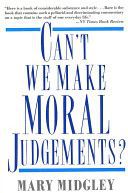
In this book, Mary Midgely turns a spotlight on the fashionable view that we no longer need or use moral judgements. She shows how the question of whether or not we can make moral judgements must inevitably affect our attitudes to the law and its institutions, but also to events that occur in our daily lives.
۰۰ Unprecedented advances in medicine, genetic engineering, and demographic forecasting raise new questions that strain the categories and assumptions of traditional ethical theories. Heyd’s approach resolves many paradoxes in intergenerational justice, while offering a major test case for the profound problems of the limits of ethics and the nature of value. Unprecedented advances in medicine, genetic engineering, and demographic forecasting raise new questions that strain the categories and assumptions of traditional ethical theories. Heyd’s approach resolves many paradoxes in intergenerational justice, while offering a major test case for the profound problems of the limits of ethics and the nature of value.
The 1991 US Supreme Court decision in Feist Publications Inc. v. Rural Telephone Service Co. held that factual matter is not subject to copyright protection because it is not original to the author, thus dramatically rejecting a two-century-old tradition of protecting factual compilations under copyright. The contributors to this book reassess this decision and its implications, particularly for the protection of electronic databases. The debate over fact-based works has grown still more complicated since Feist with the enactment of worldwide initiatives that extend the protection of databases, such as the European Union’s Database Directive. A number of legal scholars have voiced their opinions on how Congress should react to the Court’s decision and the Database Directive, but none have put forth a viable solution or questioned the debate’s underlying assumptions. The contributors to this insightful book turn their attention to these overlooked aspects, approaching the protection of factual matter from a range of perspectives: policy, historical, comparative, empirical and philosophical. The range of viewpoints and disciplines represented in this compelling book will be of great interest to students, scholars and lawyers working in the area of intellectual property law.
ما از اخلاق چه انتظاری داریم؟ این سوال شاید تاحدودی برای عموم مردم و یا متخصصان این رشته قابل پاسخ باشد؛ اینکه خوب بودن را به ما بیاموزد و در تنظیم روابط فردی م...

جشن کتاب تهران به ایستگاه سی و یکم رسیده است. حال و احوال نشر کتاب خوب نیست و باید فرهنگدوستان را به خرید و هدیه دادن کتاب ترغیب نمود. خانه اخلاقپژوهان جوان ب...

بنیاد کتابهای اخلاق اسلامی عمدتا پالایش جان از آلودگیها و آراستن آن به زیباییها است. اندیشه محوری این قبیل کتابها آن است که انسان فعلی آنی نیست که باید باشد...

-
0 Comments