Notice: تابع WP_Block_Type_Registry::register به طورنادرست فراخوانی شد. نامهای نوع بلوک نباید حروف بزرگ داشته باشند. لطفاً برای اطلاعات بیشتر، اشکال زدایی در وردپرس را مشاهده کنید. (این پیام در نگارش 5.0.0 افزوده شده است.) in /home/ethicsho/public_html/wp-includes/functions.php on line 5313
Warning: Use of undefined constant TDC_PATH_LEGACY - assumed 'TDC_PATH_LEGACY' (this will throw an Error in a future version of PHP) in /home/ethicsho/public_html/wp-content/plugins/td-composer/td-composer.php on line 109
Warning: Use of undefined constant TDSP_THEME_PATH - assumed 'TDSP_THEME_PATH' (this will throw an Error in a future version of PHP) in /home/ethicsho/public_html/wp-content/plugins/td-composer/td-composer.php on line 113 بایگانیهای 9780190272197 - خانه اخلاق پژوهان جوان Notice: Trying to access array offset on value of type bool in /home/ethicsho/public_html/wp-content/plugins/wp-ulike/inc/general-functions.php on line 807
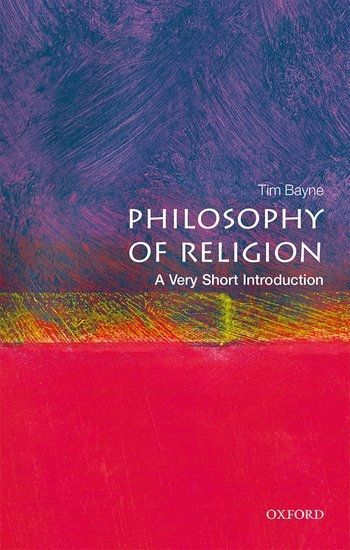
What is the philosophy of religion? How can we distinguish it from theology on the one hand and the psychology/sociology of religious belief on the other? What does it mean to describe God as ‘eternal’? And should religious people want there to be good arguments for the existence of God, or is religious belief only authentic in the absence of these good arguments?00In this ‘Very Short Introduction’ Tim Bayne introduces the field of philosophy of religion, and engages with some of the most burning questions that philosophers discuss. Considering how ‘religion’ should be defined, and whether we even need to be able to define it in order to engage in the philosophy of religion, he goes on to discuss whether the existence of God matters. Exploring the problem of evil, Bayne also debates the connection between faith and reason, and the related question of what role reason should play in religious contexts. Shedding light on the relationship between science and religion, Bayne finishes by considering the topics of reincarnation and the afterlife.
Talking to patients and their families about end-of-life issues can be difficult and stressful. End of Life Communication in the ICU looks at ways different cultures view death and then further explores how health care providers around the world communicate about such sensitive issues as withholding or withdrawing life support and discussing options when the outcome is uncertain. Through a better understanding of cultural differences in attitudes about death and methods of communications about end-of-life issues, practitioners can be better prepared to communicate with their own patients and their patientsa (TM) families.
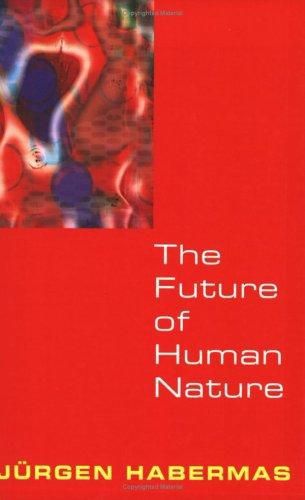
Recent developments in biotechnology and genetic research are raising complex ethical questions concerning the legitimate scope and limits of genetic intervention. As we begin to contemplate the possibility of intervening in the human genome to prevent diseases, we cannot help but feel that the human species might soon be able to take its biological evolution in its own hands. ‘Playing God’ is the metaphor commonly used for this self-transformation of the species, which, it seems, might soon be within our grasp. In this important new book, Jurgen Habermas – the most influential philosopher and social thinker in Germany today – takes up the question of genetic engineering and its ethical implications and subjects it to careful philosophical scrutiny. His analysis is guided by the view that genetic manipulation is bound up with the identity and self-understanding of the species. We cannot rule out the possibility that knowledge of one’s own hereditary factors may prove to be restrictive for the choice of an individual’s way of life and may undermine the symmetrical relations between free and equal human beings. In the concluding chapter – which was delivered as a lecture on receiving the Peace Prize of the German Book Trade for 2001 – Habermas broadens the discussion to examine the tension between science and religion in the modern world, a tension which exploded, with such tragic violence, on September 11th.
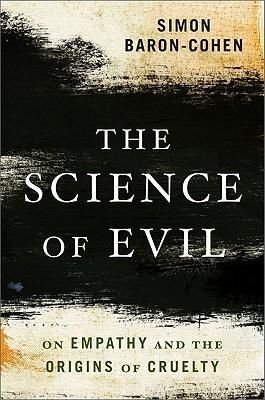
Borderline personality disorder, autism, narcissism, psychosis, Asperger’s: All of these syndromes have one thing in common–lack of empathy. In some cases, this absence can be dangerous, but in others it can simply mean a different way of seeing the world.In Cruel or Unusual Simon Baron-Cohen, an award-winning British researcher who has investigated psychology and autism for decades, develops a new brain-based theory of human cruelty. A true psychologist, however, he examines social and environmental factors that can erode empathy, including neglect and abuse. Based largely on Baron-Cohen’s own research, Cruel or Unusual will change the way we understand and treat human cruelty.
Fichte’s System of Ethics, originally published in 1798, is at once the most accessible presentation of its author’s comprehensive philosophical project, The Science of Knowledge or Wissenschaftslehre, and the most important work in moral philosophy written between Kant and Hegel. This study integrates the discussion of our moral duties into the systematic framework of a transcendental theory of the human subject. Ranging over numerous important philosophical themes, the volume offers a new translation of the work together with an introduction that sets it in its philosophical and historical contexts.
ما از اخلاق چه انتظاری داریم؟ این سوال شاید تاحدودی برای عموم مردم و یا متخصصان این رشته قابل پاسخ باشد؛ اینکه خوب بودن را به ما بیاموزد و در تنظیم روابط فردی م...

جشن کتاب تهران به ایستگاه سی و یکم رسیده است. حال و احوال نشر کتاب خوب نیست و باید فرهنگدوستان را به خرید و هدیه دادن کتاب ترغیب نمود. خانه اخلاقپژوهان جوان ب...

بنیاد کتابهای اخلاق اسلامی عمدتا پالایش جان از آلودگیها و آراستن آن به زیباییها است. اندیشه محوری این قبیل کتابها آن است که انسان فعلی آنی نیست که باید باشد...

-
0 Comments