Notice: تابع WP_Block_Type_Registry::register به طورنادرست فراخوانی شد. نامهای نوع بلوک نباید حروف بزرگ داشته باشند. لطفاً برای اطلاعات بیشتر، اشکال زدایی در وردپرس را مشاهده کنید. (این پیام در نگارش 5.0.0 افزوده شده است.) in /home/ethicsho/public_html/wp-includes/functions.php on line 5313
Warning: Use of undefined constant TDC_PATH_LEGACY - assumed 'TDC_PATH_LEGACY' (this will throw an Error in a future version of PHP) in /home/ethicsho/public_html/wp-content/plugins/td-composer/td-composer.php on line 109
Warning: Use of undefined constant TDSP_THEME_PATH - assumed 'TDSP_THEME_PATH' (this will throw an Error in a future version of PHP) in /home/ethicsho/public_html/wp-content/plugins/td-composer/td-composer.php on line 113 بایگانیهای 978-1-4020-6210-0 - خانه اخلاق پژوهان جوان Notice: Trying to access array offset on value of type bool in /home/ethicsho/public_html/wp-content/plugins/wp-ulike/inc/general-functions.php on line 807
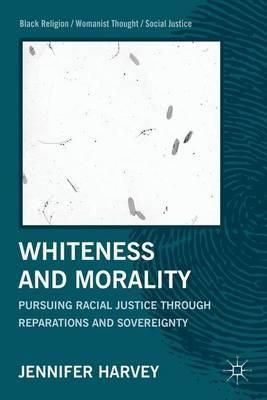
“What does it mean to “be white”? Jennifer Harvey asks this question in order to consider how white U.S. Americans can fully participate in racial justice-making. Exploring native, African, and white American relations in two moments of United States history, she illustrates how “white” identities are the concrete embodiments of deeply problematic moral realities. She argues that movements for reparations for people of African descent and sovereignty for Native peoples attempt to redress such realities. Such movements, she concludes, are thus critical for racial justice and for the moral and spiritual transformation of white people in the United States.”–BOOK JACKET.
Hamlet tells Horatio that there are more things in heaven and earth than are dreamt of in his philosophy. InDouble Vision, philosopher and literary critic Tzachi Zamir argues that there are more things in Hamlet than are dreamt of–or at least conceded–by most philosophers. Making an original and persuasive case for the philosophical value of literature, Zamir suggests that certain important philosophical insights can be gained only through literature. But such insights cannot be reached if literature is deployed merely as an aesthetic sugaring of a conceptual pill. Philosophical knowledge is not opposed to, but is consonant with, the literariness of literature. By focusing on the experience of reading literature as literature and not philosophy, Zamir sets a theoretical framework for a philosophically oriented literary criticism that will appeal both to philosophers and literary critics. Double Visionis concerned with the philosophical understanding induced by the aesthetic experience of literature. Literary works can function as credible philosophical arguments–not ones in which claims are conclusively demonstrated, but in which claims are made plausible. Such claims, Zamir argues, are embedded within an experiential structure that is itself a crucial dimension of knowing. Developing an account of literature’s relation to knowledge, morality, and rhetoric, and advancing philosophical-literary readings ofRichard III, Macbeth, Romeo and Juliet, Othello, Antony and Cleopatra, Hamlet, andKing Lear, Zamir shows how his approach can open up familiar texts in surprising and rewarding ways.
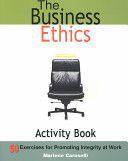
Companies in every industry are recommitting themselves to creating environments of honesty and renewing trust with their customers, employees, and the general public. But it’s not as easy as it sounds. Even in “good” organizations, proactive ethics initiatives are still a very new concept, and the question remains, “How do we do this?” The answer can be found in the 50 exercises in The Business Ethics Activity Book. These ready-to-use, easily adaptable activities will engage individuals, teams, and groups and generate the kind of thought and discussion that ultimately leads to mutual respect and an atmosphere in which ethical behavior defines organizational culture. Book jacket.
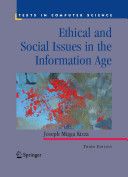
Ethical dilemmas have risen in number and intensity with the increasing dependence of contemporary society on computers and computer networks. Despite the proliferation of expert remedies, viable solutions to computer security issues remain too elusive, and society continues to suffer at the hands of cyber criminals, vandals, and hackers.This comprehensive third edition of the successful Ethical and Social Issues in the Information Age takes off where the second ended to examine ethical, social, and policy challenges stemming from the emergence of cyberspace, the convergence of telecommunication and computing technologies, and the miniaturalization of computing, telecommunication, and information-enabling devices. This accessible volume broadly surveys thought-provoking questions about the impact of these new technologies, with particular emphasis on the rapid growth of a multitude of computer networks, including the Internet. It assumes only a very modest familiarity with the basic computer literacy.Topics and features:• Describes how changes in information technology influence morality and the law• Provides fundamental discussion of network-security system design and operation to reveal vulnerable areas in computer network infrastructure (NEW chapter)• Surveys the history of computing and the evolution of computer crimes• Explores biometric techniques to system access control (NEW chapter)• Incorporates recent requirements for computer curricula• Introduces and explores techniques in electronic crime investigation (NEW chapter)• Assesses workplace concerns related to privacy, surveillance, and virtual offices• Offers a pertinent discussion on civil liberties, harassment, and discrimination• Contains chapter-ending exercises, and the author provides instructor classroom support materials and teaching guides at his websiteThis newly revised text/reference provides an updated discussion of the ethical and social issues that continue to evolve as computing and information technologies proliferate. Students at all levels who need to learn about computer ethics, the legal aspects of computing, network security, computer crime investigation, and biometrics will find this well documented work an invaluable resource. The book is also highly useful for practitioners needing such insights for their work.Supplementary material can be found at: www.utc.edu/faculty/Joseph-Kizza
ما از اخلاق چه انتظاری داریم؟ این سوال شاید تاحدودی برای عموم مردم و یا متخصصان این رشته قابل پاسخ باشد؛ اینکه خوب بودن را به ما بیاموزد و در تنظیم روابط فردی م...

جشن کتاب تهران به ایستگاه سی و یکم رسیده است. حال و احوال نشر کتاب خوب نیست و باید فرهنگدوستان را به خرید و هدیه دادن کتاب ترغیب نمود. خانه اخلاقپژوهان جوان ب...

بنیاد کتابهای اخلاق اسلامی عمدتا پالایش جان از آلودگیها و آراستن آن به زیباییها است. اندیشه محوری این قبیل کتابها آن است که انسان فعلی آنی نیست که باید باشد...

-
0 Comments