Notice: تابع WP_Block_Type_Registry::register به طورنادرست فراخوانی شد. نامهای نوع بلوک نباید حروف بزرگ داشته باشند. لطفاً برای اطلاعات بیشتر، اشکال زدایی در وردپرس را مشاهده کنید. (این پیام در نگارش 5.0.0 افزوده شده است.) in /home/ethicsho/public_html/wp-includes/functions.php on line 5313
Warning: Use of undefined constant TDC_PATH_LEGACY - assumed 'TDC_PATH_LEGACY' (this will throw an Error in a future version of PHP) in /home/ethicsho/public_html/wp-content/plugins/td-composer/td-composer.php on line 109
Warning: Use of undefined constant TDSP_THEME_PATH - assumed 'TDSP_THEME_PATH' (this will throw an Error in a future version of PHP) in /home/ethicsho/public_html/wp-content/plugins/td-composer/td-composer.php on line 113 بایگانیهای 0321235118 - خانه اخلاق پژوهان جوان Notice: Trying to access array offset on value of type bool in /home/ethicsho/public_html/wp-content/plugins/wp-ulike/inc/general-functions.php on line 807
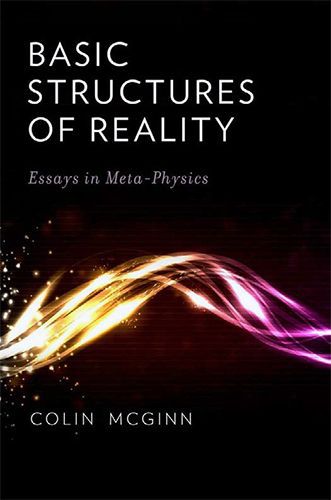
In Basic Structures of Reality, Colin McGinn deals with questions of metaphysics, epistemology, and philosophy of mind from the vantage point of physics. Combining general philosophy with physics, he covers such topics as the definition of matter, the nature of space, motion, gravity, electromagnetic fields, the character of physical knowledge, and consciousness and meaning. Throughout, McGinn maintains an historical perspective and seeks to determine how much we really know of the world described by physics. He defends a version of “structuralism”: the thesis that our knowledge is partial and merely abstract, leaving a large epistemological gap at the center of physics.
McGinn then connects this element of mystery to parallel mysteries in relation to the mind. Consciousness emerges as just one more mystery of physics. A theory of matter and space is developed, according to which the impenetrability of matter is explained as the deletion of volumes of space. McGinn proposes a philosophy of science that distinguishes physics from both psychology and biology, explores the ontology of energy, and considers the relevance of physics to seemingly remote fields such as the theory of meaning. In the form of a series of aphorisms, the author presents a metaphysical system that takes laws of nature as fundamental. With its broad scope and deep study of the fundamental questions at the heart of philosophy of physics, this book is not intended primarily for specialists, but for the general philosophical reader interested in how physics and philosophy intersect.
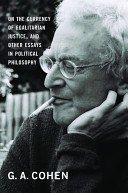
G. A. Cohen was one of the most gifted, influential, and progressive voices in contemporary political philosophy. At the time of his death in 2009, he had plans to bring together a number of his most significant papers. This is the first of three volumes to realize those plans. Drawing on three decades of work, it contains previously uncollected articles that have shaped many of the central debates in political philosophy, as well as papers published here for the first time. In these pieces, Cohen asks what egalitarians have most reason to equalize, he considers the relationship between freedom and property, and he reflects upon ideal theory and political practice.Included here are classic essays such as “Equality of What?” and “Capitalism, Freedom, and the Proletariat,” along with more recent contributions such as “Fairness and Legitimacy in Justice,” “Freedom and Money,” and the previously unpublished “How to Do Political Philosophy.” On ample display throughout are the clarity, rigor, conviction, and wit for which Cohen was renowned. Together, these essays demonstrate how his work provides a powerful account of liberty and equality to the left of Ronald Dworkin, John Rawls, Amartya Sen, and Isaiah Berlin.
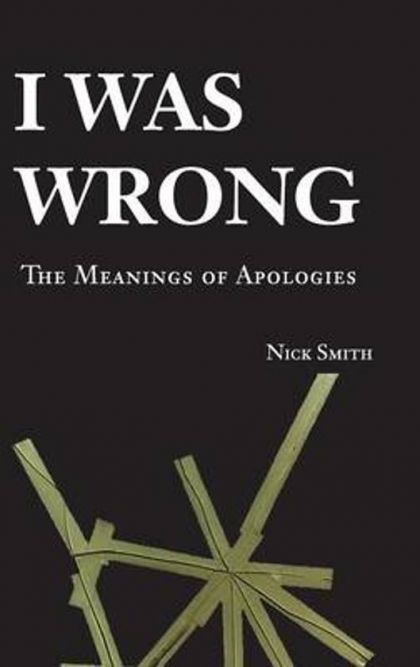
Apologies pervade our news headlines and our private affairs, but how should we evaluate these often vague and deceptive rituals? Discussing numerous examples from ancient and recent history, I Was Wrong: On The Meanings of Apologies argues that we suffer from considerable confusion about the moral meanings and social functions of these complex interactions. Rather than asking whether a speech act “is or is not” an apology, Smith offers a nuanced theory of apologetic meaning. Smith leads us with a clear voice though a series of rich philosophical and interdisciplinary questions, arguing that apologies have evolved from a confluence of diverse cultural and religious practices that do not translate easily into pluralistic secular discourse. After describing several varieties of apologies between individuals, Smith turns to collectives. Although apologies from corporations, governments, and other groups can be profoundly significant, Smith guides readers to appreciate the kinds of meaning that collective apologies often do not convey and warns of the dangers of collective acts of contrition that allow individual wrongdoers to obscure their personal blame. Dr. Smith is an assistant professor of philosophy at the University of New Hampshire. A graduate of Vassar College, he earned a law degree from SUNY at Buffalo and a Ph.D. in philosophy from Vanderbilt University. Before coming to UNH, he worked as a litigator for LeBoeuf, Lamb, Greene, and MacRae and as a judicial clerk for the Honorable R.L. Nygaard of the United States Court of Appeals for the Third Circuit. He specializes in the philosophy of Law, Politics, and Society and he writes on and teaches aesthetics. He is working with Cambridge University Press on the sequel to I Was Wrong, applying his framework for apologetic meanings to examples in criminal and civil law. His writings have appeared in journals such as Continental Philosophy Review, Social Theory and Practice, The Journal of Social Philosophy, Culture, Theory & Critique, The Rutgers Law Journal, and The Buffalo Law Review.
Provides a unique approach to the study of ethics by incorporating both the philosophical and religious perspectives against a discussion of moral issues. It requires readers to examine their own positions on a range of moral issues and to provide reasons in support of those opinions through readings that emphasize the use of critical thinking skills as necessary to moral reasoning.
ما از اخلاق چه انتظاری داریم؟ این سوال شاید تاحدودی برای عموم مردم و یا متخصصان این رشته قابل پاسخ باشد؛ اینکه خوب بودن را به ما بیاموزد و در تنظیم روابط فردی م...

جشن کتاب تهران به ایستگاه سی و یکم رسیده است. حال و احوال نشر کتاب خوب نیست و باید فرهنگدوستان را به خرید و هدیه دادن کتاب ترغیب نمود. خانه اخلاقپژوهان جوان ب...

بنیاد کتابهای اخلاق اسلامی عمدتا پالایش جان از آلودگیها و آراستن آن به زیباییها است. اندیشه محوری این قبیل کتابها آن است که انسان فعلی آنی نیست که باید باشد...

-
0 Comments