Notice: تابع WP_Block_Type_Registry::register به طورنادرست فراخوانی شد. نامهای نوع بلوک نباید حروف بزرگ داشته باشند. لطفاً برای اطلاعات بیشتر، اشکال زدایی در وردپرس را مشاهده کنید. (این پیام در نگارش 5.0.0 افزوده شده است.) in /home/ethicsho/public_html/wp-includes/functions.php on line 5313
Warning: Use of undefined constant TDC_PATH_LEGACY - assumed 'TDC_PATH_LEGACY' (this will throw an Error in a future version of PHP) in /home/ethicsho/public_html/wp-content/plugins/td-composer/td-composer.php on line 109
Warning: Use of undefined constant TDSP_THEME_PATH - assumed 'TDSP_THEME_PATH' (this will throw an Error in a future version of PHP) in /home/ethicsho/public_html/wp-content/plugins/td-composer/td-composer.php on line 113 بایگانیهای 0-8070-1426-5 - خانه اخلاق پژوهان جوان Notice: Trying to access array offset on value of type bool in /home/ethicsho/public_html/wp-content/plugins/wp-ulike/inc/general-functions.php on line 807
Written by internationally renowned scholars, this Companion maps the moral teachings of the world’s religions, and also charts new directions for work in the field of religious ethics. Now available in paperback, this is a rich resource for understanding the moral teachings and practices of the world’s religions Includes detailed discussions of issues in moral theory Offers extensive treatment of the world’s major religious traditions, including Judaism, Christianity, Islam, Buddhism, Hinduism, Chinese religions and African religions Compares the ways in which the religions provide resources for addressing current moral challenges in areas such as ecology, economics, global dynamics, religious war, human rights and other topics.
How do we know what is morally right or wrong, good or bad? There have been innumerable answers to this question in the history of philosophy. Most of these answers can be grouped under two major positions. Either moral experience is emotional, but then it must be subjective (sentimentalism); or it is objective, but then it must be rational (rationalism). This division is based on a dichotomy between reason and emotion. However, this dichotomy has long been rejected by many emotion-scholars. This book presents a new philosophical theory according to which we need intuitions and emotions in order to have objective moral knowledge, which is called affectual intuitionism. Affectual Intuitionism combines ethical intuitionism with a cognitive theory of emotions. This approach avoids a phenomenologically implausible rationalism as much as a morally problematic relativism, and it connects well with recent developments in moral psychology.
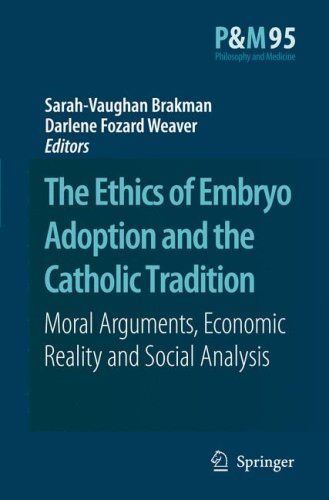
At last, a comprehensive collection of essays that examines and advances ethical evaluations of the controversial and increasingly popular practice of embryo adoption. In the United States alone, 400,000 frozen embryos created for in vitro fertilization exist but are no longer desired for that purpose. What are we morally obliged or permitted to do about these “spare” embryos? More of their genetic parents are considering donating these embryos to others to gestate and raise. This practice is politically volatile (figuring in debates about embryonic stem cells) and medically and morally complex. At the present time within the Roman Catholic Church there is no official teaching on embryo adoption. Catholic ethical analyses grapple with the way embryo adoption comports with respect for embryonic human life yet challenges Catholic moral critiques of assisted reproductive technologies. This volume is the first to bring together leading philosophers and theologians to engage Catholic debates about embryo adoption in an interactive format. The editors, a philosopher bioethicist and a moral theologian, provide a helpful overview of the practice and the arguments surrounding embryo adoption. They engage neglected Catholic ethical resources and issues to advance the current debate and chart new directions in Catholic moral thinking about this intriguing practice. The volume also includes a description of embryo adoption from a physician practitioner along with reflections from a couple who successfully adopted an embryo.
This volume is an edited collection of original papers on the theme of “Values, Rational Choice, and the Will”. The editor is a Stanford-trained moral philosopher, and the organizer of a conference held on April 1-3, 2004. The conference succeeded in bringing together a wide range of essays that dealt with most of the central questions of moral philosophy today, in both normative ethics and meta-ethics, theoretical and applied ethics, and especially in moral psychology.
ما از اخلاق چه انتظاری داریم؟ این سوال شاید تاحدودی برای عموم مردم و یا متخصصان این رشته قابل پاسخ باشد؛ اینکه خوب بودن را به ما بیاموزد و در تنظیم روابط فردی م...

جشن کتاب تهران به ایستگاه سی و یکم رسیده است. حال و احوال نشر کتاب خوب نیست و باید فرهنگدوستان را به خرید و هدیه دادن کتاب ترغیب نمود. خانه اخلاقپژوهان جوان ب...

بنیاد کتابهای اخلاق اسلامی عمدتا پالایش جان از آلودگیها و آراستن آن به زیباییها است. اندیشه محوری این قبیل کتابها آن است که انسان فعلی آنی نیست که باید باشد...

-
0 Comments