Notice: تابع WP_Block_Type_Registry::register به طورنادرست فراخوانی شد. نامهای نوع بلوک نباید حروف بزرگ داشته باشند. لطفاً برای اطلاعات بیشتر، اشکال زدایی در وردپرس را مشاهده کنید. (این پیام در نگارش 5.0.0 افزوده شده است.) in /home/ethicsho/public_html/wp-includes/functions.php on line 5313
Warning: Use of undefined constant TDC_PATH_LEGACY - assumed 'TDC_PATH_LEGACY' (this will throw an Error in a future version of PHP) in /home/ethicsho/public_html/wp-content/plugins/td-composer/td-composer.php on line 109
Warning: Use of undefined constant TDSP_THEME_PATH - assumed 'TDSP_THEME_PATH' (this will throw an Error in a future version of PHP) in /home/ethicsho/public_html/wp-content/plugins/td-composer/td-composer.php on line 113 بایگانیهای 0-262-07252-1 - خانه اخلاق پژوهان جوان Notice: Trying to access array offset on value of type bool in /home/ethicsho/public_html/wp-content/plugins/wp-ulike/inc/general-functions.php on line 807
Challenging, with several powerful arguments, some of our deepest beliefs about rationality, morality, and personal identity, Parfit claims that we have a false view about our own nature. It is often rational to act against our own best interests, he argues, and most of us have moral views that are self-defeating. We often act wrongly, although we know there will be no one with serious grounds for complaint, and when we consider future generations it is very hard to avoid conclusions that most of us will find very disturbing.
Jason Stanley presents a startling and provocative claim about knowledge: that whether or not someone knows a proposition at a given time is in part determined by his or her practical interests, i.e. by how much is at stake for that person at that time. So whether a true belief is knowledge is not merely a matter of supporting beliefs or reliability; in the case of knowledge, practical rationality and theoretical rationality are intertwined. Stanley defends this thesis against alternative accounts of the phenomena that motivate it, such as the claim that knowledge attributions are linguistically context-sensitive (contextualism about knowledge attributions), and the claim that the truth of a knowledge claim is somehow relative to the person making the claim (relativism about knowledge). In the course of his argument Stanley introduces readers to a number of strategies for resolving philosophical paradox, making the book essential not just for specialists in epistemology but for all philosophers interested in philosophical methodology. Since a number of his strategies appeal to linguistic evidence, it will be of great interest to linguists as well.
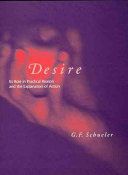
Does action always arise out of desire? G. F. Schueler examines this hotly debated topic in philosophy of action and moral philosophy, arguing that once two senses of “desire” are distinguished – roughly, genuine desires and pro attitudes – apparently plausible explanations of action in terms of the agent’s desires can be seen to be mistaken.Desire probes a fundamental issue in philosophy of mind, the nature of desires and how, if at all, they motivate and justify our actions. At least since Hume argued that reason “is and of right ought to be the slave of the passions,” many philosophers have held that desires play an essential role both in practical reason and in the explanation of intentional action. G. F. Schueler looks at contemporary accounts of both roles in various belief-desire models of reasons and explanation and argues that the usual belief-desire accounts need to be replaced.Schueler contends that the plausibility of the standard belief-desire accounts rests largely on a failure to distinguish “desires proper,” like a craving for sushi, from so-called “pro attitudes,” which may take the form of beliefs and other cognitive states as well as desires proper. Schueler’s “deliberative model” of practical reasoning suggests a different view of the place of desire in practical reason and the explanation of action. He holds that we can arrive at an intention to act by weighing the relevant considerations and that these may not include desires proper at all.A Bradford Book
ما از اخلاق چه انتظاری داریم؟ این سوال شاید تاحدودی برای عموم مردم و یا متخصصان این رشته قابل پاسخ باشد؛ اینکه خوب بودن را به ما بیاموزد و در تنظیم روابط فردی م...

جشن کتاب تهران به ایستگاه سی و یکم رسیده است. حال و احوال نشر کتاب خوب نیست و باید فرهنگدوستان را به خرید و هدیه دادن کتاب ترغیب نمود. خانه اخلاقپژوهان جوان ب...

بنیاد کتابهای اخلاق اسلامی عمدتا پالایش جان از آلودگیها و آراستن آن به زیباییها است. اندیشه محوری این قبیل کتابها آن است که انسان فعلی آنی نیست که باید باشد...

-
0 Comments