Notice: تابع WP_Block_Type_Registry::register به طورنادرست فراخوانی شد. نامهای نوع بلوک نباید حروف بزرگ داشته باشند. لطفاً برای اطلاعات بیشتر، اشکال زدایی در وردپرس را مشاهده کنید. (این پیام در نگارش 5.0.0 افزوده شده است.) in /home/ethicsho/public_html/wp-includes/functions.php on line 5313
Warning: Use of undefined constant TDC_PATH_LEGACY - assumed 'TDC_PATH_LEGACY' (this will throw an Error in a future version of PHP) in /home/ethicsho/public_html/wp-content/plugins/td-composer/td-composer.php on line 109
Warning: Use of undefined constant TDSP_THEME_PATH - assumed 'TDSP_THEME_PATH' (this will throw an Error in a future version of PHP) in /home/ethicsho/public_html/wp-content/plugins/td-composer/td-composer.php on line 113 بایگانیهای 0-02-865785-3 - خانه اخلاق پژوهان جوان Notice: Trying to access array offset on value of type bool in /home/ethicsho/public_html/wp-content/plugins/wp-ulike/inc/general-functions.php on line 807
Informal Logic is an introductory guidebook to the basic principles of constructing sound arguments and criticizing bad ones. Non-technical in approach, it is based on 186 examples, which Douglas Walton, a leading authority in the field of informal logic, discusses and evaluates in clear, illustrative detail. Walton explains how errors, fallacies, and other key failures of argument occur. He shows how correct uses of argument are based on sound strategies for reasoned persuasion and critical responses. Among the many subjects covered are: forms of valid argument, defeasible arguments, relevance, appeals to emotion, personal attack, straw man argument, jumping to a conclusion, uses and abuses of expert opinion, problems in drawing conclusions from polls and statistics, loaded terms, equivocation, arguments from analogy, and techniques of posing, replying to, and criticizing questions. This new edition takes into account many new developments in the field of argumentation study that have occurred since 1989, many created by the author. Drawing on these developments, Walton includes and analyzes 36 new topical examples and also brings in recent work on argumentation schemes. Ideally suited for use in courses in informal logic and introduction to philosophy, this book will also be valuable to students of pragmatics, rhetoric, and speech communication.
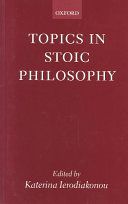
Stoicism is one of the richest and most influential intellectual traditions of antiquity. Now, in this excellent volume, leading scholars contribute new studies of a set of topics that are at the center of current research. They combine careful analytical attention to the original texts with historical sensitivity and philosophical acuity, providing the basis for a better understanding of Stoic ethics, political theory, logic, and physics.
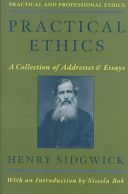
A classic work in the field of practical and professional ethics, this collection of nine essays by English philosopher and educator Henry Sidgwick (1838-1900) was first published in 1898 and forms a vital complement to Sidgwick’s major treatise on moral theory, The Methods of Ethics. Reissued here as Volume One in a new series sponsored by the Association for Practical and Professional Ethics, the book is composed chiefly of addresses to members of two ethical societies that Sidgwick helped to found in Cambridge and London in the 1880s. Clear, taut, and lively, these essays demonstrate the compassion and calm reasonableness that Sidgwick brought to all his writings. As Sidgwick explains in his opening essay, the societies he addressed aimed to allow academics, professionals, and others to pursue joint efforts at reaching “some results of value for practical guidance and life.” Sidgwick hoped that members might discuss such questions as when, if ever, public officials might be justified in lying or in breaking promises, whether scientists could legitimately inflict suffering on animals for research purposes, when nations might have just cause in going to war, and a score of other issues of ethics in public and private life still debated a century later. This valuable reissue returns Practical Ethics to its rightful place in Sidgwick’s oeuvre. Noted ethicist Sissela Bok provides a superb Introduction, ranging over the course of Sidgwick’s life and career and underscoring the relevance of Practical Ethics to contemporary debate. She writes: “Practical Ethics, the last book that Henry Sidgwick published before his death in 1900, contains the distillation of a lifetime of reflection on ethics and on what it would take for ethical debate to be ‘really of use in the solution of practical questions.'” This rich, engaging work is essential reading for all concerned with the relationship between ethical theory and. practice, and with the questions that have driven the study of professional ethics in recent years.
ما از اخلاق چه انتظاری داریم؟ این سوال شاید تاحدودی برای عموم مردم و یا متخصصان این رشته قابل پاسخ باشد؛ اینکه خوب بودن را به ما بیاموزد و در تنظیم روابط فردی م...

جشن کتاب تهران به ایستگاه سی و یکم رسیده است. حال و احوال نشر کتاب خوب نیست و باید فرهنگدوستان را به خرید و هدیه دادن کتاب ترغیب نمود. خانه اخلاقپژوهان جوان ب...

بنیاد کتابهای اخلاق اسلامی عمدتا پالایش جان از آلودگیها و آراستن آن به زیباییها است. اندیشه محوری این قبیل کتابها آن است که انسان فعلی آنی نیست که باید باشد...

-
0 Comments