Notice: تابع WP_Block_Type_Registry::register به طورنادرست فراخوانی شد. نامهای نوع بلوک نباید حروف بزرگ داشته باشند. لطفاً برای اطلاعات بیشتر، اشکال زدایی در وردپرس را مشاهده کنید. (این پیام در نگارش 5.0.0 افزوده شده است.) in /home/ethicsho/public_html/wp-includes/functions.php on line 5313
Warning: Use of undefined constant TDC_PATH_LEGACY - assumed 'TDC_PATH_LEGACY' (this will throw an Error in a future version of PHP) in /home/ethicsho/public_html/wp-content/plugins/td-composer/td-composer.php on line 109
Warning: Use of undefined constant TDSP_THEME_PATH - assumed 'TDSP_THEME_PATH' (this will throw an Error in a future version of PHP) in /home/ethicsho/public_html/wp-content/plugins/td-composer/td-composer.php on line 113 بایگانیهای 949 - خانه اخلاق پژوهان جوان Notice: Trying to access array offset on value of type bool in /home/ethicsho/public_html/wp-content/plugins/wp-ulike/inc/general-functions.php on line 807
Antirealist views about morality claim that moral facts or truths do not exist. Does this imply that other types of normative facts, such as epistemic facts, do not exist? The Normative Web develops a positive answer to this question. Terence Cuneo argues that moral and epistemic facts are sufficiently similar so that, if moral facts do not exist, then epistemic facts do not exist. But epistemic facts do exist: to deny their existence would commit us to an extreme version of epistemological scepticism. Therefore, Cuneo concludes, moral facts do exist. And if moral facts exist, then moral realism is true. It is sometimes said that moral realists rarely offer arguments for their position, settling instead for mere defenses of a view they find intuitively plausible. By contrast, The Normative Web provides not merely a defense of robust realism in ethics, but a positive argument for this position. In so doing, it engages with a range of antirealist positions in epistemology such as error theories, expressivist views, and reductionist views of epistemic reasons. These positions, Cuneo claims, come at a prohibitively high theoretical cost. Given this cost, it follows that realism about both epistemic and moral facts is a position that we should find highly attractive.
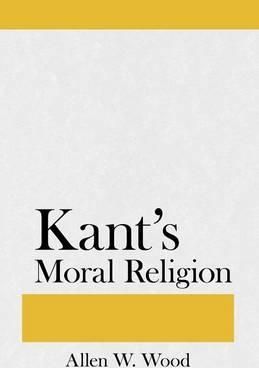
In Kant’s Moral Religion, Allen W. Wood argues that Kant’s doctrine of religious belief is consistent with his best critical thinking and, in fact, that the “moral arguments”-along with the faith they justify-are an integral part of Kant’s critical philosophy. Wood shows that Kant’s sensitive religious outlook on the world deserves to be counted among the greatest of his philosophical contributions.
“This compact book is intended as a practical guide for students involved in research, and it fulfils that goal well. …The chapter on ‘The funding and sponsorship of research’ is an excellent example of the author’s willingness and ability to include relevant, sensitive and practical content that is often left out of texts on ethics. …This is an easy book to read, it is concise and keeps to relevant content. …It would make an excellent text for a course in research ethics and/or research methods, and it will also provide an excellent planning and self-review guide for a practising researcher.” Higher Education Review”The book is aimed primarily at higher education students in education and the social sciences who are conducting a (typically small scale) research project. That is not to say that the publication is of little value to the supervisors of such projects or to experienced researchers as a resource. …the successful integration of a wide range of theoretical perspectives on ethics in the text is… one of the main accomplishments of this publication” RTI Resource CentreThis essential guide examines the ethical issues and questions which occur in university and professional research. The book helps both beginning and experienced researchers to identify ethical issues when they are conducting research, and attempt to resolve those issues.* Examines ethical issues which arise throughout research, from the design stage through to data collection and analysis * Investigates topical issues including consent, confidentiality, ethical questions in the dissemination of research* Discusses ethical theories and how these may be applied towards resolving ethical problems* Provides examples of ethical dilemmas and case studies throughout the textInsightful, wide-ranging and accessible, this guide is an invaluable tool for both undergraduate and postgraduate students and professionals who research as part of their jobs.
ما از اخلاق چه انتظاری داریم؟ این سوال شاید تاحدودی برای عموم مردم و یا متخصصان این رشته قابل پاسخ باشد؛ اینکه خوب بودن را به ما بیاموزد و در تنظیم روابط فردی م...

جشن کتاب تهران به ایستگاه سی و یکم رسیده است. حال و احوال نشر کتاب خوب نیست و باید فرهنگدوستان را به خرید و هدیه دادن کتاب ترغیب نمود. خانه اخلاقپژوهان جوان ب...

بنیاد کتابهای اخلاق اسلامی عمدتا پالایش جان از آلودگیها و آراستن آن به زیباییها است. اندیشه محوری این قبیل کتابها آن است که انسان فعلی آنی نیست که باید باشد...

-
0 Comments