Notice: تابع WP_Block_Type_Registry::register به طورنادرست فراخوانی شد. نامهای نوع بلوک نباید حروف بزرگ داشته باشند. لطفاً برای اطلاعات بیشتر، اشکال زدایی در وردپرس را مشاهده کنید. (این پیام در نگارش 5.0.0 افزوده شده است.) in /home/ethicsho/public_html/wp-includes/functions.php on line 5313
Warning: Use of undefined constant TDC_PATH_LEGACY - assumed 'TDC_PATH_LEGACY' (this will throw an Error in a future version of PHP) in /home/ethicsho/public_html/wp-content/plugins/td-composer/td-composer.php on line 109
Warning: Use of undefined constant TDSP_THEME_PATH - assumed 'TDSP_THEME_PATH' (this will throw an Error in a future version of PHP) in /home/ethicsho/public_html/wp-content/plugins/td-composer/td-composer.php on line 113 بایگانیهای 90 - خانه اخلاق پژوهان جوان Notice: Trying to access array offset on value of type bool in /home/ethicsho/public_html/wp-content/plugins/wp-ulike/inc/general-functions.php on line 807
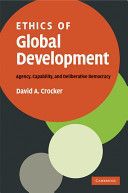
Poverty, inequality, violence, environmental degradation, and tyranny continue to afflict the world. Ethics of Global Development offers a moral reflection on the ends and means of local, national, and global efforts to overcome these five scourges. After emphasizing the role of ethics in development studies, policy-making, and practice, David A. Crocker analyzes and evaluates Amartya Sen’s philosophy of development in relation to alternative ethical outlooks. He argues that Sen’s turn to robust ideals of human agency and democracy improves on both Sen’s earlier emphasis on ‘capabilities and functionings’ and Martha Nussbaum’s version of the capability orientation. This agency-focused capability approach is then extended and strengthened by applying it to the challenges of consumerism and hunger, the development responsibilities of affluent individuals and nations, and the dilemmas of globalization. Throughout the book the author argues for the importance of more inclusive and deliberative democratic institutions.
In this book John Kekes examines the indispensable role enjoyment plays in a good life. The key to it is the development of a style of life that combines an attitude and a manner of living and acting that jointly express one’s deepest concerns. Since such styles vary with characters and circumstances, a reasonable understanding of them requires attending to the particular and concrete details of individual lives. Reflection on works of literature is a better guide to this kind of understanding than the futile search for general theories and principles that preoccupies much of contemporary moral thought. Enjoyment proceeds by the detailed examination of particular cases, shows how this kind of reflection can be reasonably conducted, and how the quest for universality and impartiality is misguided in this context. Central to the argument is a practical, particular, pluralistic, and yet objective conception of reason that rejects the pervasive contemporary tendency to regard reasons as good only if they are binding on all who aspire to live reasonably and morally. Reason in morality is neither theoretical nor general. Reasons for living and acting in particular ways are individually variable and none the worse for that. Kekes aims to reorient moral thought from deontological, contractarian, and consequentialist preoccupations toward a reasonable but pluralistic reflection on what individuals can do to make their lives better.
The Edge of Life: Human Dignity and Contemporary Bioethics treats a number of distinct moral questions and ?nds their answer in the dignity of the person, both as an agent and as a patient (in the sense of the recipient of action). Characteristically one’s view of the human being ultimately shapes one’s outlook on these matters. This book addresses questions that divide a culture of life from a culture of death as well as a number of questions debated within the Catholic tradition itself. The Edge of Life offers a critique of the new bio-ethic, represented by such notable authors as Peter Singer; it also attempts to shore up some of the dif?culties leveled by critics against the traditional ethic as well as to answer some questions disputed by those within the tradition. This book does not treat the basic principles of morality but rather many of their applications and suppositions. (For an account of contemporary debates within the Catholic tradition on these matters, see Kaczor 2002). Rather, The Edge of Life seeks to address a number of disputed contemporary questions touching upon human dignity at what has been called “the margins of life. ” The ?rst section of the book treats the dignity of the human person as recipient of action and as agent. Chapter two examines various accounts of when a human being becomes a person.
ما از اخلاق چه انتظاری داریم؟ این سوال شاید تاحدودی برای عموم مردم و یا متخصصان این رشته قابل پاسخ باشد؛ اینکه خوب بودن را به ما بیاموزد و در تنظیم روابط فردی م...

جشن کتاب تهران به ایستگاه سی و یکم رسیده است. حال و احوال نشر کتاب خوب نیست و باید فرهنگدوستان را به خرید و هدیه دادن کتاب ترغیب نمود. خانه اخلاقپژوهان جوان ب...

بنیاد کتابهای اخلاق اسلامی عمدتا پالایش جان از آلودگیها و آراستن آن به زیباییها است. اندیشه محوری این قبیل کتابها آن است که انسان فعلی آنی نیست که باید باشد...

-
0 Comments