Notice: تابع WP_Block_Type_Registry::register به طورنادرست فراخوانی شد. نامهای نوع بلوک نباید حروف بزرگ داشته باشند. لطفاً برای اطلاعات بیشتر، اشکال زدایی در وردپرس را مشاهده کنید. (این پیام در نگارش 5.0.0 افزوده شده است.) in /home/ethicsho/public_html/wp-includes/functions.php on line 5313
Warning: Use of undefined constant TDC_PATH_LEGACY - assumed 'TDC_PATH_LEGACY' (this will throw an Error in a future version of PHP) in /home/ethicsho/public_html/wp-content/plugins/td-composer/td-composer.php on line 109
Warning: Use of undefined constant TDSP_THEME_PATH - assumed 'TDSP_THEME_PATH' (this will throw an Error in a future version of PHP) in /home/ethicsho/public_html/wp-content/plugins/td-composer/td-composer.php on line 113 بایگانیهای 639 - خانه اخلاق پژوهان جوان Notice: Trying to access array offset on value of type bool in /home/ethicsho/public_html/wp-content/plugins/wp-ulike/inc/general-functions.php on line 807
Why democracy? Most often this question is met with an appeal to some decidedly moral value, such as equality, liberty, dignity, or even peace. But in contemporary democratic societies, there is deep disagreement and conflict about the precise nature and relative worth of these values. And when democracy votes, some of those who lose will see the prevailing outcome as not merely disappointing, but morally intolerable. How should citizens react when confronted with a democratic result that they regard as intolerable? Should they revolt, or instead pursue democratic means of social change? In this book, Robert Talisse argues that each of us has reasons to uphold democracy – even when it makes serious moral errors – and that these reasons are rooted in our most fundamental epistemic commitments. His original and compelling study will be of interest to a wide range of readers in political philosophy and political theory.
This collection of essays, memoirs, poems, stories, and artwork looks at globalization as a worldwide exchange of art and ideas. Writing the World focuses on the cultural realities of globalism—the opportunities it provides to learn from other cultures. This knowledge, argue David Rothenberg and Wandee Pryor in their introduction, can be power: “When all of us learn enough about our differences to respect the diversity that exists, we will be unable to pretend we are the same. We will never accept the old innocence and ignorance bred by oppression and exploitation.” For the contributors to Writing the World, to dream of the global village is to see the world not as a vast market but as a place of shared values and linked wonder.”It is time to listen to the many literate voices the world speaks,” say Rothenberg and Pryor. The voices of Writing the World range from Arundhati Roy on the “colonization of knowledge” in her essay “The Ladies Have Feelings, So… Shall We Leave It to the Experts?” to Naomi Klein’s meditation on fences, ownership, and property. They include Bill McKibben on women farmers in Bangladesh, Hannes Westberg’s account of being shot by Swedish police at a demonstration, James Barilla on invading and indigenous plant species in “The Aliens in the Garden,” and many other vivid, compelling, and provocative writings that celebrate—and illustrate—”the poetry of cultural contact.” Artists and photographers whose work appears in the book include Adam Clayman, Jenny Matthews, Richard Robinson, and Arpita Singh.
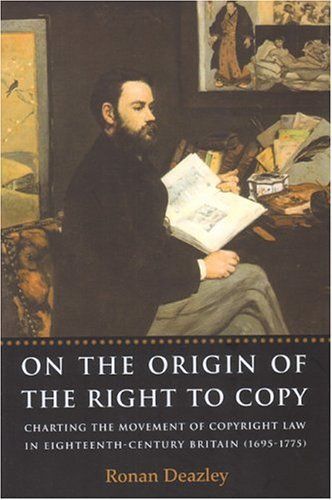
Taking as its point of departure the lapse of the Licensing Act 1662 in 1695, this book examines the lead up to the passage of the Statute of Anne 1709 and charts the movement of copyright law throughout the eighteenth century, culminating in the House of Lords decision in Donaldson v Becket (1774). The established reading of copyright’s development throughout this period, from the 1709 Act to the pronouncement in Donaldson, is that it was transformed from a publisher’s right to an author’s right; that is, legislation initially designed to regulate the marketplace of the bookseller and publisher evolved into an instrument that functioned to recognise the proprietary inevitability of an author’s intellectual labours. The historical narrative which unfolds within this book presents a challenge to that accepted orthodoxy. The traditional analysis of the development of copyright in eighteenth-century Britain is revealed as exhibiting the character of long-standing myth, and the centrality of the modern proprietary author as the raison d’être of the copyright regime is displaced.
ما از اخلاق چه انتظاری داریم؟ این سوال شاید تاحدودی برای عموم مردم و یا متخصصان این رشته قابل پاسخ باشد؛ اینکه خوب بودن را به ما بیاموزد و در تنظیم روابط فردی م...

جشن کتاب تهران به ایستگاه سی و یکم رسیده است. حال و احوال نشر کتاب خوب نیست و باید فرهنگدوستان را به خرید و هدیه دادن کتاب ترغیب نمود. خانه اخلاقپژوهان جوان ب...

بنیاد کتابهای اخلاق اسلامی عمدتا پالایش جان از آلودگیها و آراستن آن به زیباییها است. اندیشه محوری این قبیل کتابها آن است که انسان فعلی آنی نیست که باید باشد...

-
0 Comments