Notice: تابع WP_Block_Type_Registry::register به طورنادرست فراخوانی شد. نامهای نوع بلوک نباید حروف بزرگ داشته باشند. لطفاً برای اطلاعات بیشتر، اشکال زدایی در وردپرس را مشاهده کنید. (این پیام در نگارش 5.0.0 افزوده شده است.) in /home/ethicsho/public_html/wp-includes/functions.php on line 5313
Warning: Use of undefined constant TDC_PATH_LEGACY - assumed 'TDC_PATH_LEGACY' (this will throw an Error in a future version of PHP) in /home/ethicsho/public_html/wp-content/plugins/td-composer/td-composer.php on line 109
Warning: Use of undefined constant TDSP_THEME_PATH - assumed 'TDSP_THEME_PATH' (this will throw an Error in a future version of PHP) in /home/ethicsho/public_html/wp-content/plugins/td-composer/td-composer.php on line 113 بایگانیهای 622 - خانه اخلاق پژوهان جوان Notice: Trying to access array offset on value of type bool in /home/ethicsho/public_html/wp-content/plugins/wp-ulike/inc/general-functions.php on line 807
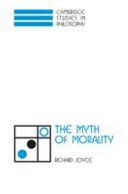
“In The Myth of Morality, Richard Joyce argues that moral discourse is hopelessly flawed. At the heart of ordinary moral judgments is a notion of moral inescapability, or practical authority, which, upon investigation, cannot be reasonably defended. Joyce argues that natural selection is to blame, in that it has provided us with a tendency to invest the world with values that it does not contain, and demands that it does not make. Should we therefore do away with morality, as we did away with other faulty notions such as witches? Possibly not. We may be able to carry on with morality as a useful fiction – allowing it to have a regulative influence on our lives and decisions, perhaps even playing a central role – while not committing ourselves to believing or asserting falsehoods, and thus not being subject to accusations of error.”–BOOK JACKET.
This book combines ancient, modern, and postmodern resources to argue that moral life and thought are inherently and radically creative. Human beings are called by their own primordially created depths to exceed historical evil and tragedy through the ongoing creative transformation together of their world. This creative capability can be understood in its fullest dimensions only as a religious or mythological affirmation of humanity as an image of its Creator. This thesis challenges Greek and biblical separations of ethics and poetic image-making, as well as contemporary conceptions of moral life as grounded in fixed principles or preconstituted traditions. It instead recasts a range of mythic, prophetic, and tragic resources to uncover moral life’s poetics, tension, dynamism, catharsis, disruptiveness, excess, and impossible possibility for renewal. The book takes as its starting point a critical reading of the hermeneutical poetics of the will of Paul Ricoeur, and from there enters into a range of conversations with Aristotle and contemporary Aristotelianism, Immanuel Kant and modernism, and current Continental, narrative, liberationist, and feminist ethics such as in Emmanuel Levinas, Richard Kearney, Martha Nussbaum, Jürgen Habermas, Gustavo Gutiérrez, Luce Irigaray, and Sallie McFague. In the process, it develops a meta-ethical phenomenology of moral creativity along the lines of four increasingly complex dimensions: ontology (creativity of the self), teleology (positive creativity of narrative goods), deontology (negative creativity in response to otherness), and social practice (mixed creativity between plural others in society). Moral creativity is in the end an original and necessary religious capability for responding anew to the tensions within and between selves in the world by forming over time, in love and hope, an ever more radically inclusive humanity.
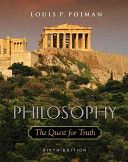
Praised for its accessibility and comprehensiveness, Philosophy: The Quest for Truth provides an excellent selection of classical and contemporary readings on nineteen key problems in philosophy. Louis P. Pojman has carefully organized the essays in each section so that they present pro/con dialogues that allow students to compare and contrast the philosophers’ positions. Topics covered include the nature of philosophy, the existence of God, immortality, knowledge, the mind-body question, personal identity, free will and determinism, ethics, political philosophy, and the meaning of life. The sixth edition offers selections from Plato, Rene Descartes, John Locke, David Hume, William James, Bertrand Russell, John Hick, John Hospers, and James Rachels–as well as essays by Aristotle, Thomas Aquinas, Blaise Pascal, Thomas Hobbes, George Berkeley, Immanuel Kant, Gilbert Ryle, Albert Camus, Jean-Paul Sartre, Alvin Plantinga, and many others. In Philosophy: The Quest for Truth, Sixth Edition, Pojman offers substantial introductions to each of the nineteen philosophical problems. In addition, each of the seventy-six readings is accompanied by an individual introduction with a biographical sketch of the philosopher, study questions, and reflective questions that challenge students to analyze and critique the material. Short bibliographies following each major section and a detailed glossary further enhance the text’s pedagogical value. Invaluable for introductory courses in philosophy, this highly acclaimed text inspires and guides students’ quest for wisdom. New to the Sixth Edition:: * Six selections: William Lane Craig: The Kalam Cosmological Argument and the Anthropic Principle William Rowe: An Analysis of the Ontological Argument Daniel Dennett: Postmodernism and Truth William James: The Dilemma of Determinism Harry Frankfurt: Freedom of the Will and the Concept of a Person John Rawls: The Contemporary Liberal Answer * More exercises in the excursus on logic
Susan K. Sell s book shows how power in international politics is increasingly exercised by private interests rather than governments. In 1994 the WTO adopted the Agreement on Trade-Related Aspects of Intellectual Property Rights (TRIPS), which dictated to states how they should regulate the protection of intellectual property. This book argues that TRIPS resulted from lobbying by twelve powerful CEOs of multinational corporations who wished to mould international law to protect their markets. This book examines the politics leading up to TRIPS, the first seven years of its implementation, and the political backlash against TRIPS in the face of the HIV/AIDS crisis. Focusing on global capitalism, ideas, and economic coercion, this work explains the politics behind TRIPS and the controversies created in its wake. It is a fascinating study of the influence of private interests in government decision-making, and in the shaping of the global economy.
We live in a ‘bimoral’ society, in which people govern their lives by two contrasting sets of principles. On the one hand there are the principles associated with traditional morality. Although these allow a modicum of self-interest, their emphasis is on our duties and obligations to others: to treat people honestly and with respect, to treat them fairly and without prejudice, to help and are for them when needed, and ultimately, to put their needs above their own. On the other hand there are the principles associated with the entrepreneurial self-interest. These also impose obligations, but of a much more limited kind. Their emphasis is competitive rather than cooperative: to advance our own interests rather than to meet the needs of others. Both sets of principles have always been present in society but in recent years, traditional moral authorities have lost much of their force and the morality of self-interest has acquired a much greater social legitimacy, over a much wider field of behavior, than ever before. The result of this is that in many situations it is no longer at all apparent which set of principles should take precedence. In this book, John Hendry traces the cultural and historical origins of the ‘bimoral’ society have also led to new, more flexible forms of organizing, which have released people’s entrepreneurial energies and significantly enhanced the creative capacities of business. Working within these organizations, however is fraught with moral tensions as obligations and self-interest conflict and managers are pulled in all sorts of different directions. Managing them successfully poses major new challenges of leadership, and ‘moral’ management, as the technical problem-solving that previously characterized managerial work is increasingly accomplished by technology and market mechanisms. The key role of management becomes the political and moral one of determining purposes and priorities, reconciling divergent interests, and nurturing trust in interpersonal relationships. Exploring these tensions and challenges, Hendry identifies new issues of contemporary management and puts recognized issues into context. He also explores the challenges posed for a post-traditional society as it seeks to regulate and govern an increasingly powerful and global business sector.
ما از اخلاق چه انتظاری داریم؟ این سوال شاید تاحدودی برای عموم مردم و یا متخصصان این رشته قابل پاسخ باشد؛ اینکه خوب بودن را به ما بیاموزد و در تنظیم روابط فردی م...

جشن کتاب تهران به ایستگاه سی و یکم رسیده است. حال و احوال نشر کتاب خوب نیست و باید فرهنگدوستان را به خرید و هدیه دادن کتاب ترغیب نمود. خانه اخلاقپژوهان جوان ب...

بنیاد کتابهای اخلاق اسلامی عمدتا پالایش جان از آلودگیها و آراستن آن به زیباییها است. اندیشه محوری این قبیل کتابها آن است که انسان فعلی آنی نیست که باید باشد...

-
0 Comments