Notice: تابع WP_Block_Type_Registry::register به طورنادرست فراخوانی شد. نامهای نوع بلوک نباید حروف بزرگ داشته باشند. لطفاً برای اطلاعات بیشتر، اشکال زدایی در وردپرس را مشاهده کنید. (این پیام در نگارش 5.0.0 افزوده شده است.) in /home/ethicsho/public_html/wp-includes/functions.php on line 5313
Warning: Use of undefined constant TDC_PATH_LEGACY - assumed 'TDC_PATH_LEGACY' (this will throw an Error in a future version of PHP) in /home/ethicsho/public_html/wp-content/plugins/td-composer/td-composer.php on line 109
Warning: Use of undefined constant TDSP_THEME_PATH - assumed 'TDSP_THEME_PATH' (this will throw an Error in a future version of PHP) in /home/ethicsho/public_html/wp-content/plugins/td-composer/td-composer.php on line 113 بایگانیهای 612 - خانه اخلاق پژوهان جوان Notice: Trying to access array offset on value of type bool in /home/ethicsho/public_html/wp-content/plugins/wp-ulike/inc/general-functions.php on line 807
Book Summary of Aristotle And Moral RealismThis volume of essays brings together scholars of ancient philosophy and some of today’s most distinguished moral philosophers to discuss Aristotle’s ethics and the problems of moral realism. One of the central and perennial philosophical problems is the question of whether our ethical assertions and beliefs can be justifiably claimed to rest on some objective foundation. As an upholder of the objectivity of ethics and as one of the most important ethical thinkers in the history of philosophy, Aristotle’s writings on these questions are of the greatest interest. Indeed, much of recent moral philosophy has looked directly to Aristotle for inspiration on the problem of moral objectivity. For example, “virtue theorists” were influenced by Aristotle in their proposal that what determines the right thing to do in a particular case is what the virtuous man would do. Similarly, “sensibility theorists” have found support for their view in Aristotle’s remarks about the importance of the conditioning of one’s desires for the development of virtue and knowledge about the human good. One of the central issues addressed by the contributors is whether it is wrong to believe that the justification of a moral claim requires an “external” validation which goes beyond reference to human practices of moral condemnation and approval. Or does moral objectivity require ethical discourse to have an origin and explanatory power similar in important respects to that of an empirical science? The contributors range over many other issues and areas of Aristotle’s philosophy, including his account of tragedy and his theory of justice. It will be welcomed by all philosophers and classicists with an interest in moral philosophy and Greek ethics..
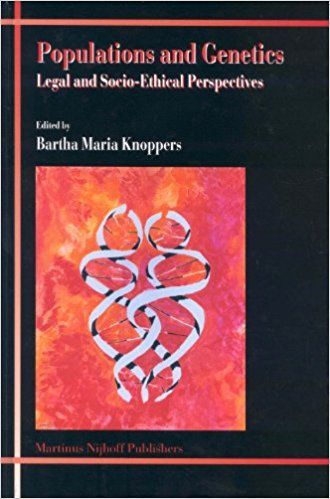
Genetic research and testing is not limited to individuals and their families. Increasingly, there is focus on communities and even whole populations. This raises legal and socio-ethical and issues that have not been addressed. In this age of international biobanking involving populations, are current legal and ethical approaches sufficient? This book of selected papers covers population research and banking as well as accompanying confidentiality, and governance concerns. Possible commercialization, patents, benefit sharing, discrimination, and the role of patient organizations and of developing countries are also discussed. New perspectives and models are provided. The book concludes with a “Statement of Principles on the Ethical Conduct of Human Genetic Research Involving Populations,” Policymakers, academics, legislators and researchers will find this book to be current and controversial. The human genome may be mapped but the legal and socio-ethical debate is far from over.
The striking parallels between Derrida?s deconstruction and certain strategies eschewing oppositional hierarchies in Asian thought, especially in Buddhism and Daoism, have attracted much attention from scholars of both Western and Asian philosophy. This book contributes to this discussion by focusing on the ethical dimension and function of deconstruction in Asian thought. Examining different traditions and schools of Asian thought, including Indian Buddhism, Zen, other schools of East Asian Buddhism, the Kyoto School, and Daoism, the contributors explore the central theme from different contexts and different angles. Insights and notions from the contemporary discussion of Derridean deconstruction and its ethic or Derridean-Levinasian ethic as a paradigm for comparison or interpretation are used as a framework. Furthering our understanding of the relationship between deconstruction and the ethical in Asian traditions, this book also enriches the contemporary ethical discourse from a globalperspective by bridging Asia and the West.
ما از اخلاق چه انتظاری داریم؟ این سوال شاید تاحدودی برای عموم مردم و یا متخصصان این رشته قابل پاسخ باشد؛ اینکه خوب بودن را به ما بیاموزد و در تنظیم روابط فردی م...

جشن کتاب تهران به ایستگاه سی و یکم رسیده است. حال و احوال نشر کتاب خوب نیست و باید فرهنگدوستان را به خرید و هدیه دادن کتاب ترغیب نمود. خانه اخلاقپژوهان جوان ب...

بنیاد کتابهای اخلاق اسلامی عمدتا پالایش جان از آلودگیها و آراستن آن به زیباییها است. اندیشه محوری این قبیل کتابها آن است که انسان فعلی آنی نیست که باید باشد...

-
0 Comments