Notice: تابع WP_Block_Type_Registry::register به طورنادرست فراخوانی شد. نامهای نوع بلوک نباید حروف بزرگ داشته باشند. لطفاً برای اطلاعات بیشتر، اشکال زدایی در وردپرس را مشاهده کنید. (این پیام در نگارش 5.0.0 افزوده شده است.) in /home/ethicsho/public_html/wp-includes/functions.php on line 5313
Warning: Use of undefined constant TDC_PATH_LEGACY - assumed 'TDC_PATH_LEGACY' (this will throw an Error in a future version of PHP) in /home/ethicsho/public_html/wp-content/plugins/td-composer/td-composer.php on line 109
Warning: Use of undefined constant TDSP_THEME_PATH - assumed 'TDSP_THEME_PATH' (this will throw an Error in a future version of PHP) in /home/ethicsho/public_html/wp-content/plugins/td-composer/td-composer.php on line 113 بایگانیهای 3543 - خانه اخلاق پژوهان جوان Notice: Trying to access array offset on value of type bool in /home/ethicsho/public_html/wp-content/plugins/wp-ulike/inc/general-functions.php on line 807
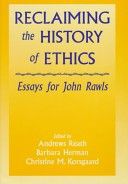
The essays in this volume offer an approach to the history of moral and political philosophy that takes its inspiration from John Rawls. The distinctive feature of this approach is to address substantive normative questions in moral and political philosophy through an analysis of the texts and theories of major figures in the history of the subject: Aristotle, Hobbes, Hume, Rousseau, Kant, and Marx. By reconstructing the core of these theories in a way that is informed by contemporary theoretical concerns, the contributors show how the history of the subject is a resource for understanding present and perennial problems in moral and political philosophy.
Alan Millar examines our understanding of why people think and act as they do. His key theme is that normative considerations form an indispensable part of the explanatory framework in terms of which we seek to understand each other. Millar defends a conception according to which normativity is linked to reasons. On this basis he examines the structure of certain normative commitments incurred by having propositional attitudes. Controversially, he argues that ascriptions of beliefs and intentions in and of themselves attribute normative commitments and that this has implications for the psychology of believing and intending. Indeed, all propositional attitudes of the sort we ascribe to people have a normative dimension, since possessing the concepts that the attitudes implicate is of its very nature commitment-incurring. The ramifications of these views for our understanding of people is explored. Millar offers illuminating discussions of reasons for belief and reasons for action; the explanation of beliefs and actions in terms of the subject’s reasons; the idea that simulation has a key role in understanding people; and the limits of explanation in terms of propositional attitudes. He compares and contrasts the commitments incurred by propositional attitudes with those incurred by participating in practices, arguing that the former should not be assimilated to the latter. Understanding People will be of great interest to most philosophers of mind, as well as to those working on practical and theoretical reasoning.
What rational justification is there for conceiving of all living things as possessing inherent worth? In Respect for Nature, Paul Taylor draws on biology, moral philosophy, and environmental science to defend a biocentric environmental ethic in which all life has value. Without making claims for the moral rights of plants and animals, he offers a reasoned alternative to the prevailing anthropocentric view–that the natural environment and its wildlife are valued only as objects for human use or enjoyment. Respect for Nature provides both a full account of the biological conditions for life–human or otherwise–and a comprehensive view of the complex relationship between human beings and the whole of nature. This classic book remains a valuable resource for philosophers, biologists, and environmentalists alike–along with all those who care about the future of life on Earth. A new foreword by Dale Jamieson looks at how the original 1986 edition of Respect for Nature has shaped the study of environmental ethics, and shows why the work remains relevant to debates today.
This book is a long-awaited major statement by a pre-eminent analytic philosopher, Alvin Plantinga, on one of our biggest debates — the compatibility of science and religion. The last twenty years has seen a cottage industry of books on this divide, but with little consensus emerging. Plantinga, as a top philosopher but also a proponent of the rationality of religious belief, has a unique contribution to make. His theme in this short book is that the conflict between science and theistic religion is actually superficial, and that at a deeper level they are in concord. Plantinga examines where this conflict is supposed to exist — evolution, evolutionary psychology, analysis of scripture, scientific study of religion — as well as claims by Dan Dennett, Richard Dawkins, and Philip Kitcher that evolution and theistic belief cannot co-exist. Plantinga makes a case that their arguments are not only inconclusive but that the supposed conflicts themselves are superficial, due to the methodological naturalism used by science. On the other hand, science can actually offer support to theistic doctrines, and Plantinga uses the notion of biological and cosmological “fine-tuning” in support of this idea. Plantinga argues that we might think about arguments in science and religion in a new way — as different forms of discourse that try to persuade people to look at questions from a perspective such that they can see that something is true. In this way, there is a deep and massive consonance between theism and the scientific enterprise.
ما از اخلاق چه انتظاری داریم؟ این سوال شاید تاحدودی برای عموم مردم و یا متخصصان این رشته قابل پاسخ باشد؛ اینکه خوب بودن را به ما بیاموزد و در تنظیم روابط فردی م...

جشن کتاب تهران به ایستگاه سی و یکم رسیده است. حال و احوال نشر کتاب خوب نیست و باید فرهنگدوستان را به خرید و هدیه دادن کتاب ترغیب نمود. خانه اخلاقپژوهان جوان ب...

بنیاد کتابهای اخلاق اسلامی عمدتا پالایش جان از آلودگیها و آراستن آن به زیباییها است. اندیشه محوری این قبیل کتابها آن است که انسان فعلی آنی نیست که باید باشد...

-
0 Comments