Notice: تابع WP_Block_Type_Registry::register به طورنادرست فراخوانی شد. نامهای نوع بلوک نباید حروف بزرگ داشته باشند. لطفاً برای اطلاعات بیشتر، اشکال زدایی در وردپرس را مشاهده کنید. (این پیام در نگارش 5.0.0 افزوده شده است.) in /home/ethicsho/public_html/wp-includes/functions.php on line 5313
Warning: Use of undefined constant TDC_PATH_LEGACY - assumed 'TDC_PATH_LEGACY' (this will throw an Error in a future version of PHP) in /home/ethicsho/public_html/wp-content/plugins/td-composer/td-composer.php on line 109
Warning: Use of undefined constant TDSP_THEME_PATH - assumed 'TDSP_THEME_PATH' (this will throw an Error in a future version of PHP) in /home/ethicsho/public_html/wp-content/plugins/td-composer/td-composer.php on line 113 بایگانیهای 342 - خانه اخلاق پژوهان جوان Notice: Trying to access array offset on value of type bool in /home/ethicsho/public_html/wp-content/plugins/wp-ulike/inc/general-functions.php on line 807
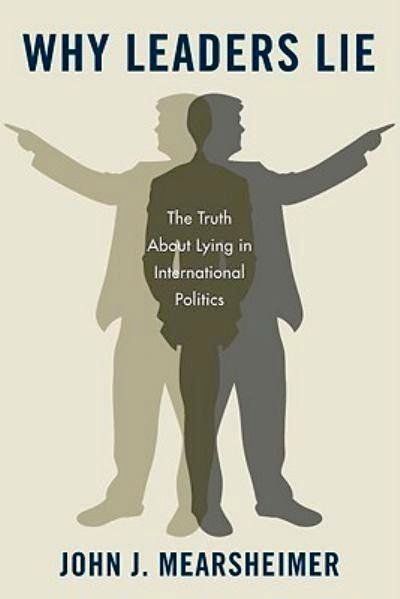
For more than two decades, John J. Mearsheimer has been regarded as one of the foremost realist thinkers on foreign policy. Clear and incisive, a fearlessly honest analyst, his coauthored 2007 New York Times bestseller, The Israel Lobby and U.S. Foreign Policy, aroused a firestorm with its unflinching look at the making of America’s Middle East policy. Now he takes a look at another controversial but understudied aspect of international relations: lying.In Why Leaders Lie, Mearsheimer provides the first systematic analysis of lying as a tool of statecraft, identifying the varieties, the reasons, and the potential costs and benefits. Drawing on a trove of examples, he argues that leaders often lie for good strategic reasons, so a blanket condemnation is unrealistic and unwise. Yet there are other kinds of deception besides lying, including concealment and spinning. Perhaps no distinction is more important than that between lying to another state and lying to one’s own people. Mearsheimer was amazed to discover how unusual interstate lying has been; given the atmosphere of distrust among the great powers, he found that outright deceit is difficult to pull off and thus rarely worth the effort. Plus it sometimes backfires when it does occur. Khrushchev lied about the size of the Soviet missile force, sparking an American build-up. Eisenhower got caught lying about U-2 spy flights in 1960, which scuttled an upcoming summit with Krushchev. Leaders more often mislead their own publics, sometimes with damaging consequences. Though the reasons may be noble–Franklin Roosevelt, for example, lied to the American people about German U-boats attacking the destroyer Greer in 1940, to build a case for war against Hitler–they can easily lead to disaster, as with the Bush administration’s falsehoods about Iraq’s weapons of mass destruction. There has never been a full discussion of international lying. Now a leading expert fills the gap with a richly informed and powerfully argued book.
Hilary Putnam has been convinced for some time that the present situation in philosophy calls for revitalization and renewal; in this latest book he shows us what shape he would like that renewal to take. Words and Life offers a sweeping account of the sources of several of the central problems of philosophy, past and present, and of why some of those problems are not going to go away As the first four part tides in the volume-“The Return of Aristotle,” “The Legacy of Logical Positivism,” “The Inheritance of Pragmatism,” and “Essays after Wittgenstein”-suggest, many of the essays are concerned with tracing the recent, and the not so recent, history of these problems.The goal is to bring out what is coercive and arbitrary about some of our present ways of posing the problems and what is of continuing interest in certain past approaches to them. Various supposedly timeless philosophical problems appear, on closer inspection, to change with altered historical circumstances, while there turns out to be much of permanent value in Aristotle’s, Peirce’s, Dewey’s, and Reichenbach’s work on some of the problems that continue to exercise us.A unifying theme of the volume as a whole is that reductionism, scientism, and old-style disenchanted naturalism tend to be obstacles to philosophical progress. The titles of the final three parts of the volume-Truth andReference,” “Mind and Language,” and “The Diversity of the Sciences-indicate that the sweep of the problems considered here comprehends all the fundamental areas of contemporary analytic philosophy Rich in detail, the book is also grand in scope, allowing us to trace the ongoing intellectual evolution of one of the most significant philosophers of the century.
In this book, William O’Neill, S.J., offers an interpretation of the nature and scope of practical reasoning in light of postmodern philosophical criticism. He charts a via media between the abstract formalism of neo-Kantian morality and relativist interpretations of neo-Aristotelian ethics. The three parts of the book treat the eclipse of the classical Aristotelian conception of practical reason; the Kantian heritage in the modern moral theories of John Rawls and R.M. Hare; and the hermeneutical retrieval of a moral interpretation of the world. Drawing upon the philosophical hermeneutics of Hans-Georg Gadamer, modern analytical philosophy, and the discourse ethics of Jurgen Habermas, O’Neill offers a critical reconstruction of practical reason which upholds the primacy of moral community while recognizing the ethical import of historical and cultural difference. The final chapter applies the preceding hermeneutical critique to the question of the distinctiveness of Christian ethics in the writings of Karl Barth, Hans Urs von Balthasar, Josef Fuchs, and Bruno Schuller. This original contribution will be of special interest to students and teachers of moral philosophy and theology.
Weakness of will, the phenomenon of acting contrary to one’s own better judgment, has remained a prominent discussion topic of philosophy. The history of this discussion in ancient, medieval, and modern times has been outlined in many studies. Weakness of Will in Renaissance and Reformation Thought is, however, the first book to cover the fascinating source materials on weakness of will between 1350 and 1650. In addition to considering the work of a broad range of Renaissance authors (including Petrarch, Donato Acciaiuoli, John Mair, and Francesco Piccolomini), Risto Saarinen explores the theologically coloured debates of the Reformation period, such as those provided by Martin Luther, Philip Melanchthon, John Calvin, and Lambert Daneau. He goes on to discuss the impact of these authors on prominent figures of early modernity, including Shakespeare, Descartes, Spinoza, and Leibniz.While most of the historical research on weakness of will has focused on the reception history of Aristotle’s Nicomachean Ethics, Saarinen pays attention to the Platonic and Stoic discussions and their revival during the Renaissance and the Reformation. He also shows the ways in which Augustine’s discussion of the divided will is intertwined with the Christian reception of ancient Greek ethics, and argues that the theological underpinnings of early modern authors do not rule out weakness of will, but transform the philosophical discussion and lead it towards new solutions.
ما از اخلاق چه انتظاری داریم؟ این سوال شاید تاحدودی برای عموم مردم و یا متخصصان این رشته قابل پاسخ باشد؛ اینکه خوب بودن را به ما بیاموزد و در تنظیم روابط فردی م...

جشن کتاب تهران به ایستگاه سی و یکم رسیده است. حال و احوال نشر کتاب خوب نیست و باید فرهنگدوستان را به خرید و هدیه دادن کتاب ترغیب نمود. خانه اخلاقپژوهان جوان ب...

بنیاد کتابهای اخلاق اسلامی عمدتا پالایش جان از آلودگیها و آراستن آن به زیباییها است. اندیشه محوری این قبیل کتابها آن است که انسان فعلی آنی نیست که باید باشد...

-
0 Comments