Notice: تابع WP_Block_Type_Registry::register به طورنادرست فراخوانی شد. نامهای نوع بلوک نباید حروف بزرگ داشته باشند. لطفاً برای اطلاعات بیشتر، اشکال زدایی در وردپرس را مشاهده کنید. (این پیام در نگارش 5.0.0 افزوده شده است.) in /home/ethicsho/public_html/wp-includes/functions.php on line 5313
Warning: Use of undefined constant TDC_PATH_LEGACY - assumed 'TDC_PATH_LEGACY' (this will throw an Error in a future version of PHP) in /home/ethicsho/public_html/wp-content/plugins/td-composer/td-composer.php on line 109
Warning: Use of undefined constant TDSP_THEME_PATH - assumed 'TDSP_THEME_PATH' (this will throw an Error in a future version of PHP) in /home/ethicsho/public_html/wp-content/plugins/td-composer/td-composer.php on line 113 بایگانیهای 3368 - خانه اخلاق پژوهان جوان Notice: Trying to access array offset on value of type bool in /home/ethicsho/public_html/wp-content/plugins/wp-ulike/inc/general-functions.php on line 807
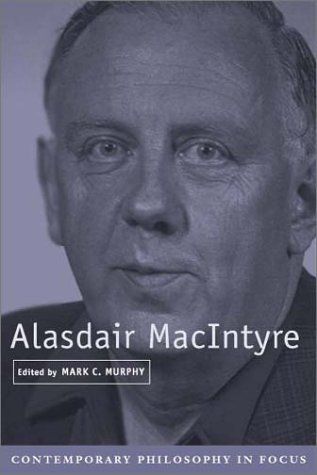
Alasdair MacIntyre’s writings on ethics, political philosophy, philosophy of religion, philosophy of the social sciences and the history of philosophy have established him as one of the philosophical giants of the last fifty years. His best-known book, After Virtue (1981), spurred the profound revival of virtue ethics. Moreover, MacIntyre, unlike so many of his contemporaries, has exerted a deep influence beyond the bounds of academic philosophy. This volume focuses on the major themes of MacIntyre’s work with critical expositions of MacIntyre’s views on the history of philosophy, the role of tradition in philosophical inquiry, the philosophy of the social sciences, moral philosophy, political theory, and his critique of the assumptions and institutions of modernity. Written by a distinguished roster of philosophers, this volume will have a wide appeal outside philosophy to students in the social sciences, law, theology, and political theory. Mark C. Murphy is Associate Professor of Philosophy at Georgetown University. He is author of Natural Law and Practical Rationality (Cambridge, 2001) and An Essay on Divine Authority (Cornell, 2002), as well as of a number of articles on natural law theory, political obligation, and Hobbes’ moral, political, and legal philosophy. His papers have appeared in Ethics, Philosophy and Public Affairs, Nous, Faith and Philosophy, Law and Philosophy, American Philosophical Quarterly, the Thomist, and elsewhere.
This is the most up-to-date, brief and accessible introduction to Kants ethics available. It approaches the moral theory via the political philosophy, thus allowing the reader to appreciate why Kant argued that the legal structure for any civil society must have a moral basis. This approach also explains why Kant thought that our basic moral norms should serve as laws of conduct for everyone. The volume includes a detailed commentary on Foundations of the Metaphysics of Morals, Kants most widely studied work of moral philosophy. The book complements the authors much more comprehensive and systematic study Immanuel Kants Moral Theory (Cambridge, 1989), a volume that has received the highest critical praise. With its briefer compass and non-technical style this new introduction should help to disseminate the key elements of one of the great modern philosophies to an even wider readership.
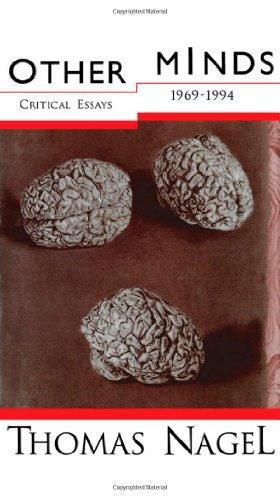
Over the past twenty-five years, Thomas Nagel has played a major role in the philosophico-biological debate on subjectivity and consciousness. This extensive collection of published essays and reviews offers Nagel’s opinionated views on the philosophy of mind, epistemology, and political philosophy, as well as on fellow philosophers like Freud, Wittgenstein, Rawls, Dennet, Chomsky, Searle, Nozick, Dworkin, and MacIntyre.
Much of our knowledge of stem cells has been inferred from studies of remarkable few species. The ability to manipulate stem cells in “model” organisms such as the mouse and a few other vertebrate species has driven our understanding of basic biology of stem cells. The power and efficiency of studying model organisms, however, comes at a cost since a few species, obviously, do not reflect natureA´s true diversity. Unfortunately, although all multicellular organisms seem to rely on stem cells, and although this seems to be a question of key importance for understanding the evolution of animal life, little is known about stem cells in early-branching taxa. The book “Stem Cells: From Hydra to Man” illustrates that here is more than human and mouse stem cells to learn from. Reflecting an enormous growth in the knowledge of stem cells in various organisms, the book presents the conceptual language and the nature of questions, as well as a summary of the advances in our understanding of stem cells from a comparative point of view that has resulted from the development of new technology and the development of novel model organisms over the past few decades. As such this book is largely a horizon analysis of a frontier rather than a retrospective. It presents an integrative approach to animal stem cells and covers the major contributions, tools and trends in a newly emerging field: comparative stem cell biology.
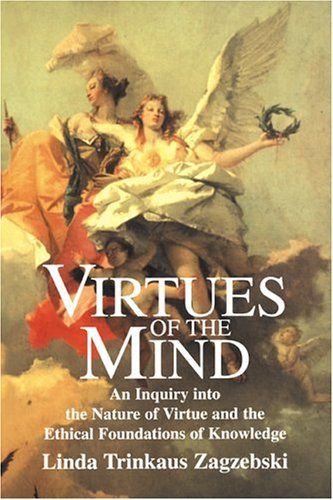
Almost all theories of knowledge and justified belief employ moral concepts and forms of argument borrowed from moral theories, but none of them pay attention to the current renaissance in virtue ethics. This remarkable book is the first attempt to establish a theory of knowledge based on the model of virtue theory in ethics. The book develops the concept of an intellectual virtue, and then shows how the concept can be used to give an account of the major concepts in epistemology, including the concept of knowledge.
ما از اخلاق چه انتظاری داریم؟ این سوال شاید تاحدودی برای عموم مردم و یا متخصصان این رشته قابل پاسخ باشد؛ اینکه خوب بودن را به ما بیاموزد و در تنظیم روابط فردی م...

جشن کتاب تهران به ایستگاه سی و یکم رسیده است. حال و احوال نشر کتاب خوب نیست و باید فرهنگدوستان را به خرید و هدیه دادن کتاب ترغیب نمود. خانه اخلاقپژوهان جوان ب...

بنیاد کتابهای اخلاق اسلامی عمدتا پالایش جان از آلودگیها و آراستن آن به زیباییها است. اندیشه محوری این قبیل کتابها آن است که انسان فعلی آنی نیست که باید باشد...

-
0 Comments