Notice: تابع WP_Block_Type_Registry::register به طورنادرست فراخوانی شد. نامهای نوع بلوک نباید حروف بزرگ داشته باشند. لطفاً برای اطلاعات بیشتر، اشکال زدایی در وردپرس را مشاهده کنید. (این پیام در نگارش 5.0.0 افزوده شده است.) in /home/ethicsho/public_html/wp-includes/functions.php on line 5313
Warning: Use of undefined constant TDC_PATH_LEGACY - assumed 'TDC_PATH_LEGACY' (this will throw an Error in a future version of PHP) in /home/ethicsho/public_html/wp-content/plugins/td-composer/td-composer.php on line 109
Warning: Use of undefined constant TDSP_THEME_PATH - assumed 'TDSP_THEME_PATH' (this will throw an Error in a future version of PHP) in /home/ethicsho/public_html/wp-content/plugins/td-composer/td-composer.php on line 113 بایگانیهای 3328 - خانه اخلاق پژوهان جوان Notice: Trying to access array offset on value of type bool in /home/ethicsho/public_html/wp-content/plugins/wp-ulike/inc/general-functions.php on line 807
From the relative obscurity in which Levinas’s work languished until very recently, Emmanuel Levinas must now be judged as one of the most influential figures in contemporary Continental philosophy. There is no better guide than John Lewelyn to lead one through the thickets of Levinas’s prose. Bursting with questions, multiple references, cascading citations and multilingual puns and nuances, this book is the compelling record of intellectual obsession. Taking as its guiding thre the theme of genealogy, the book gives a broadly chronological and impressively manageable presentation of the whole sweep of the Levinas’s work. Balanced and finely grained, Llewelyn confronts questions of method, Heidegger, phenomenology, the theme of sensibility, religion, enjoyment, feminity, eros, justice and the political. The book reaches a stunning climax in a series of chapters that give a hestitant but tolerant discussion of the question of God in Levinas, the relation to Levinasian ethics to Nietzscheangenealogy, and an extraordinary discussion of metaphor that leads into a wholly original analysis of Levinas’s poetics and metaphorics. The book concludes with a sensitive reading of the autobiographical epigraphs to Levinas’sOtherwise than Being…and a consideration of the Holocaust.
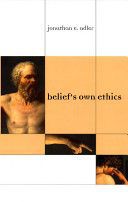
The fundamental question of the ethics of belief is “What ought one to believe?” According to the traditional view of evidentialism, the strength of one’s beliefs should be proportionate to the evidence. Conventional ways of defending and challenging evidentialism rely on the idea that what one ought to believe is a matter of what it is rational, prudent, ethical, or personally fulfilling to believe. Common to all these approaches is that they look outside of belief itself to determine what one ought to believe.In this book Jonathan Adler offers a strengthened version of evidentialism, arguing that the ethics of belief should be rooted in the concept of belief—that evidentialism is belief’s own ethics. A key observation is that it is not merely that one ought not, but that one cannot, believe, for example, that the number of stars is even. The “cannot” represents a conceptual barrier, not just an inability. Therefore belief in defiance of one’s evidence (or evidentialism) is impossible. Adler addresses such questions as irrational beliefs, reasonableness, control over beliefs, and whether justifying beliefs requires a foundation. Although he treats the ethics of belief as a central topic in epistemology, his ideas also bear on rationality, argument and pragmatics, philosophy of religion, ethics, and social cognitive psychology.
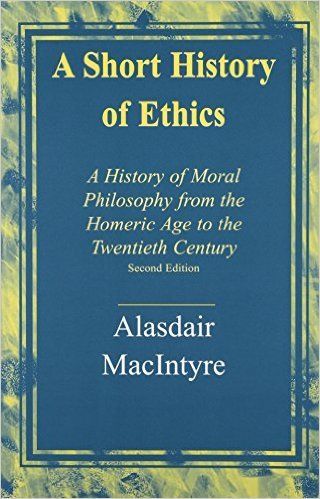
The author writes…’This history of moral philosophy which runs from the Greeks to contemporary Anglo-Saxon discussion is necessarily compressed and selective, but is intended to enable the general reader and the student to place particular texts in moral philosophy in an historical perspective. The function of this perspective is to clarify three kinds of historical and philosophical connection whose importance is often underrated. The first is a matter of the debts which moral philosophers owe to their predecessors; the second concerns the question of the nature of the moral concepts which furnish any moral philosopher with the objects of his enquiry upon moral concepts themselves and the extent to which the philosophical analysis of a concept may play a part in transforming or even discrediting it. A consequence of these preoccupations is that the book contains a higher proportion of purely philosophical enquiry than might be expected in an historical work.’
ما از اخلاق چه انتظاری داریم؟ این سوال شاید تاحدودی برای عموم مردم و یا متخصصان این رشته قابل پاسخ باشد؛ اینکه خوب بودن را به ما بیاموزد و در تنظیم روابط فردی م...

جشن کتاب تهران به ایستگاه سی و یکم رسیده است. حال و احوال نشر کتاب خوب نیست و باید فرهنگدوستان را به خرید و هدیه دادن کتاب ترغیب نمود. خانه اخلاقپژوهان جوان ب...

بنیاد کتابهای اخلاق اسلامی عمدتا پالایش جان از آلودگیها و آراستن آن به زیباییها است. اندیشه محوری این قبیل کتابها آن است که انسان فعلی آنی نیست که باید باشد...

-
0 Comments