Notice: تابع WP_Block_Type_Registry::register به طورنادرست فراخوانی شد. نامهای نوع بلوک نباید حروف بزرگ داشته باشند. لطفاً برای اطلاعات بیشتر، اشکال زدایی در وردپرس را مشاهده کنید. (این پیام در نگارش 5.0.0 افزوده شده است.) in /home/ethicsho/public_html/wp-includes/functions.php on line 5313
Warning: Use of undefined constant TDC_PATH_LEGACY - assumed 'TDC_PATH_LEGACY' (this will throw an Error in a future version of PHP) in /home/ethicsho/public_html/wp-content/plugins/td-composer/td-composer.php on line 109
Warning: Use of undefined constant TDSP_THEME_PATH - assumed 'TDSP_THEME_PATH' (this will throw an Error in a future version of PHP) in /home/ethicsho/public_html/wp-content/plugins/td-composer/td-composer.php on line 113 بایگانیهای 2989 - خانه اخلاق پژوهان جوان Notice: Trying to access array offset on value of type bool in /home/ethicsho/public_html/wp-content/plugins/wp-ulike/inc/general-functions.php on line 807
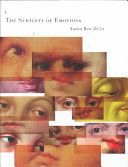
Why do we cry at the movies? What is the best way to manage destructive feelings such as jealousy? Although emotions pervade our lives, their nature, causes, and effects have only recently been studied by social scientists and philosophers. Despite growing scientific interest in the subject, empirical findings have not yet caught up with our intuitive knowledge. In this book Aaron Ben-Ze’ev carries out what he calls “a careful search for general patterns in the primeval jungle of emotions.” In an engaging, informal style he draws on a variety of theoretical approaches and popular sources to produce a coherent account of emotions in all their subtlety. All of the ideas are illustrated with examples drawn from everyday life.The book is organized into two parts. The first presents an overall conceptual framework for understanding emotions. It looks at the typical characteristics and components of emotions, distinguishes emotions from other affective phenomena, classifies the emotions, and covers such related issues as emotional intelligence, regulating emotions, and emotions and morality. The second part discusses individual emotions, including envy, jealousy, pleasure-in-others’-misfortune, pity, compassion, anger, hate, disgust, love, sexual desire, happiness, sadness, pride, regret, and shame. The text is laced with insightful and often amusing quotations from sources ranging from Mae West to Montesquieu.
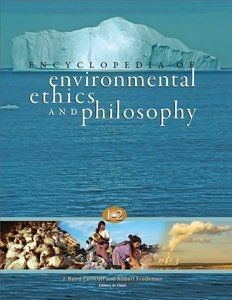
The field of environmental ethics is a new but now well-established sub-discipline of philosophy. Emerging in the mid-1970s, the field coalesced with the inaugural volume of the journal Environmental Ethics in 1979 and developed rapidly. By the turn of the century, most colleges and universities offered courses, if not major programs of study, in this important discipline. The Encyclopedia of Environmental Ethics and Philosophy addresses the needs of upper high school students, undergraduate researchers, teachers and professors, as well as general readers by examining the philosophical and ethical issues underlying contemporary and historical environmental issues, policies, and debates. More than 300 peer-reviewed articles cover concepts, institutions, topics, events and people, including global warming, animal rights, environmental movements, alternative energy, green chemistry, industrial ecology, and eco-sabotage. Encyclopedia of Environmental Ethics and Philosophy joins the suite of other MacMillan applied ethics titles: Encyclopedia of Bioethics and the Encyclopedia of Science, Technology, and Ethics. Additional features include 200 photographs and illustrations, thematic outline, annotated bibliography, and a comprehensive index.
This new volume of philosophical papers by Bernard Williams is divided into three sections: the first Action, Freedom, Responsibility, the second Philosophy, Evolution and the Human Sciences; in which appears the essay which gives the collection its title; and the third Ethics, which contains essays closely related to his 1983 book Ethics and the Limits of Philosophy. Like the two earlier volumes of Williams’s papers published by Cambridge University Press, Problems of the Self and Moral Luck, this volume will be welcomed by all readers with a serious interest in philosophy. It is published alongside a volume of essays on Williams’s work, World, Mind, and Ethics: Essays on the Ethical Philosophy of Bernard Williams, edited by J. E. J. Altham and Ross Harrison, which provides a reappraisal of his work by other distinguished thinkers in the field.
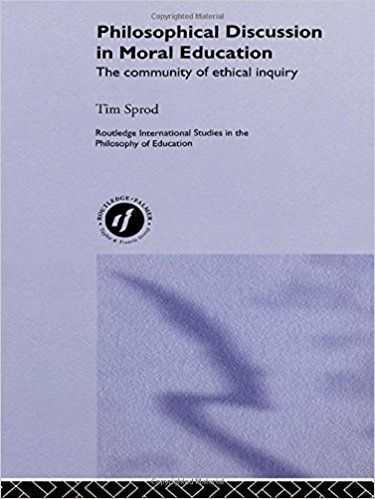
In recent years there has been an increase in the number of calls for moral education to receive greater public attention. In our pluralist society, however, it is difficult to find agreement on what exactly moral education requires. Philosophical Discussion in Moral Education develops a detailed philosophical defence of the claim that teachers should engage students in ethical discussions to promote moral competence and strengthen moral character. Paying particular attention to the teacher’s role, this book highlights the justification for, and methods of, creating a classroom community of ethical inquiry.
ما از اخلاق چه انتظاری داریم؟ این سوال شاید تاحدودی برای عموم مردم و یا متخصصان این رشته قابل پاسخ باشد؛ اینکه خوب بودن را به ما بیاموزد و در تنظیم روابط فردی م...

جشن کتاب تهران به ایستگاه سی و یکم رسیده است. حال و احوال نشر کتاب خوب نیست و باید فرهنگدوستان را به خرید و هدیه دادن کتاب ترغیب نمود. خانه اخلاقپژوهان جوان ب...

بنیاد کتابهای اخلاق اسلامی عمدتا پالایش جان از آلودگیها و آراستن آن به زیباییها است. اندیشه محوری این قبیل کتابها آن است که انسان فعلی آنی نیست که باید باشد...

-
0 Comments