Notice: تابع WP_Block_Type_Registry::register به طورنادرست فراخوانی شد. نامهای نوع بلوک نباید حروف بزرگ داشته باشند. لطفاً برای اطلاعات بیشتر، اشکال زدایی در وردپرس را مشاهده کنید. (این پیام در نگارش 5.0.0 افزوده شده است.) in /home/ethicsho/public_html/wp-includes/functions.php on line 5313
Warning: Use of undefined constant TDC_PATH_LEGACY - assumed 'TDC_PATH_LEGACY' (this will throw an Error in a future version of PHP) in /home/ethicsho/public_html/wp-content/plugins/td-composer/td-composer.php on line 109
Warning: Use of undefined constant TDSP_THEME_PATH - assumed 'TDSP_THEME_PATH' (this will throw an Error in a future version of PHP) in /home/ethicsho/public_html/wp-content/plugins/td-composer/td-composer.php on line 113 بایگانیهای 2974 - خانه اخلاق پژوهان جوان Notice: Trying to access array offset on value of type bool in /home/ethicsho/public_html/wp-content/plugins/wp-ulike/inc/general-functions.php on line 807
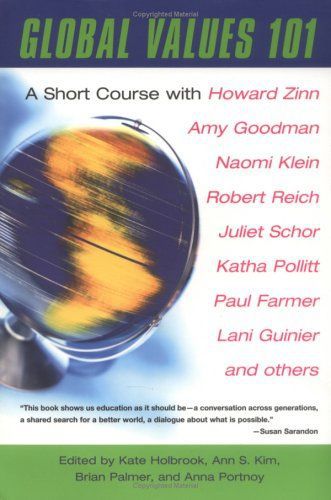
Global Values 101 grew out of one of the most popular courses ever offered at Harvard University, in which some of the most original thinkers of our day sat down with students and explored how ideas have made them—and can make us—more engaged, involved, and compassionate citizens. They addressed the topics of war, religion, the global economy, and social change: Amy Goodman, host of the popular radio program Democracy Now as well as the author of The Exception to the Ruler, speaks about the role of the citizen and the media in a free society; Lani Guinier reveals that students’ SAT scores more accurately describe the kind of car their parents drive than the grades they will earn in college and shows the way to a more equitable college admissions system; Juliet Schor, author of Born to Buy and The Overspent American, discusses the evolution of personal responsibility in a consumer culture; and Robert Reich, author of Locked in the Cabinet, tells us to get involved in politics because, if you want to see change, you have to make change happen.For anyone who has been moved by idealism and wondered how to become an engaged citizen, this collection offers a range of stories on how progressive ideals can inform, inspire, engage, and ultimately change lives.Other contributors include Harvey Cox, Katha Pollitt, Howard Zinn, Diana Eck, and Naomi Klein.
This volume reprints in a scholar’s edition the first English-language texts on bioethics, John Gregory’s (1724-1773) Observations on the Duties and Offices of a Physician and on the Method of Prosecuting Enquiries in Philosophy (London, 1770) and Lectures on the Duties and Qualifications of a Physician (London, 1772). Five previously unpublished manuscripts of Gregory’s lectures are also included. An introduction places Gregory’s medical ethics and philosophy of medicine in their eighteenth-century contexts of Scottish Enlightenment history and culture, Baconian science and philosophy of medicine, medical practice, the feminine and feminist philosophy of the Bluestocking Circle, and moral sense philosophy, particularly David Hume’s concept of sympathy, and provides a bibliography of primary and secondary sources as an aid to teaching and future scholarship. The book’s index provides access to Gregory’s texts, by using both historical terms and current terminology of bioethics. A volume in the subseries Classics of Medical Ethics.
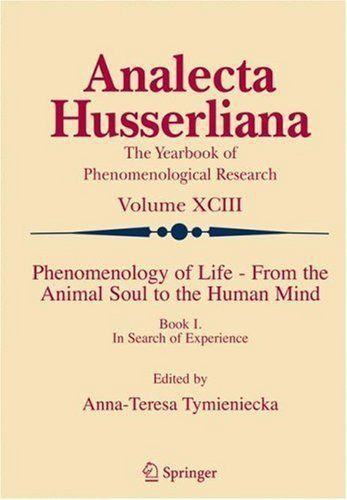
Transcendental phenomenology presumed to have overcome the classic mind-body dichotomy in terms of consciousness, yet, according to progress in scientific studies, the biological functions of the brain seem to appropriate significant functions attributed traditionally to consciousness. Should we indeed dissolve the specificity of human consciousness by explaining human experience in its multiple sense-giving modalities through the physiological functions of the brain? The present collection of studies addresses this crucial question challenging such “naturalizing” reductionism from multiple angles. In search for the roots of “The Specifically Human Experience” (Bombala), moving along the line of “Animality and Intellection”(Gosetti-Ferencei), “Naturalistic Attitude and Personalistic Attitude”(Villela-Petit), and numerous other perspectives, we arrive at a novel proposal to explain the scholar functional differentiation of conscious modalities. We reach their source in the ontopoietic thread conducting the Logos of Life in its stepwise “Evolutive Unfolding”(Carmen Cozma), and in “sentience” as its quintessential core of further irreducible continuity (Tymieniecka) dispelling dichotomies and reductionisms. Papers by: Grahame Lock, Anna-Teresa Tymieniecka, Daniela Verducci, Ted Toadvine, Mary Trachsel, Martin Holt, Mary Jeanne Larrabee, Leszek Pyra, Bronislaw Bombala, Konrad Rokstad, Ilja Maso, Nancy Mardas, Jennifer Anna Gosetti-Ferencei, Maria Villela-Petit, Mara Stafecka, Carmen Cozma, Francesco Totaro, Andreas Brenner, Sinan Kadir Celik, Osvaldo Rossi, Maria Manuela Brinto Martins, Elga Freiberga, Klymet Selvi, J.C. Couciero-Bueno, Patricia Trutty-Coohill, Walter Lammi, Ljudmila Molodkina, Martin Nkafu Nkemnkia.
ما از اخلاق چه انتظاری داریم؟ این سوال شاید تاحدودی برای عموم مردم و یا متخصصان این رشته قابل پاسخ باشد؛ اینکه خوب بودن را به ما بیاموزد و در تنظیم روابط فردی م...

جشن کتاب تهران به ایستگاه سی و یکم رسیده است. حال و احوال نشر کتاب خوب نیست و باید فرهنگدوستان را به خرید و هدیه دادن کتاب ترغیب نمود. خانه اخلاقپژوهان جوان ب...

بنیاد کتابهای اخلاق اسلامی عمدتا پالایش جان از آلودگیها و آراستن آن به زیباییها است. اندیشه محوری این قبیل کتابها آن است که انسان فعلی آنی نیست که باید باشد...

-
0 Comments